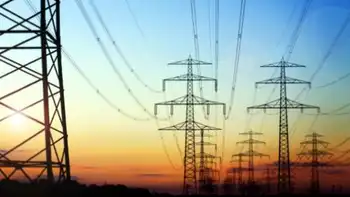
Australia power prices rise due to supply woes

By Reuters


Substation Relay Protection Training

Our customized live online or in‑person group training can be delivered to your staff at your location.

  • Live Online
  • 12 hours Instructor-led
  • Group Training Available
Regular Price:
$699
Coupon Price:
$599
Reserve Your Seat Today
Spot electricity prices jumped fourfold in Australia's southern states recently as Victoria battled supply problems and power flow from neighbouring New South Wales was restricted, traders said.

"The Victoria/Snowy interconnector, which usually runs at 1800 megawatts, had a 900 megawatt limit in place and available capacity in Victoria was less than 6,000 megawatts compared to the maximum of 8,400 megawatts," a trader said.

Average half-hour spot prices in Victoria jumped to A$88.89 ($61.30) per megawatt hour (MWh) at 3:00 p.m. (0500 GMT) from around A$20 per MWh in the morning and are forecast to reach A$140 at the peak time of 7:00 p.m, according to the National Electricity Market Management Company (NEMMCO).

The pattern was similar in South Australia where prices reached A$83.86 per MWh by mid afternoon and are projected to rise to A$127.23 at 7:00 p.m. Another trader said one of Yallourn Energy's four, 350 MW units went down on Monday while a 500 MW unit at Loy Yang A's 2000 MW power station in Victoria was still not operating at full strength.

"That unit has been out of operation for nearly two months and has tried to come back. Recently, it came back but is still only operating at 300 MW so will probably have to be taken offline again," the second trader said.

Hong Kong's largest power utility, CLP Holdings Ltd, said it was selling down its 92 percent stake in Yallourn Energy's 1,450 MW coal-fired plant to fund future expansion in the country.

CLP said it wanted to retain majority ownership of Yallourn and was seeking a partner that shared its goal of establishing a long-term presence in Australia. A source close to the transaction said CLP was seeking to sell a 45 percent stake.

Related News
Revenue from Energy Storage for Microgrids to Total More Than $22 Billion in the Next Decade

Energy Storage for Microgrids enables renewables integration via ESS, boosting resilience and reliability while supporting solar PV and wind, innovative financing, and business models, with strong growth forecast across Asia-Pacific and North America.


Key Points

Systems that store energy in microgrids to integrate renewables, boost resilience, and optimize distributed power.

✅ Integrates solar PV and wind with stable, dispatchable output

✅ Reduces costs via new financing and service business models

✅ Expands reliable power for remote, grid-constrained regions


A new report from Navigant Research examines the global market for energy storage for microgrids (ESMG), providing an analysis of trends and market dynamics in the context of the evolving digital grid landscape, with forecasts for capacity and revenue that extend through 2026.

Interest in energy storage-enabled microgrids is growing alongside an increase in solar PV and wind deployments. Although not required for microgrids to operate, energy storage systems (ESSs) have emerged as an increasingly valuable component of distributed energy networks, including virtual power plants that coordinate distributed assets, because of their ability to effectively integrate renewable generation.

“There are several key drivers resulting in the growth of energy storage-enabled microgrids globally, including the desire to improve the resilience of power supply both for individual customers and the entire grid, the need to expand reliable electricity service to new areas, rising electricity prices, and innovations in business models and financing,” says Alex Eller, research analyst with Navigant Research. “Innovations in business models and financing will likely play a key role in the expansion of the ESMG market during the coming years.”

One example of microgrid deployment for resilience is the SDG&E microgrid in Ramona built to help communities prepare for peak wildfire season.

According to the report, the most successful companies in this industry will be those that can unlock the potential of new business models to reduce the risk and upfront costs to customers. This is particularly true in Asia Pacific and North America, which are projected to be the largest regional markets for new ESMG capacity by far, a trend underscored by California's push for grid-scale batteries to stabilize the grid.

The report, “Market Data: Energy Storage for Microgrids,” outlines the key market drivers and barriers within the global ESMG market. The study provides an analysis of specific trends, including evolving grid edge trends, and market dynamics for each major world region to illustrate how different markets are taking shape. Global ESMG forecasts for capacity and revenue, segmented by region, technology, and market segment, extend through 2026. The report also briefly examines the major technology issues related to ESSs for microgrids.

Google made energy storage news recently when its parent company Alphabet announced it is hoping to revolutionize renewable energy storage using vats of salt and antifreeze. Alphabet’s secretive research lab, simply named “X,” is developing a system for storing renewable energy that would otherwise be wasted. The project, named “Malta,” is hoping its energy storage systems “has the potential to last longer than lithium-ion batteries and compete on price with new hydroelectric plants and other existing clean energy storage methods, according to X executives and researchers,” reports Bloomberg.


Related News

View more

Ontario, Quebec to swap energy in new deal to help with electricity demands

Ontario-Quebec Energy Swap streamlines electricity exchange, balancing peak demand across clean grids with hydroelectric and nuclear power, enhancing reliability, capacity banking, and interprovincial load management for industry growth, EV adoption, and seasonal heating-cooling needs.


Key Points

10-year, no-cash power swap aligning peaks; hydro and nuclear enhance reliability and let Ontario bank capacity.

✅ Up to 600 MW exchanged yearly; reviews adjust volumes

✅ Peaks differ: summer A/C in Ontario, winter heating in Quebec

✅ Capacity banking enables future-year withdrawals


Ontario and Quebec have agreed to swap energy to build on an electricity deal to help each other out when electricity demands peak.

The provinces' electricity operators, the Independent Electricity System Operator holds capacity auctions and Hydro-Quebec, will trade up to 600 megawatts of energy each year, said Ontario Energy Minister Todd Smith.

“The deal just makes a lot of sense from both sides,” Smith said in an interview.

“The beauty as well is that Quebec and Ontario are amongst the cleanest grids around.”

The majority of Ontario's power comes from nuclear energy while the majority of Quebec's energy comes from hydroelectric power, including Labrador power in regional transmission networks.

The deal works because Ontario and Quebec's energy peaks come at different times, Smith said.

Ontario's energy demands spike in the summer, largely driven by air conditioning on hot days, and the province has occasionally set off-peak electricity prices to provide temporary relief, he said.

Quebec's energy needs peak in the winter, mostly due to electric heating on cold days.

The deal will last 10 years, with reviews along the way to adjust energy amounts based on usage.

“With the increase in energy demand, we must adopt more energy efficiency programs like Peak Perks and intelligent measures in order to better manage peak electricity consumption,” Quebec's Energy Minister Pierre Fitzgibbon wrote in a statement.

Smith said the energy deal is a straight swap, with no payments on either side, and won't reduce hydro bills as the transfer could begin as early as this winter.

Ontario will also be able to bank unused energy to save capacity until it is needed in future years, Smith said.

Both provinces are preparing for future energy needs, as electricity demands are expected to grow dramatically in the coming years with increased demand from industry and the rise of electric vehicles, and Ontario has tabled legislation to lower electricity rates to support consumers.


Related News

View more

Doug Ford ‘proud’ of decision to tear up hundreds of green energy contracts

Ontario Renewable Energy Cancellations highlight Doug Ford's move to scrap wind turbine contracts, citing electricity rate relief and taxpayer savings, while critics, the NDP, and industry warn of job losses, termination fees, and auditor scrutiny.


Key Points

Ontario's termination of renewable contracts, defended as cost and rate relief, faces disputes over savings and jobs.

✅ PCs cite electricity rate relief and taxpayer savings.

✅ Critics warn of job losses and termination fees.

✅ Auditor inquiry sought into contract cancellation costs.


Ontario Premier Doug Ford, whose new stance on wind power has drawn attention, said Thursday he is “proud” of his decision to tear up hundreds of renewable energy deals, a move that his government acknowledges could cost taxpayers more than $230 million.

Ford dismissed criticism that his Progressive Conservatives are wasting public money, telling a news conference that the cancellation of 750 contracts signed by the previous Liberal government will save cash, even as Ontario moves to reintroduce renewable energy projects in the coming years.

“I’m so proud of that,” Ford said of his decision. “I’m proud that we actually saved the taxpayers $790 million when we cancelled those terrible, terrible, terrible wind turbines that really for the last 15 years have destroyed our energy file.”

Later Thursday, Ford went further in defending the cancelled contracts, saying “if we had the chance to get rid of all the wind mills we would,” though a court ruling near Cornwall challenged such cancellations.

The NDP first reported the cost of the cancellations Tuesday, saying the $231 million figure was listed as “other transactions”, buried in government documents detailing spending in the 2018-2019 fiscal year.

The Progressive Conservatives have said the final cost of the cancellations, which include the decommissioning of a wind farm already under construction in Prince Edward County, Ont., has yet to be established, amid warnings about wind project cancellation costs from developers.

The government has said it tore up the deals because the province didn’t need the power and it was driving up electricity rates, and the decision will save millions over the life of the contracts. Industry officials have disputed those savings, saying the cancellations will just mean job losses for small business, and ignore wind power’s growing competitiveness in electricity markets.

NDP Leader Andrea Horwath has asked Ontario’s auditor general to investigate the contracts and their termination fees, amid debates over Ontario’s electricity future among leadership contenders. She called Ford’s remarks on Thursday “ridiculous.”

“Every jurisdiction around the world is trying to figure out how to bring more renewables onto their electricity grids,” she said. “This government is taking us backwards and costing us at the very least $231 million in tearing these energy contracts.”

At the federal level, a recent green electricity contract with an Edmonton company underscores that shift.


Related News

View more

Negative Electricity Prices Amid Renewable Energy Surplus

France Negative Electricity Prices highlight surplus renewables as solar and wind output exceeds demand, driving grid flexibility, demand response, and storage signals while reshaping energy markets, lowering emissions, and improving economic efficiency and energy security.


Key Points

They occur when surplus solar and wind push wholesale power prices below zero, signaling flexible, low-carbon grids.

✅ Surplus solar and wind outpace demand, flipping price signals

✅ Incentivizes demand response, storage, and flexible loads

✅ Enhances decarbonization, energy security, and market efficiency


In a remarkable feat for renewable energy, France has recently experienced negative electricity prices due to an abundant supply of solar and wind power. This development highlights the country's progress towards sustainable energy solutions and underscores the potential of renewables to reshape global energy markets.

The Surge in Renewable Energy Supply

France's electricity grid benefited from a surplus of renewable energy generated by solar panels and wind turbines. During periods of peak production, such as sunny and windy days, the supply of electricity exceeded demand, leading to negative prices and reflecting how solar is reshaping price dynamics in Northern Europe.

Implications for Energy Markets

The occurrence of negative electricity prices reflects a shift towards a more flexible and responsive energy system. It demonstrates the capability of renewables to meet substantial portions of electricity demand reliably and economically, with evidence of falling wholesale prices in many markets, challenging traditional notions of energy supply and pricing dynamics.

Technological Advancements and Policy Support

Technological advancements in renewable energy infrastructure, coupled with supportive government policies and incentives, have played pivotal roles in France's achievement. Investments in solar farms, wind farms, and grid modernization, including the launch of France's largest battery storage platform by TagEnergy, have enhanced the efficiency and reliability of renewable energy integration into the national grid.

Economic and Environmental Benefits

The adoption of renewable energy sources not only reduces greenhouse gas emissions but also fosters economic growth and energy independence. By harnessing abundant solar and wind resources, France strengthens its energy security and reduces reliance on fossil fuels, contributing to long-term sustainability goals and reflecting a continental shift as renewable power has surpassed fossil fuels for the first time.

Challenges and Future Outlook

While France celebrates the success of negative electricity prices, challenges remain in scaling renewable energy deployment and optimizing grid management. Balancing supply and demand, integrating intermittent renewables, and investing in energy storage technologies are critical for ensuring grid stability and maximizing the benefits of renewable energy, particularly in addressing clean energy's curtailment challenge across modern grids.

Global Implications

France's experience with negative electricity prices serves as a model for other countries striving to transition to clean energy economies. It underscores the potential of renewables to drive economic prosperity, mitigate climate change impacts, and reshape global energy markets towards sustainability, as seen in Germany where solar-plus-storage is now cheaper than conventional power in several contexts.

Conclusion

France's achievement of negative electricity prices driven by renewable energy surplus marks a significant milestone in the global energy transition. By leveraging solar and wind power effectively, France demonstrates the feasibility and economic viability of renewable energy integration at scale. As countries worldwide seek to reduce carbon emissions and enhance energy resilience, France's example provides valuable insights and inspiration for advancing renewable energy agendas and accelerating towards a sustainable energy future.


Related News

View more

Coal, Business Interests Support EPA in Legal Challenge to Affordable Clean Energy Rule

Affordable Clean Energy Rule Lawsuit pits EPA and coal industry allies against health groups over Clean Power Plan repeal, greenhouse gas emissions standards, climate change, public health, and state authority before the D.C. Circuit.


Key Points

A legal fight over EPA's ACE rule and CPP repeal, weighing emissions policy, state authority, climate, and public health.

✅ Challenges repeal of Clean Power Plan and adoption of ACE.

✅ EPA backed by coal, utilities; health groups seek stricter limits.

✅ D.C. Circuit to review emissions authority and state roles.


The largest trade association representing coal interests in the country has joined other business and electric utility groups in siding with the EPA in a lawsuit challenging the Trump administration's repeal of the Clean Power Plan.

The suit -- filed by the American Lung Association and the American Public Health Association -- seeks to force the U.S. Environmental Protection Agency to drop a new rule-making process that critics claim would allow higher levels of greenhouse gas emissions, further contributing to the climate crisis and negatively impacting public health.

The new rule, which the Trump administration calls the "Affordable Clean Energy rule" (ACE), "would replace the 2015 Clean Power Plan, which EPA has proposed to repeal because it exceeded EPA's authority. The Clean Power Plan was stayed by the U.S. Supreme Court and has never gone into effect," according to an EPA statement.

EPA has also moved to rewrite wastewater limits for coal power plants, signaling a broader rollback of related environmental requirements.

America's Power -- formerly the American Coalition for Clean Coal Electricity -- the U.S. Chamber of Commerce, the National Mining Association, and the National Rural Electric Cooperative Association have filed motions seeking to join the lawsuit. The U.S. Court of Appeals for the District of Columbia Circuit has not yet responded to the motion.

Separately, energy groups warned that President Trump and Energy Secretary Rick Perry were rushing major changes to electricity pricing that could disrupt markets.

"In this rule, the EPA has accomplished what eluded the prior administration: providing a clear, legal pathway to reduce emissions while preserving states' authority over their own grids," Hal Quinn, president and chief executive officer of the mining association, said when the new rule was released last month. "ACE replaces a proposal that was so extreme that the Supreme Court issued an unprecedented stay of the proposal, having recognized the economic havoc the mere suggestion of such overreach was causing in the nation's power grid."

Around the same time, a coal industry CEO blasted a federal agency's decision on the power grid as harmful to reliability.

The trade and business groups have argued that the Clean Power Plan, set by the Obama administration, was an overreach of federal power. Finalized in 2015, the plan was President Obama's signature policy on climate change, rooted in compliance with the Paris Climate Treaty. It would have set state limits on emissions from existing power plants but gave wide latitude for meeting goals, such as allowing plant operators to switch from coal to other electric generating sources to meet targets.

Former EPA Administrator Scott Pruitt argued that the rule exceeded federal statutory limits by imposing "outside the fence" regulations on coal-fired plants instead of regulating "inside the fence" operations that can improve efficiency.

The Clean Power Plan set a goal of reducing carbon emissions from power generators by 32 percent by the year 2030. An analysis from the Rhodium Group found that had states taken full advantage of the CPP's flexibility, emissions would have been reduced by as much as 72 million metric tons per year on average. Still, even absent federal mandates, the group noted that states are taking it upon themselves to enact emission-reducing plans based on market forces.

In its motion, America's Power argues the EPA "acknowledged that the [Best System of Emission Reduction] for a source category must be 'limited to measures that can be implemented ... by the sources themselves.'" If plants couldn't take action, compliance with the new rule would require the owners or operators to buy emission rate credits that would increase investment in electricity from gas-fired or renewable sources. The increase in operating costs plus federal efforts to shift power generation to other sources of energy, thereby increasing costs, would eventually force the coal-fired plants out of business.

In related proceedings, renewable energy advocates told FERC that a DOE proposal to subsidize coal and nuclear plants was unsupported by the record, highlighting concerns about market distortions.

"While we are confident that EPA will prevail in the courts, we also want to help EPA defend the new rule against others who prefer extreme regulation," said Michelle Bloodworth, president and CEO of America's Power.

"Extreme regulation" to one group is environmental and health protections to another, though.

Howard A. Learner, executive director of the Environmental Law & Policy Center of the Midwest, defended the Clean Power Plan in an opinion piece published in June.

"The Midwest still produces more electricity from coal plants than any other region of the country, and Midwesterners bear the full range of pollution harms to public health, the Great Lakes, and overall environmental quality," Learner wrote. "The new [Affordable Clean Energy] Rule is a misguided policy, moves our nation backward in solving climate change problems, and misses opportunities for economic growth and innovation in the global shift to renewable energy. If not reversed by the courts, as it should be, the next administration will have the challenge of doing the right thing for public health, the climate and our clean energy future."

When it initially filed its lawsuit against the Trump administration's Affordable Clean Energy Rule, the American Lung Association accused the EPA of "abdicat[ing] its legal duties and obligations to protect public health." It also referred to the new rule as "dangerous."


Related News

View more

Metering Pilot projects may be good example for Ontario utilities

Ontario Electricity Pricing Pilot Projects explore alternative rates beyond time-of-use, with LDCs and the Ontario Energy Board testing dynamic pricing, demand management, smart-meter billing, and residential customer choice to enhance service and energy efficiency.


Key Points

Ontario LDC trials testing alternatives to time-of-use rates to improve billing, demand response, and efficiency.

✅ Data shared across LDCs and Ontario Energy Board provincewide

✅ Tests dynamic pricing, peak/off-peak plans, demand management

✅ Insights to enhance customer choice, bills, and energy savings


The results from three electricity pilot projects being offered in southern Ontario will be valuable to utility companies across the province.

Ontario Energy Minister Glenn Thibeault was in Barrie on Tuesday to announce the pilot projects, which will explore alternative pricing plans for electricity customers from three different utility companies, informed by the electricity cost allocation framework guiding rate design.

"Everyone in the industry is watching to see how the pilots deliver.", said Wendy Watson, director of communications for Greater Sudbury Utilities.

"The data will be shared will all the LDCs [local distribution companies] in the province, and probably beyond...because the industry tends to share that kind of information."

Most electricity customers in the province are billed using time-of-use rates, including options like the ultra-low overnight rates that lower costs during off-peak periods, where the cost of electricity varies depending on demand.

The Ontario Energy Board said in a media release that the projects will give residential customers more choice in how much they pay for electricity at different times, reflecting changes for Ontario electricity consumers that expand plan options.

Pilot projects can help improve service

Watson says these kinds of projects give LDCs the chance to experiment and explore new ways of delivering their service, including demand-response initiatives like the Peak Perks program that encourage conservation.

"Any pilot project is a great way to see if in practice if the theory proves out, so I think it's great that the province is supporting these LDCs," she says.

GSU recently completed its own pilot project, the Home Energy Assessment and Retrofit (HEAR) program, which focused on customers who use electric baseboards to heat their homes, amid broader provincial support for electric bills to ease costs."We installed some measures, like programmable thermostats and a few other pieces of equipment into their house," Watson says. "We also made some recommendations about other things that they could do to make their homes more energy efficient."

At the end of the program, GSU provided customers with a report so that they could the see the overall impact on their energy consumption.

Watson says a report on the results of the HEAR program will be released in the near future, for other LDCs interested in new ways to improve their service.

"We think it's incumbent on every LDC...to see what ideas that they can come up with and get approved so they can best serve their customers."


Related News

View more

Sign Up for Electricity Forum’s Newsletter

Stay informed with our FREE Newsletter — get the latest news, breakthrough technologies, and expert insights, delivered straight to your inbox.

Electricity Today T&D Magazine Subscribe for FREE

Stay informed with the latest T&D policies and technologies.
  • Timely insights from industry experts
  • Practical solutions T&D engineers
  • Free access to every issue

Download the 2025 Electrical Training Catalog

Explore 50+ live, expert-led electrical training courses –

  • Interactive
  • Flexible
  • CEU-cerified