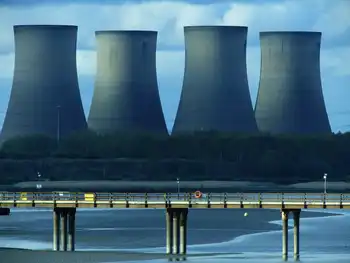
Utilities, Coal Companies Support DOE Zero-emission Plant

By


Protective Relay Training - Basic

Our customized live online or in‑person group training can be delivered to your staff at your location.
  • Live Online
  • 12 hours Instructor-led
  • Group Training Available
Regular Price:
$699
Coupon Price:
$599
Reserve Your Seat Today
Eight utilities and coal companies came out in support earlier this week of the Bush administration's $1 billion proposal to build a zero-emissions coal-fired power plant in the next 10 years.

Research scientists and environmentalists have applauded some aspects of the so-called FutureGen project, but say that much of the technology that would be used in the plant has already been developed by other industries. DOE officials contend however that the demonstration plant is part of an effort to drive down the cost of pollution-reducing and carbon-storage techniques.

In February, the administration laid out plans for FutureGen, a plant that would would turn coal into a gas for hydrogen fuel cells. The prototype would explore several technologies to attempt emissions-free coal energy, including using a membrane to remove upwards of 90 percent of CO2 from the coal gas, storing the CO2 underground in geological formations. Sulfur dioxide, mercury and nitrogen oxides would be removed as well.

The Energy Department has committed to paying about 80 percent of the tab, and will ask about 20 countries to become involved with the project starting this summer (Greenwire, Feb. 28).

Eight power and coal companies, including American Electric Power, Peabody Energy, Southern Company, and others, said earlier this week that they are forming an alliance in support of the initiative, an important step given some companies' initial skepticism regarding the proposal. "Companies are skittish about the ability of the federal government to deliver on a financial commitment over a long period of time," AEP's Dale Heydlauff told the New York Times in February when the program was proposed.

"Providing that we can collaboratively define agreeable terms and technological content that meets the needs of the nation and our industry, and protects the interests of our shareholders, we will seriously consider becoming the charter industrial members of a public-private partnership," the companies said in a letter to President Bush earlier this month. "We plan to formalize an alliance in early summer and seek, from our respective organizations, a major financial commitment to cost-share the effort over the coming decade."

AEP and other companies haven't set out any hard financial targets yet, said Pat Hemlepp, a spokesman for AEP. "We felt it was important that companies in this alliance move to the head of the line," he said. "If this moves forward, the other companies will want to come on board."

Sequestration experts and environmental groups say the FutureGen project should only be one aspect of an expanded research and demonstration effort by the federal government.

"I think FutureGen should be looked at as part of the program," said Howard Herzog, principal research engineer at the Massachusetts Institute of Technology, but the project shouldn't be considered a substitute for DOE's core research program. DOE's carbon capture storage research has "grown significantly," Herzog said, to about $30 million per year. And DOE has boosted some sequestration research efforts recently. In November, DOE Secretary Spencer Abraham proposed up to $90 million for a "nationwide network of regional sequestration partnerships," while speaking before the National Coal Council. (Greenwire, Nov. 22).

Herzog noted that the private sector has been doing a lot of research as well, pointing to the $25 million CO2 Capture Project, an effort by eight oil companies led by BP. But, "money on sequestration overall is way too small," he said. "Thirty million a year is a pittance," he said.

FutureGen "could work hand-in-hand with the research and be very good," said Herzog. "But demonstration projects in the past haven't been as successful. They haven't followed up in the marketplace."

"These plants will not be accepted in the marketplace until you have some sort of policy that restricts carbon emissions," he said. "The government can't put up 80 percent of the money on every one of these plants."

"I think that the Energy Department is serious about moving forward with it," said David Hawkins, director of the climate center at Natural Resources Defense Council. "It seems like there are some companies that are willing to raise their share of the money. All of those are good signs."

But, Hawkins said, "this is a toe in the water. We really need to be swimming laps at this point."

"The building blocks have all been demonstrated," said Hawkins. "We know how to gasify coal. We know how to separate CO2 from a gas stream," he said. "We also know how to inject CO2 into geologic formations." The only way to get such practices widely accepted commercially is by recognizing CO2 as a pollutant, which would "send the required signal to the market."

"It seems to us that this project is far too much future and far too little gen," said Armond Cohen, executive director of the Clean Air Task Force. "Coal gasification is commercially available today and deployed in the chemical industry worldwide. So is the technology for carbon removal and sequestration, in the petroleum industry."

Rather than spending $1 billion on FutureGen, the government should put more funding toward helping companies overcome the "near-term price barrier between coal gasification and conventional coal or gas plants," said Cohen. "Instead, the FutureGen project seems to reflect a kind of moonshot approach that leaves the impression that this technology is at the R&D phase and will take decades to deploy. We're much farther along than that and policy should reflect that fact."

And instead of one large demonstration project, DOE should instead be doing a number of projects to increase the amount of on-the-ground experience with new technologies. "We need more practical experience with storing [carbon] geologically," he said, so that researchers gain experience with a range of different underground options, like abandoned oil fields, coal seams, brine-filled reservoirs and other underground areas.

According to DOE, there is currently only one commercial CO2 geological sequestration facility in the world. Norwegian oil and gas company Statoil has injected about one million tons of CO2 into an aquifer half a mile beneath the North Sea. In that case, the Norwegian government's decision to levy a tax of $50 per ton of CO2 emitted spurred the company towards capturing some of the CO2 lost when it drilled for natural gas.

In the next 30 years, other countries have planned to build coal-fired power plants equivalent to five times the current amount of current coal-fired capacity in the U.S., Hawkins said, and it will be difficult to retrofit those new plants.

"The retrofit issue is a problem," conceded David Conover, director of DOE's Climate Change Technology Program, speaking with reporters at a climate change conference this week. "It's not like putting on a scrubber."

But, Conover said, FutureGen is important as an international demonstration project, as well as domestically. "We're fooling ourselves if we think China's going to give up their coal reserves," he said.

"A lot of the technology is available and what we're trying to do is go well beyond that," said George Rudins, DOE's deputy assistant secretary for coal and power systems. "If you look at carbon sequestration today, some of the sequestration costs can be as high as $200 a ton of carbon," which translates to about $55 per ton of CO2. That would be a "considerable penalty on the costs of electricity," said Rudins.

DOE's overall R&D goal is to bring carbon sequestration costs down to $10 per ton, which would result in an electricity cost increase of only two-tenths of a cent per kilowatt hour. Researchers have already made large strides in reducing sequestration costs, said Rudins. "None of the existing processes approach the kinds of cost targets we've talked about," he said. "The objective is to reach for the cutting-edge technology which has the greatest performance and cost potential."

The department hopes to get EPA and other federal agencies involved with FutureGen to monitor the potential effects of CO2 storage, Rudins said.

Related News

Advanced Reactors Will Stand On The Shoulders Of Giants

Advanced Nuclear Reactors redefine nuclear energy with SMRs, diverse fuels, passive safety, digital control rooms, and flexible heat and power, pairing veteran operator expertise with cost-efficient, carbon-free electricity for a resilient grid.


Key Points

SMR-based advanced reactors with passive cooling and digital controls deliver flexible power and process heat.

✅ Veteran operators transfer proven safety culture and risk management.

✅ SMRs, passive safety, and digital controls simplify operations.

✅ Flexible output: electricity, process heat, and grid support.


Advanced reactors will break the mold of what we think next-gen nuclear power can accomplish: some will be smaller, some will use different kinds of fuel and others will do more than just make electricity. This new technology may seem like uncharted waters, but when operators, technicians and other workers start up the first reactors of the new generation, they will bring with them years of nuclear experience to run machines that have been optimized with lessons from the current fleet.

While advanced reactors are often portrayed as the future of nuclear energy, and atomic energy is heating up across markets, its our current plants that have paved the way for these exciting innovations and which will be workhorses for years to come.


Reactor Veterans Bring Their Expertise to New Designs

Many of the workers who will operate the next generation of reactors come from a nuclear background. Even though the design of an advanced reactor may be different, the experience and instincts these operators have gained from working at the current fleet will help new plants get off to a more productive start.

They have a questioning attitude; they are always exploring what could go wrong and always understanding the notion of risk management in nuclear operations, whether its the oldest design or the newest design, said Chip Pardee, the president of Terrestrial Energy USA, who is the former chief operating officer at two nuclear utilities, Exelon Corp. and the Tennessee Valley Authority.

They have respect for the technology and a bias towards conservative decision-making.

Jhansi Kandasamy, vice president of engineering at GE Hitachi Nuclear Energy, agrees. She said that the presence of industry veterans will benefit the new modelslike the 300 megawatt boiling water reactor her company is developing.

From the beginning, a new reactor will have people who have touched it, worked on it, and experienced it, she said.

Theyre going to be able to tell you if something doesnt look right, because theyve lived through it.


Experience Informs New Reactor Design

Advanced reactors are designed by engineers who are fully familiar with existing plants and can use that experience to optimize the new ones, like a family building a house and wanting the kitchen just so. New reactors will be simpler to operate because of insights gained from years of operations of the current fleet, and some designs even integrate molten salt energy storage to enhance flexibility.

NuScale Power LLC, for example, has a very different design from the current fleet amid an advanced nuclear push that is reshaping development: up to 12 small reactorsinstead of one or two large reactorsmanaged from a single digital control roominstead of one full of analog switches and dials. When the company designed its control room, it brought in industry veterans who had collectively worked at more than two dozen nuclear plants.

The experts that NuScale brought in critiqued everything, even down to the shape of the symbols on the computer screens to make them easier to read for operators who sometimes need to quickly interpret lots of incoming data. The control panels for NuScales small modular reactor (SMR) present information according to its importance and automatically call up appropriate procedures for operators.

Many advanced reactors are also smaller than those currently operating, which makes their components simpler and less expensive. Kandasamy pointed out that the giant mechanical pumps in todays reactors generate a lot of heat and require a lot of supporting systems, including air conditioning in the rooms that house them.

GE Hitachis SMR design relies more on passive cooling so it needs fewer pumps, and those that remain use magnets, so they generate less heat. Fewer, smaller pumps means a smaller building and less cost.


Advanced Nuclear Will Further the Work of Current Reactors

Advanced reactors promise improved flexibility and the ability to do more kinds of work, including nuclear beyond electricity applications, to displace carbon and stabilize the climate. And they will continue nuclear energys legacy of providing reliable, carbon-free electricity, as a recent new U.S. reactor startup illustrates in practice. As new designs come on line over the next decade, we will continue to rely on operating plants which provide nearly 55 percent of the countrys carbon-free electricity.

The world will need all the carbon-free generation it can get for many years to come, as companies, states and countries aim for zero emissions by mid-century and pursue strategies like the green industrial revolution to accelerate deployment. That means it will need wind, solar, advanced reactors and current plants.


Related News

View more

Crossrail will generate electricity using the wind created by trains

Urban Piezoelectric Energy Textiles capture wind-driven motion on tunnels, bridges, and facades, enabling renewable microgeneration for smart cities with decentralized power, resilient infrastructure, and flexible lamellae sheets that harvest airflow vibrations.


Key Points

Flexible piezoelectric sheets that convert urban wind and vibration into electricity on tunnels, bridges, and facades.

✅ Installed on London Crossrail to test airflow energy capture

✅ Flexible lamellae panels retrofit tunnels, bridges, facades

✅ Supports decentralized, resilient urban microgrids


Charlotte Slingsby and her startup Moya Power are researching piezo-electric textiles that gain energy from movement, similar to advances like a carbon nanotube energy harvester being explored by materials researchers. It seems logical that Slingsby originally came from a city with a reputation for being windy: “In Cape Town, wind is an energy source that you cannot ignore,” says the 27-year-old, who now lives in London.

Thanks to her home city, she also knows about power failures. That’s why she came up with the idea of not only harnessing wind as an alternative energy source by setting up wind farms in the countryside or at sea, but also for capturing it in cities using existing infrastructure.


The problem

The United Nations estimates that by 2050, two thirds of the world’s population will live in cities. As a result, the demand for energy in urban areas will increase dramatically, spurring interest in nighttime renewable technology that can operate when solar and wind are variable. Can the old infrastructure grow fast enough to meet demand? How might we decentralise power generation, moving it closer to the residents who need it?

For a pilot project, she has already installed grids of lamellae-covered plastic sheets in tunnels on London Crossrail routes; the draft in the tube causes the protrusions to flutter, which then generates electricity.

“If we all live in cities that need electricity, we need to look for new, creative ways to generate it, including nighttime solar cells that harvest radiative cooling,” says Slingsby, who studied design and engineering at Imperial College and the Royal College of Art. “I wanted to create something that works in different situations and that can be flexibly adapted, whether you live in an urban hut or a high-rise.”

The yield is low compared to traditional wind power plants and is not able to power whole cities, but Slingsby sees Moya Power as just a single element in a mixture of urban energy sources, alongside approaches like gravity power that aid grid decarbonization.

In the future, Slingsby’s invention could hang on skyscrapers, in tunnels or on bridges – capturing power in the windiest parts of the city, alongside emerging air-powered generators that draw energy from humidity. The grey concrete of tunnels and urban railway cuttings could become our cities’ most visually appealing surfaces...


Related News

View more

Georgia Power warns customers of scams during pandemic

Georgia Power Scam Alert cautions customers about phone scams, phishing, and fraud during COVID-19, urging identity verification, refusal of prepaid card payments, use of Authorized Payment Locations, and customer service contact to avoid disconnection threats.


Key Points

A warning initiative on fraud, phone scams, and safe payments to protect Georgia Power customers during COVID-19.

✅ Never pay by phone with prepaid cards or credit card numbers.

✅ Verify employee ID, badge, and marked vehicle before opening.

✅ Call 888-660-5890 or use Authorized Payment Locations only.


With continued reports of attempted scams and fraud, including holiday scam warnings in other regions, by criminals posing as Georgia Power employees during the COVID-19 pandemic, the company reminds customers to be aware and follow simple tips to avoid becoming a victim.

Customers should beware of phone calls demanding payment via phone to avoid pandemic-related electricity shut-offs and penalties.

In other regions, Texas utilities waived fees to support customers during the pandemic.

Last month, Georgia Power and the Georgia Public Service Commission extended the suspension of disconnections due to the impact of the pandemic on customers. In addition, the company will never ask for a credit card or pre-paid debit card number over the phone. The company will also never send employees into the field to collect payment in person or ask a customer to pay anywhere other than an Authorized Payment Location.

Similarly, Gulf Power offered a one-time bill decrease to ease customer costs.

If an account becomes past due, Georgia Power will contact the customer via a pre-recorded message to the primary account telephone number or by letter requesting that the customer call to discuss the account, including available June bill reductions where applicable.

If a customer receives a suspicious call from someone claiming to be from Georgia Power and demanding payment to avoid disconnection despite utility moratoriums on shutoffs, the customer should hang up and contact the company's customer service line at 888-660-5890.

If an employee needs to visit a customer's home or business for a service-related issue, they will be in uniform and present a badge with a photo, their name and the company's name and logo. They will also be in a vehicle marked with the company's logo.

During the pandemic, visiting a customer's home or business will be even less likely, so identity verification should be completed before opening the door to anyone.

Georgia Power continues to work with law enforcement agencies throughout the state to identify and prosecute criminals who pose as Georgia Power employees to defraud customers.


Related News

View more

Former B.C. Hydro CEO earns half a million without working a single day

B.C. Hydro Salary Continuance Payout spotlights executive compensation, severance, and governance at a Crown corporation after a firing, citing financial disclosure reports, Site C dam ties, and a leadership change under a new government.


Key Points

Severance-style pay for B.C. Hydro's fired CEO, via salary continuance and disclosed in public filings.

✅ $541,615 total compensation without working days

✅ Salary continuance after NDP firing; financial disclosures

✅ Later named Canada Post interim CEO amid strike


Former B.C. Hydro president and chief executive officer Jessica McDonald received a total of $541,615 in compensation during the 2017-2018 fiscal year, a figure that sits amid wider debates over executive pay at utilities such as Hydro One CEO pay at the provincial utility, without having worked a single day for the Crown corporation.

She earned this money under a compensation package after the in-coming New Democratic government of John Horgan fired her, a move comparable to Ontario's decision when the Hydro One CEO and board exit amid share declines. The previous B.C. Liberal government named her president and CEO of B.C. Hydro in 2014, and McDonald was a strong supporter of the controversial Site C dam project now going ahead following a review.

The current New Democratic government placed her on what financial disclosure documents call “salary continuance” effective July 21, 2017 — the day the government announced her departure — at a utility scrutinized in a misled regulator report that raised oversight concerns.

According to financial disclosure statements, McDonald remained on “salary continuance” until Sept. 21 of this year, and the utility has also been assessed in a deferred operating costs report released by the auditor general. During this period, she earned $272,659, a figure that includes benefits, pension and other compensation.

McDonald — who used to be the deputy minister to former premier Gordon Campbell — is now working for Canada Post, which appointed her as interim president and chief executive officer in March, while developments at Manitoba Hydro highlight broader political pressures on Crown utilities.

She started in her new role on April 2, 2018, and now finds herself in the middle of managing a postal carrier strike.


Related News

View more

Trump's Proposal on Ukraine's Nuclear Plants Sparks Controversy

Ukraine Nuclear Plant Ownership Proposal outlines U.S. management of Ukrainian reactors amid the Russia-Ukraine war, citing nuclear safety, energy security, and IAEA oversight; Kyiv rejects ownership transfer, especially regarding Zaporizhzhia under Russian control.


Key Points

U.S. control of Ukraine's nuclear plants for safety; Kyiv rejects transfer, citing sovereignty risks at Zaporizhzhia.

✅ U.S. proposal to manage Ukraine's reactors amid war

✅ Kyiv refuses ownership transfer; open to investment

✅ Zaporizhzhia under Russian control raises safety risks


In the midst of the ongoing conflict between Russia and Ukraine, U.S. President Donald Trump has proposed a controversial idea: Ukraine should give its nuclear power plants to the United States for safekeeping and management. This suggestion came during a phone call with Ukrainian President Volodymyr Zelenskyy, wherein Trump expressed the belief that American ownership of these nuclear plants could offer them the best protection amid the ongoing war. But Kyiv, while open to foreign support, has firmly rejected the idea of transferring ownership, especially as the Zaporizhzhia nuclear plant remains under Russian occupation.

Ukraine’s nuclear energy infrastructure has always been a vital component of its power generation. Before the war, the country’s four nuclear plants supplied nearly half of its electricity. As Russia's military forces target Ukraine's energy infrastructure, including power plants and coal mines, international watchdogs like the IAEA have warned of nuclear risks as these nuclear facilities have become crucial to maintaining the nation’s energy stability. The Zaporizhzhia plant, in particular, has attracted international concern due to its size and the ongoing threat of a potential nuclear disaster.

Trump’s Proposal and Ukraine’s Response

Trump’s proposal of U.S. ownership came as a response to the ongoing threats posed by Russia’s occupation of the Zaporizhzhia plant. Trump argued that the U.S., with its expertise in running nuclear power plants, could safeguard these facilities from further damage and potential nuclear accidents. However, Zelenskyy quickly clarified that the discussion was only focused on the Zaporizhzhia plant, which is currently under Russian control. The Ukrainian president emphasized that Kyiv would not entertain the idea of permanently transferring ownership of its nuclear plants, even though they would welcome investment in their restoration and modernization, particularly after the war.

The Zaporizhzhia nuclear plant has been a focal point of geopolitical tensions since Russia's occupation in 2022. Despite being in "cold shutdown" to prevent further risk of explosions, the facility remains a major concern due to its potential to cause a nuclear disaster. Ukrainian officials, along with international observers, have raised alarm about the safety risks posed by the plant, including mines at Zaporizhzhia reported by UN watchdogs, which is situated in a war zone and under the control of Russian forces who are reportedly neglecting proper safety protocols.

The Fear of a Nuclear Provocation

Ukrainians have expressed concerns that Trump’s proposal could embolden Russia to escalate tensions further, even as a potential agreement on power-plant attacks has been discussed by some parties. Some fear that any attempt to reclaim the plant by Ukraine could trigger a Russian provocation, including a deliberate attack on the plant, which would have catastrophic consequences for both Ukraine and the broader region. The analogy is drawn with the destruction of the Nova Kakhovka dam, which Ukraine accuses Russia of sabotaging, an act that severely disrupted water supplies to the Zaporizhzhia plant. Ukrainian military officials, including Ihor Romanenko, a former deputy head of Ukraine’s armed forces, warned that Trump’s suggestion might be an exploitation of Ukraine’s vulnerable position in the ongoing war.

Despite these fears, there are some voices within Ukraine, including former employees of the Zaporizhzhia plant, who believe that a deliberate attack by Russian forces is unlikely. They argue that the Russian military needs the plant in functioning condition for future negotiations, with Russia building new power lines to reactivate the site as part of that calculus, and any damage could reduce its value in such exchanges. However, the possibility of Russian negligence or mismanagement remains a significant risk.

The Strategic Role of Ukraine's Nuclear Plants

Ukraine's nuclear plants were a cornerstone of the country’s energy sector long before the conflict began. In recent years, as Ukraine lost access to coal resources in the Donbas region due to Russian occupation, nuclear power became even more vital, alongside a growing focus on wind power to improve resilience. The country’s reliance on these plants grew as Russia launched a sustained campaign to destroy Ukraine’s energy infrastructure, including attacks on nuclear power stations.

The Zaporizhzhia plant, in particular, holds strategic importance not only due to its size but also because of its location in southeastern Ukraine, an area that has been at the heart of the conflict. Despite being in Russian hands, the plant’s reactors have been safely shut down, reducing the immediate risk of a nuclear explosion. However, the plant’s future remains uncertain, as Russia’s long-term control over it could disrupt Ukraine’s energy security for years to come.

Wider Concerns About Aging Nuclear Infrastructure

Beyond the geopolitical tensions, there are broader concerns about the aging infrastructure of Ukraine's nuclear power plants. International watchdogs, including the environmentalist group Bankwatch, have criticized these facilities as “zombie reactors” due to their outdated designs and safety risks. Experts have called for Ukraine to decommission some of these reactors, fearing that they are increasingly unsafe, especially in the context of a war.

However, Ukrainian officials, including Petro Kotin, head of Energoatom (Ukraine's state-owned nuclear energy company), argue that these reactors are still functional and critical to Ukraine's energy needs. The ongoing conflict, however, complicates efforts to modernize and secure these facilities, which are increasingly vulnerable to both physical damage and potential nuclear hazards.

The Global Implications

Trump's suggestion to take control of Ukraine's nuclear power plants has raised significant concerns on the international stage. Some fear that such a move could set a dangerous precedent for nuclear security and sovereignty. Others see it as an opportunistic proposal that exploits Ukraine's wartime vulnerability.

While the future of Ukraine's nuclear plants remains uncertain, one thing is clear: these facilities are now at the center of a geopolitical struggle that could have far-reaching consequences for the energy security of Europe and the world. The safety of these plants and their role in Ukraine's energy future will remain a critical issue as the war continues and as Ukraine navigates its relations with both the U.S. and Russia, with the grid even having resumed electricity exports at times.


Related News

View more

'Transformative change': Wind-generated electricity starting to outpace coal in Alberta

Alberta wind power surpasses coal as AESO reports record renewable energy feeding the grid, with natural gas conversions, solar growth, energy storage, and decarbonization momentum lowering carbon intensity across Alberta's electricity system.


Key Points

AESO data shows wind surpassing coal in Alberta, driven by coal retirements, gas conversions, and growing renewables.

✅ AESO reports wind output above coal several times this week

✅ Coal units retire or convert to natural gas, boosting renewables

✅ Carbon intensity falls; storage and solar improve grid reliability


Marking a significant shift in Alberta energy history, wind generation trends provided more power to the province's energy grid than coal several times this week.

According to data from the Alberta Energy System Operator (AESO) released this week, wind generation units contributed more energy to the grid than coal at times for several days. On Friday afternoon, wind farms contributed more than 1,700 megawatts of power to the grid, compared to around 1,260 megawatts from coal stations.

"The grid is going through a period of transformative change when we look at the generation fleet, specifically as it relates to the coal assets in the province," Mike Deising, AESO spokesperson, told CTV News in an interview.

The shift in electricity generation comes as more coal plants come offline in Alberta, or transition to cleaner energy through natural gas generation, including the last of TransAlta's units at the Keephills Plant west of Edmonton.

Only three coal generation stations remain online in the province, at the Genesee plant southwest of Edmonton, as the coal phase-out timeline advances. Less available coal power, means renewable energy like wind and solar make up a greater portion of the grid.


EVOLUTION OF THE GRID
"Our grid is changing, and it's evolving," Deising said, adding that more units have converted to natural gas and companies are making significant investments into solar and wind energy.

For energy analyst Kevin Birn with IHS Markit, that trend is only going to continue.

"What we've seen for the last 24 to 36 months is a dramatic acceleration in ambition, policy, and projects globally around cleaner forms of energy or lower carbon forms of energy," Birn said.

Birn, who is also chief analyst of Canadian Oil Markets, added that not only has the public appetite for cleaner energy helped fuel the shift, but technological advancements have made renewables like wind and solar more cost-efficient.

"Alberta was traditionally heavily coal-reliant," he said. "(Now) western Canada has quite a diverse energy base."


LESS CARBON-INTENSIVE
According to Birn, the shift in energy production marks a significant reduction in carbon emissions as Alberta progresses toward its last coal plant closure milestone.

Ten years ago, IHS Markit estimates that Alberta's grid contributed about 900 kilograms of carbon dioxide equivalent per megawatt-hour of energy generation.

"That (figure is) really representing the dominance and role of coal in that grid," Birn said.

Current estimates show that figure is closer to 600 kilograms of CO2 equivalent.

"That means the power you and I are using is less carbon-intensive," Birn said, adding that figure will continue to fall over the next couple of years.


RENEWABLES HERE TO STAY
While many debate whether Alberta's energy is getting clean enough fast enough, Birn believes change is coming.

"It's been a half-decade of incredible price volatility in the oil market which had really dominated this sector and region," the analyst said.

"When I think of the future, I see the power sector building on large-scale renewables, which means decarbonization, and that provides an opportunity for those tech companies looking for clean energy places to land facilities."

Coal and natural gas are considered baseline assets by the AESO, where generation capacity does not shift dramatically, though some utilities report declining coal returns in other markets.

"Wind is a variable resource. It will generate when the wind is blowing, and it obviously won't when the wind is not," Deising said. "Wind and solar can ramp quickly, but they can drop off quite quickly, and we have to be prepared.

"We factor that into our daily planning and assessments," he added. "We follow those trends and know where the renewables are going to show up on the system, how many renewables are going to show up."

Deising says one wind plant in Alberta currently has an energy storage capacity to preserve renewably generated electricity during summer demand records and peak hours as needed. As the technology becomes more affordable, he expects more plants to follow suit.

"As a system operator, our job is to make sure as (the grid) is evolving we can continue to provide reliable power to Albertans at every moment every day," Deising said. "We just have to watch the system more carefully." 


Related News

View more

Sign Up for Electricity Forum’s Newsletter

Stay informed with our FREE Newsletter — get the latest news, breakthrough technologies, and expert insights, delivered straight to your inbox.

Electricity Today T&D Magazine Subscribe for FREE

Stay informed with the latest T&D policies and technologies.
  • Timely insights from industry experts
  • Practical solutions T&D engineers
  • Free access to every issue

Live Online & In-person Group Training

Advantages To Instructor-Led Training – Instructor-Led Course, Customized Training, Multiple Locations, Economical, CEU Credits, Course Discounts.

Request For Quotation

Whether you would prefer Live Online or In-Person instruction, our electrical training courses can be tailored to meet your company's specific requirements and delivered to your employees in one location or at various locations.