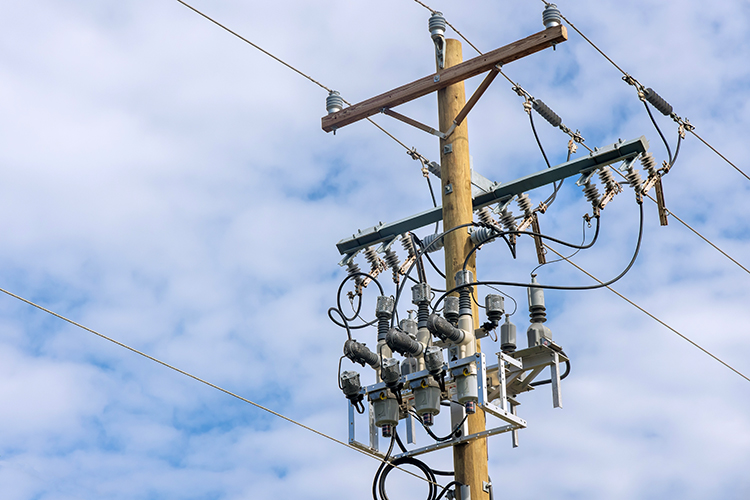
Reclosers play an important role in distribution system reliability by detecting fault conditions, interrupting current, and automatically restoring power when a fault is temporary. Modern recloser controls can include overcurrent protection, automatic reclosing, voltage and frequency protection, cold load pickup, sequence coordination, communications, and other functions.
Because of these capabilities, testing a recloser involves much more than simply verifying that it opens and closes. A typical recloser system includes the interrupter or “upper,” current and voltage sensors, control cable, and controller. Testing should consider how these components work together to measure system conditions, apply the programmed protection logic, and issue the appropriate trip and close commands.
Recloser testing can generally be approached at three levels: primary injection testing, control testing, and system testing. Primary injection provides one of the most complete tests because current is injected through the primary circuit, allowing the recloser upper, current sensors, control cable, controller, and trip circuit to be evaluated together. However, primary injection can be difficult to perform in the field because the recloser upper is typically installed high on the pole, making access and test connections challenging. For this reason, primary injection testing is commonly performed in the shop before the recloser is installed. Depending on the application, testing can be performed single-phase or three-phase.
Control testing focuses on verifying the protection functions and programmed settings. A test set can simulate the current and voltage conditions the controller would see during actual operation. Testing may include phase and ground minimum pickup, fast and slow time-current curves, shots to lockout, open interval times, reset time, and cold load pickup. CT and PT ratios and connections should also be confirmed as part of the test process.
Testing should not stop after verifying individual protection elements. The complete tripping and reclosing sequence is equally important. A recloser can be programmed for multiple “shots” before reaching lockout, allowing temporary faults an opportunity to clear. For example, a tree branch may fall onto an overhead line and create a fault. The recloser detects the fault, trips to interrupt the fault current, and waits for a programmed open interval before reclosing. If the branch falls away while the recloser is open, the fault is no longer present and the recloser can successfully reclose, restoring power after only one operation. If the fault remains, the recloser trips again and continues through its programmed sequence until the fault clears or the recloser reaches lockout. Testing verifies that the number of shots, fast and slow curves, open intervals, reset time, and final lockout operation occur as intended.
Additional operating modes should also be considered. Cold load pickup testing can verify that the control responds properly to increased load following an extended outage, while Hot Line Tag testing can confirm that automatic reclosing is disabled and the appropriate protection logic is applied for worker safety.
Finally, modern distribution automation may require testing beyond a single device. Reclosers, sectionalizers, and smart switches can work together to locate and isolate faults and restore unaffected portions of the feeder. These schemes may depend on voltage and current measurements or communications between devices. System testing can simulate a fault and verify that multiple devices respond in the proper sequence, including trip, block, open, close, and restoration commands.

Effective recloser testing therefore goes beyond proving that the recloser can trip. The objective is to verify that the measurement, protection logic, timing, reclosing sequence, communications, and switching device all work together as intended before the recloser is required to respond to an actual fault.
