Grid Edge Sensor Networks for Distribution Visibility and Control
By Jack Nevida, P.E. Principal Engineer Distribution Integration, SRP
By Jack Nevida, P.E. Principal Engineer Distribution Integration, SRP
Request for Quotation Service
Buyers Submit Free RFQs to top suppliers, no obligation.
Suppliers Browse real project RFQs directly from buyers.
Trust Electricity Forum 40 years connection buyers and suppliers.
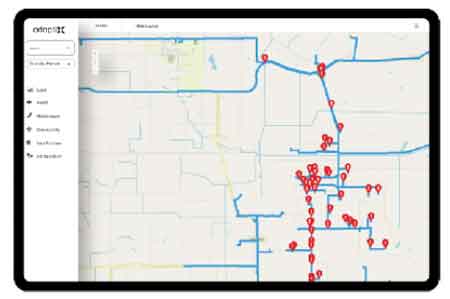
Grid edge sensor networks deliver real-time visibility into fault current, waveforms, and power flow at the feeder level, enabling ADMS model validation, faster outage restoration, and predictive asset analytics across overhead and underground distribution circuits.
Grid edge sensor networks are no longer experimental devices deployed for pilot visibility. They are becoming a structural layer in the distribution reliability architecture. As feeder complexity increases with underground density, DER penetration, and wildfire exposure, breaker-level awareness no longer provides sufficient resolution for real-time operational decisions.
For utilities managing high-risk circuits, restoration performance is no longer judged solely by average SAIDI values. It is judged by how quickly uncertainty collapses after a fault. Patrol distance, switching hesitation, and topology misinterpretation all compound restoration exposure. Distributed fault intelligence shifts that equation by reducing the distance between event detection and operational certainty.
When feeder telemetry can validate topology, confirm directional magnitude, and align with relay oscillography, operators move from inference-based restoration to evidence-based isolation. That shift determines whether grid-edge sensor networks function as telemetry accessories or as decision-grade infrastructure.
Grid edge sensor networks are distributed current and waveform devices installed along overhead and underground feeders to detect fault magnitude, direction, and sequence in near real time. They shift outage response from breaker-centered troubleshooting to segment-based isolation. In documented high-risk feeder scenarios, directional notification reduced restoration time by roughly 55 minutes, eliminating more than 1,000 customer minutes of interruption on a 20-customer circuit. That change is operational, not theoretical.
On feeders where more than 80 percent of the infrastructure is underground, visibility gaps are structural. Without edge sensing, a three-phase mid-feeder fault forces crews to patrol linearly from the substation outward. With segment-level fault direction and magnitude data, dispatch staging changes immediately. Patrol distance shrinks. Restoration certainty increases. Fire exposure windows narrow.
Download our FREE Electrical Training Catalog and explore a full range of expert-led electrical training courses.

Operational value emerges only when sensor waveform data aligns with relay oscillography and feeder model expectations. If waveform duration and magnitude diverge from substation relay records, confidence collapses at the moment operators must act. Edge telemetry must be reliable enough to influence switching decisions, not merely inform them.
Grid edge sensor networks must be deployed with intent, which is why Grid Edge Sensors should be treated as a control-layer measurement strategy rather than a coverage initiative.
Without feeder-level sensing, outage response begins with a breaker trip and an assumption about the topology. Crews patrol until evidence appears. Each additional mile of uncertainty increases customer minutes of interruption and elevates switching exposure. When integrated into ADMS, sensor-reported direction and magnitude become validation points for feeder topology and load flow state.
A critical operational fork appears when sensor-reported current direction conflicts with the modeled feeder state during switching. In that moment, operators must decide whether to trust the model or the field measurement. If Grid Edge Intelligence does not quickly reconcile that discrepancy, the system introduces hesitation where decisiveness is required.
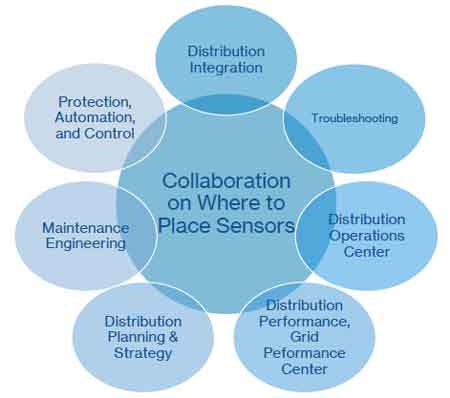
Placement discipline determines whether grid edge sensor networks reduce uncertainty or introduce noise. Circuits with high fire risk, electromechanical relays, unknown outage causes, or extended restoration history justify priority deployment. Installing sensors on low-risk feeders may improve metrics without materially improving reliability.
Scaling deployments introduces governance friction. Devices installed outside substations blur accountability between operations, protection, asset management, and cybersecurity. Once fleet size increases, Utility Network Device Management becomes an operational requirement because firmware control, communications health, and threshold integrity directly affect restoration outcomes.
Cloud-based integration gateways can reduce infrastructure overhead, but they introduce a dependency on network availability and a need for segmentation discipline. The choice between high-security operational zones and broader enterprise routing determines how much exposure the control environment accepts when faults occur.
Sensor waveform fidelity determines whether operators trust edge telemetry. In pilot comparisons, fault duration and magnitude aligned closely with relay oscillography, allowing edge measurements to be treated as operational inputs rather than advisory indicators.
Threshold configuration introduces a measurable risk. Overcurrent sensitivity set too low generates nuisance events that erode operator trust. Set too high, it masks high-impedance faults and evolving conductor degradation. This is not a configuration detail. It is a reliability threshold decision.
Sensor data strengthens directional confirmation before dispatch, particularly when integrated with Electrical Fault Detection workflows that interpret waveform context rather than relying on binary alarms.
When event data is reconciled with customer voltage-loss signatures, the confidence in outage boundaries increases. Using AMI Data for cross-validation exposes feeder model drift that would otherwise remain hidden behind apparently stable dashboards.
Distributed energy resources complicate directional fault logic. Reverse current contribution during inverter ride-through can distort magnitude interpretation if algorithms are not tuned for feeder penetration levels. In underground systems with high density, electromagnetic coupling, and limited access, telemetry blind spots are created when sensor spacing is inadequate.
A second operational edge case occurs when a temporary fault clears before crew arrival. Without stored waveform history and event retention, operators cannot determine whether the risk of reclosing remains. False confidence in a cleared alarm can introduce more risk than uncertainty itself.

Grid edge sensor networks function as infrastructure only when lifecycle governance, cybersecurity routing, and model discipline are treated as permanent responsibilities rather than pilot projects. Their long-term value depends on alignment with Intelligent Asset Management strategies that maintain telemetry integrity and threshold consistency.
As electrification increases and load profiles shift, reliance on breaker-only visibility becomes structurally insufficient. Grid-edge sensor networks can reduce restoration uncertainty and strengthen model validation, but only if deployment discipline, ownership clarity, and conflict-resolution logic are deliberately engineered. Otherwise, they become additional telemetry layers that create the illusion of control without increasing it.
Explore 50+ live, expert-led electrical training courses –