Power Grid Resilience in Modern Distribution
By R.W. Hurst, Editor
By R.W. Hurst, Editor
Request for Quotation Service
Buyers Submit Free RFQs to top suppliers, no obligation.
Suppliers Browse real project RFQs directly from buyers.
Trust Electricity Forum 40 years connection buyers and suppliers.
Power grid resilience is the ability of an electric system to withstand disturbances, maintain critical service during disruption, and restore normal operations efficiently while adapting to changing system conditions.
Traditional grid design focused on reliability, which measures how often outages occur. Power grid resilience expands this view to include how the system behaves under stress, how quickly it recovers, and how effectively it adapts during and after disruptive events.
In operational terms, resilience is not a planning abstraction. It is a real-time control challenge that involves field devices, distributed energy resources, outage detection systems, and operator decision-making under uncertainty.
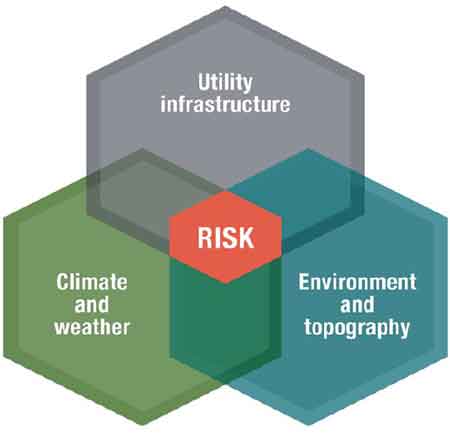
Utilities are now required to manage multiple simultaneous stressors such as severe weather, wildfire exposure, DER variability, and equipment failures that do not follow predictable patterns. This shifts the problem from preventing outages to managing system behavior during disruption.
Reliability measures system performance under normal operating conditions. It tracks outage frequency and duration using metrics that reflect historical performance.
Power grid resilience addresses conditions where those assumptions break down. It focuses on maintaining service during abnormal events and restoring it under constrained or degraded system states.
A system can be reliable but not resilient. For example, a network may have a low outage frequency but fail to recover quickly when a major storm simultaneously disrupts multiple feeders. This distinction is critical when planning grid investments and operational strategies.
This difference becomes clear when comparing resilience strategies with grid reliability, where performance is measured rather than actively managed during system stress.
Resilience is achieved through coordinated operational capability rather than a single technology. It depends on how utilities integrate visibility, control, and response across the system.
Stay informed with our FREE Storm, Risk & Grid Resilience Newsletter — get the latest news, breakthrough technologies, and expert insights, delivered straight to your inbox.
During an event, operators must balance load, isolate faults, and restore service while system conditions are still evolving. This requires real-time awareness of feeder status, switching configurations, and distributed generation output.
The ability to reconfigure feeders dynamically and leverage DER for localized support becomes a defining factor. This operational flexibility differentiates resilient systems from those that rely only on pre-event hardening.
Utilities also depend on systems such as outage management system platforms to identify fault locations, prioritize restoration, and coordinate field crews under time pressure.
When resilience is weak, disturbances propagate through the system instead of being contained. A single feeder fault can escalate into multi-feeder outages if switching decisions are delayed or system visibility is incomplete.
This cascading behavior is often driven by limited telemetry or inaccurate system state estimation. Operators may act on outdated information, leading to incorrect switching sequences or delayed fault isolation.
As distributed resources increase, this risk becomes more complex. Reverse power flow, voltage fluctuations, and protection coordination challenges can amplify the effects of disturbances if not properly managed.
In wildfire-prone regions, resilience must also incorporate strategies described in wildfire resilience, where system operation directly influences ignition risk and outage severity.
Improving resilience introduces tradeoffs between cost, complexity, and operational flexibility. Infrastructure hardening, automation, and DER integration all require capital investment and system redesign.
Utilities must decide whether to prioritize faster restoration through automation, reduced outage exposure through system segmentation, or increased flexibility through distributed resources.
Each approach changes how the system behaves during disruption. For example, high automation improves restoration speed but increases dependence on accurate data and communication systems.
This tradeoff is closely tied to how utilities interpret utility reliability, which focuses on consistent performance but does not fully capture adaptive response capability.
Deploying resilience strategies is constrained by legacy infrastructure, limited telemetry, and system complexity. Many distribution systems were not designed for real-time visibility or dynamic reconfiguration.
Incomplete data from field devices can prevent accurate estimation of the system state. This limits the effectiveness of automation and increases reliance on manual intervention.
Coordination across multiple systems, including SCADA, DER management, and outage tracking, introduces integration challenges. Data latency, communication failures, and inconsistent device models can reduce operational effectiveness during critical events.
Utilities must also consider how resilience aligns with measurable performance indicators such as electric utility reliability metrics, even though these metrics do not fully represent adaptive system behavior.
One of the most challenging resilience scenarios occurs when DER remains active during outage conditions. Distributed generation can unintentionally energize sections of the grid, creating safety risks and complicating restoration.
Operators must verify system state before re-energizing circuits, which slows restoration and increases uncertainty. Without accurate DER visibility, switching decisions can lead to unsafe conditions or delayed recovery.
This edge case highlights the need for coordinated control strategies and integration with DER systems. It also connects directly to strategies outlined in wildfire risk reduction, where DER operation influences system stability during high-risk events.
Unlike reliability, resilience is not captured by a single metric. It is evaluated based on recovery time, service continuity, and system adaptability.
One practical signal is restoration time under large-scale events. Systems that can restore partial service within hours rather than days demonstrate higher resilience even if initial outages occur.

Another indicator is the ability to maintain service to critical loads during disruption. This reflects how well the system can isolate faults and reconfigure supply paths.
Utilities often extend these capabilities through approaches described in grid resiliency, which focus on improving system response under extreme conditions.
Ultimately, power grid resilience is defined by how the system behaves when assumptions fail. It reflects whether the grid can continue operating, adapt to changing conditions, and recover quickly when disruption occurs.
Explore 50+ live, expert-led electrical training courses –