Wildfire Risk Reduction In Electric Utility Systems
By Chad Nickell, Sr. Director Grid Transformation, Distribution, Xcel Energy
By Chad Nickell, Sr. Director Grid Transformation, Distribution, Xcel Energy
Request for Quotation Service
Buyers Submit Free RFQs to top suppliers, no obligation.
Suppliers Browse real project RFQs directly from buyers.
Trust Electricity Forum 40 years connection buyers and suppliers.
Wildfire risk reduction lowers ignition probability from utility equipment by combining vegetation management, grid hardening, situational awareness, and operational controls that limit fault energy and exposure under high-risk weather conditions.
Wildfire risk reduction in electric utility systems is the process of lowering the probability that energized infrastructure will ignite fires by controlling how electrical faults interact with fuel and environmental conditions. Ignition occurs when fault energy is sustained long enough to transfer heat to dry vegetation, meaning the risk is governed by the relationship among fault energy, exposure time, and fuel availability.
Under high-wind and low-humidity conditions, even brief contact between a conductor and vegetation or ground can produce arcing. If that arc persists beyond a few cycles, it can generate temperatures sufficient to ignite surrounding material. Wildfire risk reduction, therefore, focuses on shortening fault duration, limiting fault energy, and reducing opportunities for contact between energized equipment and combustible fuel.
This makes wildfire risk reduction a pre-event system discipline. It does not eliminate faults or outages. It reduces the likelihood that normal grid disturbances escalate into ignition events under elevated environmental risk.
Wildfire risk reduction is distinct from Wildfire Resilience, which addresses how the system withstands fire and recovers from damage. Risk reduction occurs before ignition and focuses on preventing the initial event rather than responding to it.
It also differs from Utility Wildfire Mitigation Plans, which define program structure, compliance, and investment strategy. Mitigation plans organize activities such as vegetation programs and equipment upgrades, while wildfire risk reduction refers to the physical and operational mechanisms that directly reduce the probability of ignition.
Think you know Storm, Risk & Grid Resilience? Take our quick, interactive quiz and test your knowledge in minutes.
Within the broader context of Grid Resiliency and Power Grid Resilience, wildfire risk reduction serves as a targeted layer focused on ignition prevention rather than on system recovery or adaptation.
Vegetation management reduces ignition pathways by controlling the proximity of combustible material to energized conductors. Trees, brush, and ground fuel represent the primary medium through which electrical faults transition into fire events.
Clearance programs are designed to prevent contact under both normal and extreme wind conditions. However, maintaining clearance across tens of thousands of circuit miles introduces variability. Growth rates, terrain, and access constraints create localized exposure points where vegetation can encroach on conductors.
In high-risk zones, vegetation management is not simply a maintenance activity. It is a primary control on ignition probability because it directly limits the availability of fuel at the point of electrical contact.
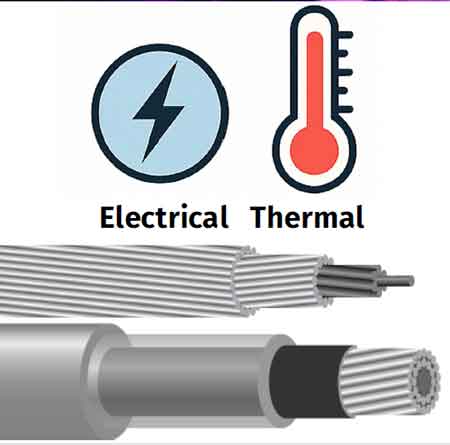
Grid hardening reduces the probability that electrical faults produce sustained arcs capable of ignition. Covered conductors, stronger structures, and selective undergrounding reduce both the frequency and severity of environmental interactions with faults.
Covered conductor systems do not eliminate faults but reduce the likelihood that incidental contact results in sustained arcing. Underground systems remove exposure entirely but are applied selectively due to cost and operational constraints.
Hardening strategies are typically concentrated in areas where the wildfire consequences are highest. This reflects a risk-based approach where infrastructure investment is aligned with ignition probability and potential fire spread.
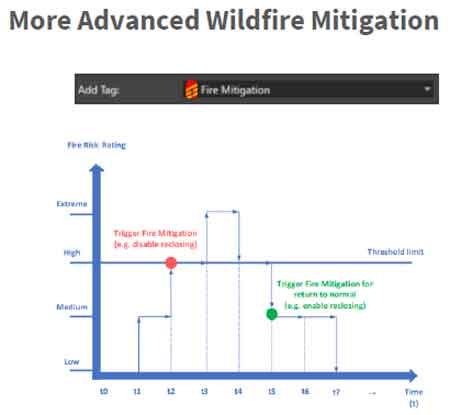
Wildfire risk is dynamic and varies with weather, fuel conditions, and system state. Situational awareness systems combine weather data, sensor inputs, and network topology to identify when and where ignition risk increases.
Utilities define risk zones based on wind speed, humidity, temperature, and vegetation conditions. These zones can shift hourly, requiring continuous monitoring rather than static planning.
Advanced distribution management systems integrate these inputs to provide visibility into system conditions, enabling operators to apply targeted controls to specific feeders or circuits rather than broad system-wide actions.
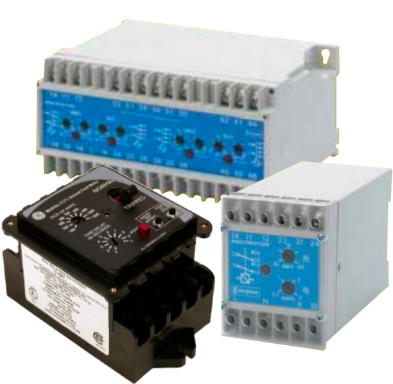
Operational controls directly influence the probability of ignition by modifying how the system responds to faults under high-risk conditions. Enhanced protection settings reduce fault clearing time, limiting the duration of arcing and the heat transferred to surrounding fuel.
Traditional reclosing schemes may attempt multiple re-energization cycles after a fault. Under wildfire conditions, this behavior increases ignition risk because repeated fault attempts can sustain or reintroduce arcing. Enhanced powerline safety settings restrict or eliminate reclosing and coordinate protection to clear faults more quickly.
Reducing clearing time from over 100 cycles to under 10 cycles significantly lowers the likelihood that a fault will ignite vegetation. This reduction in exposure time is one of the most effective mechanisms for lowering ignition probability at the system level.
In extreme conditions, utilities may implement Public Safety Power Shutoffs to de-energize targeted areas entirely. While this eliminates ignition risk from electrical sources, it introduces widespread outages and operational disruption.
System visibility and coordination are often supported by platforms such as an Outage Management System, which helps operators understand system state and manage response actions during high-risk periods.
A typical ignition scenario occurs when strong winds cause a conductor to contact dry vegetation or when a damaged conductor falls into a fuel-rich environment. If the resulting fault is not cleared rapidly, sustained arcing can ignite surrounding material.

Wildfire risk reduction addresses this through layered controls. Vegetation management reduces the probability of contact. Grid hardening reduces the severity of contact events. Enhanced protection limits fault duration. Situational awareness identifies when conditions require operational intervention. De-energization removes exposure entirely when risk becomes extreme.
If these layers are not aligned, ignition probability increases sharply. A single fault in a high-risk zone can escalate into a wildfire event affecting large geographic areas and thousands of customers.
This failure mode is difficult to detect in real time because the electrical system may appear stable while environmental conditions create ignition potential beyond safe operating thresholds.
Wildfire risk reduction is constrained by the ability to detect all relevant fault conditions. High-impedance faults, which produce low current levels, may not reliably trigger conventional protection systems.
Even advanced detection methods must balance sensitivity with reliability. Systems that are too sensitive increase outage frequency through false trips. Systems that are less sensitive may fail to detect ignition-prone faults.
This uncertainty means utilities cannot rely on detection alone and must combine multiple risk-reduction strategies to manage ignition probability effectively.
Reducing wildfire risk often requires accepting reduced system reliability. Faster protection settings and restricted reclosing increase the likelihood of outages and longer restoration times.
Public Safety Power Shutoffs eliminate the risk of ignition but can interrupt service to tens of thousands of customers. Enhanced protection settings may require a field inspection before re-energization, thereby extending the outage duration.
Utilities balance these impacts using Electric Utility Reliability Metrics to define acceptable levels of service disruption relative to wildfire risk.
In high-risk regions, utilities may prioritize ignition prevention over service continuity due to the severe consequences of uncontrolled wildfires.
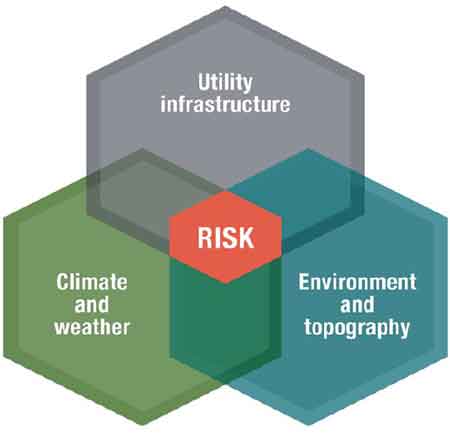
Wildfire risk is concentrated geographically rather than uniformly distributed across the grid. A relatively small portion of the network, often defined as high fire threat districts, can account for the majority of ignition exposure.
These areas experience combinations of dry fuel, high winds, and challenging terrain, where a single fault can lead to rapid fire spread. Under these conditions, ignition probability increases significantly if fault clearing times exceed critical thresholds.
This concentration of risk drives targeted investment in vegetation management, grid hardening, and operational controls within specific zones rather than across the entire system.
If wildfire risk reduction measures fail, the consequences are not limited to a localized equipment issue. A single ignition event under extreme conditions can propagate rapidly, leading to widespread outages, infrastructure damage, and long-term system impacts.
When fault energy is not cleared within milliseconds in high-risk environments, ignition probability shifts from low to system-critical, making wildfire risk reduction a core operational requirement rather than a secondary maintenance function.
Explore 50+ live, expert-led electrical training courses –