Wildfire Resilience in Electric Power System Performance
By Brittany Barnwell, Emergency Manager, Seattle City Light
By Brittany Barnwell, Emergency Manager, Seattle City Light
Request for Quotation Service
Buyers Submit Free RFQs to top suppliers, no obligation.
Suppliers Browse real project RFQs directly from buyers.
Trust Electricity Forum 40 years connection buyers and suppliers.
Wildfire resilience is the ability of power systems to withstand wildfire risk, prevent ignition from electrical faults, maintain reliability, and restore service after fire damage across transmission and distribution networks under extreme conditions.
Wildfire resilience is the ability of an electric power system to operate safely under wildfire conditions, limit ignition from electrical infrastructure, maintain service continuity, and restore operations after fire damage across transmission and distribution networks.
Wildfire conditions create abnormal operating environments in which heat, wind, and dry fuels increase both system vulnerability and the probability of ignition. Under these conditions, the electrical infrastructure does not behave the same as it does during normal operation.
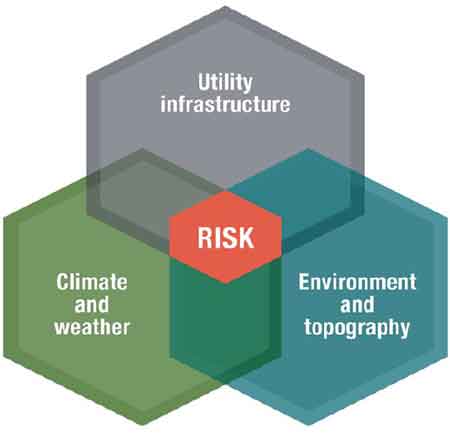
Power systems have a dual role in wildfire environments. They must withstand wildfire exposure while also managing the risk that their equipment could start fires. Wildfire resilience exists at the intersection of infrastructure performance, environmental conditions, and operational control.
Wildfire resilience describes how utilities prepare for, respond to, and recover from wildfire conditions while controlling ignition risk from their systems. It is not limited to response or restoration. It includes how the system behaves before and during high-risk conditions.
Utilities must evaluate where infrastructure interacts with the environment under specific conditions. This includes identifying ignition sources within the system and understanding how environmental factors such as wind, humidity, and fuel conditions influence those risks.
Wildfire resilience depends on recognizing abnormal operating conditions where standard system behavior becomes unsafe. A system that is reliable under normal conditions may become a source of ignition under extreme weather.
Stay informed with our FREE Storm, Risk & Grid Resilience Newsletter — get the latest news, breakthrough technologies, and expert insights, delivered straight to your inbox.
Electrical infrastructure can initiate wildfires through several well-defined mechanisms.
A common ignition scenario begins with conductor sag. As conductor temperature increases due to load or ambient heat, sag increases. Reduced clearance can allow contact with vegetation. When contact occurs, arcing can produce temperatures high enough to ignite dry fuels.
Insulation failure creates another ignition pathway. Degraded insulation can result in phase faults that generate arcs and sparks. These events can occur without warning and under normal system loading.
Mechanical failure also contributes to wildfire ignition. Broken conductors or failed hardware can bring energized lines into contact with the ground or vegetation, increasing the probability of a fire start.
These mechanisms are central to wildfire risk and are addressed through Wildfire risk reduction, but wildfire resilience focuses on how the system behaves when these risks are present.
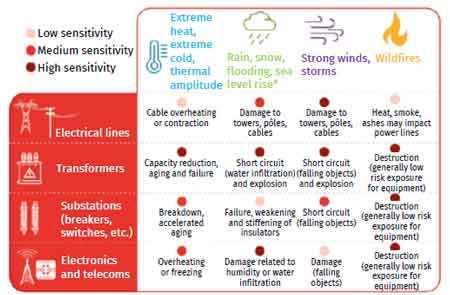
Wildfires also directly impact power system infrastructure.
A system damage scenario begins when fire enters a transmission corridor or a distribution feeder. Wooden poles can lose structural integrity, conductors can anneal and lose strength, and protective devices may trip due to fault conditions.
Substations exposed to heat or smoke may experience equipment degradation or loss of visibility of controls. Communication systems may fail, limiting situational awareness.
These impacts lead to outages that extend beyond the initial fire footprint. Loss of key feeders or transmission paths reduces system flexibility and slows restoration.
The effect of these disruptions is captured through Utility reliability, where wildfire-driven outages often exceed normal expectations for duration and scale.
Infrastructure condition plays a critical role in wildfire resilience.
Aging conductors, degraded insulation, and weakened structures increase the likelihood of failure under stress. Vegetation management constraints further increase exposure, particularly in areas with dense or fast-growing fuels.
Environmental conditions amplify these risks. High winds increase conductor movement and the probability of faults. Low humidity and dry vegetation increase the likelihood of ignition.
Utilities must continuously assess how infrastructure interacts with these conditions. This interaction defines wildfire risk more than any single component failure.
Wildfire resilience requires managing a fundamental operational tradeoff.
Utilities can reduce ignition risk by de-energizing circuits during high-risk conditions. This approach reduces the likelihood of a fire starting but directly impacts customers with outages.
Maintaining normal operation preserves service continuity but increases the risk of ignition when conditions are severe.
This tradeoff is managed through structured decision frameworks that evaluate weather conditions, fuel state, and fault probability before action is taken. These decisions directly influence Electric utility reliability metrics, where outage frequency and duration must be balanced against fire risk.
Wildfire resilience extends beyond equipment into coordination and response.
Utilities must align internal operations with external emergency response organizations. During wildfire events, multiple agencies are involved, including fire services, emergency management, and local governments.
Structured coordination frameworks ensure that resources are deployed effectively and that information is shared consistently. Without this coordination, restoration efforts can be delayed and safety risks can increase.
The role of the Outage management system becomes critical in these situations, providing visibility into outages, crew locations, and restoration progress.
Wildfire events can produce large-scale system impacts.

Major wildfire incidents have caused damage exceeding tens of billions of dollars and affected large portions of the grid. Even smaller ignition events can escalate rapidly if conditions support fire growth.
A single fault under extreme conditions can initiate a wildfire that leads to widespread outages, infrastructure damage, and prolonged restoration timelines.
If electrical infrastructure is not adjusted during high-risk conditions, a routine fault can escalate into a major wildfire with system-wide consequences.
Wildfire resilience is part of a broader system resilience strategy but remains distinct in its focus.
It supports Grid resiliency by strengthening system performance under extreme conditions, but it is specifically focused on wildfire risk.
It also contributes to Power grid resilience, where system recovery and adaptation are critical after disruption events.
Wildfire resilience differs from Utility wildfire mitigation plans, which define structured programs and compliance strategies. It is the system-level capability that determines how the grid performs when those plans are executed.
Explore 50+ live, expert-led electrical training courses –