Intelligent Connectivity Architecture for AMI, DER, and Grid Modernization
By John Sala, Duquesne Light Company
By John Sala, Duquesne Light Company

Intelligent connectivity defines the hybrid AMI 2.0 network platform that integrates private LTE, RF mesh, peer-to-peer transformer clusters, DER telemetry, and edge intelligence to deliver full device coverage, predictable latency, and resilient grid modernization control.
Intelligent connectivity is not a communications upgrade. It is the engineering framework for building the next-generation network platform that connects AMI 2.0, DER coordination, distribution automation, and edge computing into a unified operational system.
When meters become grid-edge sensors, local gateways, and distributed computing nodes, the network platform determines whether modernization initiatives operate as isolated data streams or as a synchronized control infrastructure. Connectivity becomes an operational boundary.
AMI 2.0 increases headend traffic by roughly 10 times compared to legacy deployments, as reporting intervals compress toward 1 minute and transformer-level coordination becomes continuous rather than episodic. Device counts are increasing rapidly. Traffic intensity is increasing faster. If the underlying connectivity architecture is not designed for control-grade reliability at that scale, modernization creates fragility rather than resilience.
Building the next-generation intelligent connectivity network platform requires a hybrid architecture that combines private LTE, RF, or PLC mesh networks with transformer-level peer coordination. Hybrid communications is not optional in AMI 2.0 because cellular networks do not natively support peer-to-peer coordination between meters within the same transformer cluster.
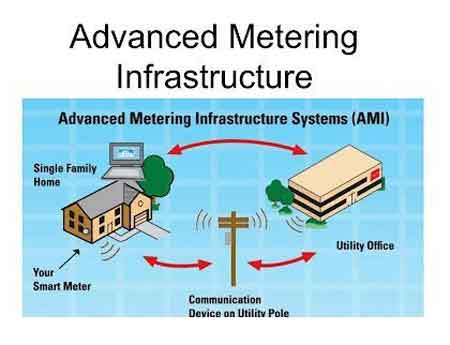
The shift from legacy billing infrastructure to Advanced Metering Infrastructure marks the moment when communications becomes an operational control domain rather than a revenue collection utility.
Pure cellular deployment simplifies topology but forces all meter-to-meter exchanges through the headend, concentrating latency and spectrum demand. Pure mesh introduces coverage and propagation variability. Neither model, on its own, satisfies the coverage, latency, and transformer-cluster coordination requirements at scale.
Stay informed with our FREE Metering, AMI & Edge Intelligence Newsletter — get the latest news, breakthrough technologies, and expert insights, delivered straight to your inbox.
Intelligent Connectivity reconciles these constraints through a layered design. Private LTE provides deterministic wide-area control and security governance. A Neighborhood Area Network tier offloads local meter-to-meter exchanges. Designated spokesmeters aggregate transformer cluster intelligence before controlled uplink to headend systems.
In practical modeling, a spokesmeter ratio of approximately 1 per 7 meters forms micro-mesh transformer clusters averaging 49 meters. That 1:7 architecture materially reduces Field Area Network site requirements compared to a cellular-only design, especially under minute-level reporting intervals and during outage surges.
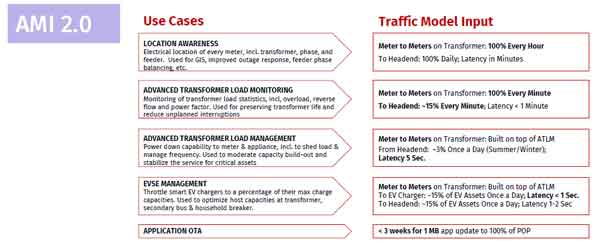
First, AMI 2.0 meters serve as grid-edge sensors for voltage, load, and anomaly detection. Reporting intervals are compressed to one minute or less in certain use cases. Headend traffic can increase by an order of magnitude compared to legacy deployments. Modern grid planning and outage sequencing now depend on high-integrity AMI data rather than periodic meter reads.
Second, DER integration introduces bidirectional flow and transformer-level coordination. EV charging management, reverse flow detection, and dynamic load management require peer interaction inside transformer clusters. These control demands fundamentally redefine the role of the AMI smart meter, transforming it from a passive endpoint into a distributed intelligence node operating within coordinated transformer groups.
Third, distribution automation and outage management depend on traffic behavior during stress. During a large circuit event, 70 to 85 percent of sector meters may transmit outage telemetry within two-minute intervals. Under a cellular-only architecture, simultaneous uplink bursts drive retransmissions and congestion. Under a hybrid 1:7 spokesmeter model, local aggregation absorbs part of that surge before upstream transmission, reducing site pressure, preserving control channel integrity, and maintaining the electrical location awareness required in modern AMI metering.
Artificial intelligence is accelerating digital transformation of intelligent connectivity within AMI 2.0 networks, where high performance hybrid architectures enable transformer-level coordination, outage surge resilience, and distributed edge analytics at scale.
Consider a high penetration DER feeder on a summer afternoon. Advanced transformer load monitoring operates at one-minute intervals across thousands of meters. A circuit fault occurs, and 70-85% of sector meters begin transmitting outage telemetry every 2 minutes.
In a cellular-only intelligent connectivity architecture, simultaneous uplink bursts increase retransmissions and congestion. Latency drifts beyond design thresholds. Transformer load management decisions are executed on stale data. Voltage instability propagates into secondary networks.
In a hybrid architecture structured around forty-nine-meter micro-mesh clusters with one spokesmeter per seven meters, a portion of peer coordination and aggregation remains local. Site count requirements decline relative to cellular-only modeling. Spectrum loading moderates. Restoration sequencing remains anchored in current telemetry.
The difference determines whether outage traffic becomes a destabilizing force or a manageable surge.
Hybrid design introduces real constraints. Micro-mesh cells require RF or PLC reliability within transformer groups. Urban density, underground deployment, and interference profiles influence performance. Private LTE requires capital discipline and spectrum planning.
Even a modest spokesmeter ratio of one per seven meters can materially reduce the required site footprint compared to a pure cellular design. However, that ratio is sensitive to assumptions about traffic frequency and payload size. If reporting intervals are tightened for new grid applications, uplink demand scales nonlinearly.
Intelligent Connectivity, therefore, requires threshold governance. Reporting frequency, payload size, latency targets, and aggregation logic must be aligned with capacity modeling. Modernization without traffic discipline results in architecture rework. Governance must extend down to the firmware and lifecycle control of every deployed AMI meter within the population.

AMI 2.0 is not static. Use cases evolve. Behind-the-meter integrations with EV chargers, solar inverters, and battery storage expand over time. Application environments allow new edge applications to be deployed across the installed base.
A network platform built solely for current use cases will fail to scale as new traffic profiles emerge. Embedding LTE Cat M1 capability in each meter increases architectural flexibility. Future evolution toward higher-bandwidth technologies can further reduce site count and improve spectral efficiency.
But flexibility without governance creates drift. Firmware control, dynamic spokesmeter election, and topology validation must be continuously verified. Intelligent Connectivity must function as a managed control system, not as a collection of radios.
Intelligent Connectivity is the control boundary that determines whether AMI 2.0 functions as a telemetry infrastructure or as a distributed grid authority.
Transformer cluster use cases depend on accurate electrical location awareness and phase identification. If topology mapping is incorrect, peer-to-peer load coordination can misallocate shed commands or misinterpret reverse flow.
A single misidentified meter inside a forty-nine-meter cluster can distort aggregate calculations. Under high DER penetration, that distortion may propagate into load management decisions. Intelligent Connectivity must therefore enforce electrical location verification and transformer grouping accuracy within the network platform.
This is where communications and operational modeling converge. The network is not separate from control logic. It is the substrate on which grid modernization executes.
Intelligent Connectivity defines whether AMI 2.0, DER coordination, and distribution automation operate as synchronized control layers or as loosely coupled data systems. Building the next-generation network platform requires hybrid architecture discipline, quantified traffic modeling, transformer-cluster governance, and outage-resilience design.
Anything less creates modernization without authority.
Note: This article is based on a presentation, "Intelligent Connectivity - Building the Next Generation Network Platform for AMI, DER, and Grid Modernization," delivered to Distributech 2026
Advantages To Instructor-Led Training – Instructor-Led Course, Customized Training, Multiple Locations, Economical, CEU Credits, Course Discounts.
Request For QuotationWhether you would prefer Live Online or In-Person instruction, our electrical training courses can be tailored to meet your company's specific requirements and delivered to your employees in one location or at various locations.