Line Sensors for Utilities in Distribution Fault Detection
By Jack Nevida, P.E. Principal Engineer Distribution Integration, SRP
By Jack Nevida, P.E. Principal Engineer Distribution Integration, SRP

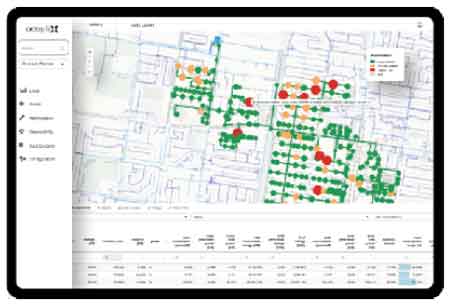
Line sensors for utilities provide near real-time fault detection, waveform capture, and feeder visibility, reducing patrol time, improving outage isolation, and strengthening ADMS model accuracy across overhead and underground distribution networks.
Line sensors for utilities shift distribution control from post-event troubleshooting to near real-time situational awareness. When deployed on critical feeders, high-fire-risk circuits, and hard-to-access underground sections, they alter how operators interpret breaker trips, patrol decisions, and sectionalizing sequences.
In systems spanning tens of thousands of distribution miles with large underground penetration, the absence of intermediate sensing creates blind segments between substations and field devices. A breaker trip confirms interruption but does not confirm fault location, magnitude, or persistence. That ambiguity increases restoration duration and inflates customer-interruption minutes.
Operational impact is measurable. On a high-risk feeder example, restoration without sensors required full patrol from the substation, resulting in 185 minutes of interruption and 3700 CMI. With sensor notification directing crews to a precise segment, patrol time dropped to 130 minutes and CMI to 2600, saving 1100 CMI. The delta alters outage reporting, wildfire exposure windows, and dispatch efficiency.
Line sensors for utilities did not move directly to full deployment. Early pilots validated the waveform fidelity, cellular reliability, and practicality of installation across overhead and underground line sensors. Evaluation criteria included measurement accuracy, cybersecurity exposure, analytics usefulness, ease of installation, and integration complexity.
Transition to strategic deployment required defined use cases. Circuits were prioritized based on outage history, vegetation exposure, fire risk, electromechanical relay presence, and unknown outage causes. Only after operational teams confirmed measurable restoration improvements were sensors integrated into production ADMS environments.
Download our FREE Electrical Training Catalog and explore a full range of expert-led electrical training courses.

This progression matters. A pilot proves the function. Production deployment requires governance, ownership, firmware management, and architectural control.
The primary value is synchronized notification to operators and field crews at the moment of fault detection. Remote fault indicator alerts reduce the lag between breaker SCADA alarm recognition and crew dispatch.
When integrated into Advanced Distribution Management Systems (ADMS), sensor fault magnitude and waveform data improve switching decisions. Operators assess phase involvement before reclosing or sectionalizing. Overcurrent alarm configuration must distinguish between transient inrush and sustained faults. Improper thresholds either create nuisance alarms or suppress actionable events.
Line sensors capture fault current waveforms that align with relay oscillography, enabling validation on feeders without advanced relays. Power flow measurements strengthen model validation when reconciled with AMI Data.
Beyond restoration, continuous sensing establishes baselines for feeder performance. Deviations from historical current signatures may indicate insulation degradation, conductor damage, or abnormal loading before failure. This is the transition from outage visibility to predictive analytics.
FLISR readiness emerges when sensor magnitude and direction are integrated into automation logic. Instead of topology-only inference, sectionalizing decisions incorporate field-validated sensing. Line sensors for utilities, therefore, become automation enablers rather than just outage tools.
Underground line sensors rely on a power harvester, current transformers, or battery-based designs. Capacitor-based overhead units require a minimum load current to sustain operation. Battery-based units remove that constraint but introduce lifecycle management and replacement scheduling.
Cellular signal strength and carrier redundancy determine placement viability. A sensor installed in a vault without reliable communications becomes an offline indicator rather than a control asset. Placement decisions combine loading thresholds, RF validation, and fault exposure analysis.
Strategic alignment with broader Distribution Line Monitoring programs and Grid Edge Sensors architecture prevents fragmented telemetry and redundant deployment.
Cloud-based integration gateways reduce infrastructure burden but introduce internet-exposed pathways. Routing through a High Security Operations Center environment segregates OT from corporate networks and enforces firewall governance and VPN tunnel control.
The architectural decision between corporate routing and HSOC segregation defines patch management ownership, certificate governance, telemetry validation, and incident response alignment. If routing discipline is weak, sensors expand attack surface faster than they expand visibility.
Ownership intersects with Intelligent Asset Management. Without defined roles for provisioning, firmware updates, and health monitoring, sensor fleets degrade operational confidence.
Consider a feeder supplying an industrial load with embedded DER. A mid-span phase-to-ground fault occurs during reverse power flow. Without sensor data, breaker operation suggests upstream failure. Crews patrol outward while DER continues energizing downstream segments. Restoration delays increase safety exposure and outage duration.
With directional sensing, crews sectionalize correctly. If the overcurrent alarm configuration is misaligned, harmonic distortion may trigger false positives, increasing switching risk. Threshold discipline, therefore, governs whether sensors reduce or degrade reliability.
Every additional minute of uncertainty on a high-fire-risk feeder compounds operational liability.
Line sensors for utilities are a control-layer architecture decision. They modify outage workflow, model confidence, cyber posture, predictive capability, and FLISR readiness. When deployed with phased maturity and governance discipline, they reduce interruption duration and strengthen feeder intelligence. Without that discipline, they amplify data without improving decisions.
Stay informed with our FREE Asset Intelligence & Predictive Maintenance Newsletter — get the latest news, breakthrough technologies, and expert insights, delivered straight to your inbox.
Explore 50+ live, expert-led electrical training courses –