Why Setpoints and Deadbands Matter More Than Expected
By Howard WIlliams, Associate Editor
By Howard WIlliams, Associate Editor
Request for Quotation Service
Buyers Submit Free RFQs to top suppliers, no obligation.
Suppliers Browse real project RFQs directly from buyers.
Trust Electricity Forum 40 years connection buyers and suppliers.
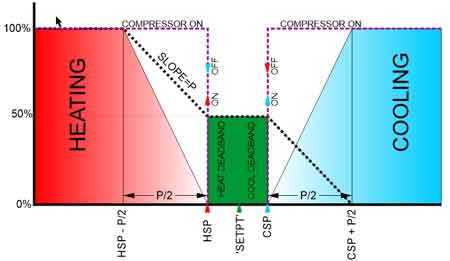
Setpoints define the desired operating conditions in a building automation system, while deadbands provide tolerance around those targets to prevent unnecessary cycling of equipment. The balance between them shapes comfort, energy use, and system stability.
In operational buildings, setpoints and deadbands are rarely the focus until something starts to feel wrong. Occupants complain of temperature swings, equipment runs harder than expected, or operators find themselves making constant adjustments that never seem to settle. In most cases, the issue is not faulty hardware or bad sensors but how these two settings interact with system logic over time. Small tuning decisions compound, quietly influencing how often equipment reacts, how aggressively it responds, and whether the system ever truly stabilizes.
Setpoints and deadbands may look like simple numeric settings, but in real buildings, they shape how systems behave hour after hour. The way they are tuned influences comfort complaints, equipment cycling, energy drift, and the steady accumulation of operational inefficiencies that rarely trigger alarms. In practice, setpoints do not operate in isolation; their real effect depends on how they are interpreted within broader control sequences in building automation systems, where logic determines when and how corrective action actually occurs.
A setpoint is not a fixed command so much as a reference target around which control logic reacts. Whether it is a zone temperature, a discharge air value, or a chilled water target, the setpoint establishes intent rather than outcome. Across a modern building automation system, those targets are filtered through sensor accuracy, actuator response, time delays, and upstream limits. A perfectly reasonable setpoint on paper can produce poor results if it conflicts with system dynamics or adjacent zones operating under different assumptions.
Think you know Building Automation? Take our quick, interactive quiz and test your knowledge in minutes.
Operators often discover this when minor adjustments fail to produce expected changes. The system may technically reach the target but still feel unstable or inefficient because the surrounding logic was never designed to operate near that value.
Deadbands exist to absorb normal variation without triggering constant correction. They define the range around a setpoint where the controller intentionally does nothing. When that range is too narrow, equipment reacts to noise rather than need. Fans hunt, valves chatter, compressors short-cycle. Many behaviors blamed on faulty hardware are, in fact, classic examples of why building automation systems underperform, especially when deadbands are narrowed in pursuit of tighter comfort without accounting for system inertia.
A well-chosen deadband allows the system to settle. It accepts minor deviation in exchange for smoother operation and longer equipment life. In most occupied buildings, occupants prioritize stability over precision.
Problems multiply when setpoints are inconsistent across zones or systems. Adjacent spaces with different temperature targets can create airflow conflicts that never fully resolve. Heating and cooling loops may alternate control authority without ever stabilizing. These situations often masquerade as balancing issues but originate in competing intent embedded in the configuration.
This is where experience matters. Experienced oversight from the building automation operator role often prevents small setpoint decisions from cascading into persistent operational issues. Understanding how a single change propagates through the system distinguishes adjustment from disruption.
Setpoints and deadbands do not operate in isolation, their real impact emerges through the logic paths and interactions defined by Control Sequences in Building Automation, where small parameter choices can cascade into larger system behavior.
Setpoints and deadbands are rarely wrong on day one. They drift into failure as buildings change. Occupancy shifts, loads evolve, equipment ages, and control assumptions quietly fall out of alignment. During initial setup or major changes, deadband behavior is often clarified during building automation commissioning, when real load conditions finally expose how the system responds outside of design assumptions.
The same need for review applies years later. What worked under original conditions may now produce oscillation or inefficiency simply because the building no longer behaves the way the logic expects.
Setpoints and deadbands sit at the intersection of comfort, energy, and reliability. They influence how aggressively systems respond, how often equipment cycles, and how forgiving systems are to everyday variation. When tuned with awareness of system behavior rather than isolated targets, they quietly support stable operation. When treated as static numbers, they often become the source of recurring issues that never seem to fully disappear.
Stay informed with our FREE Building Automation Newsletter — get the latest news, breakthrough technologies, and expert insights, delivered straight to your inbox.
Advantages To Instructor-Led Training – Instructor-Led Course, Customized Training, Multiple Locations, Economical, CEU Credits, Course Discounts.
Request For QuotationWhether you would prefer Live Online or In-Person instruction, our electrical training courses can be tailored to meet your company's specific requirements and delivered to your employees in one location or at various locations.