Control Sequences in Building Automation
By Howard WIlliams, Associate Editor
By Howard WIlliams, Associate Editor

Request for Quotation Service
Buyers Submit Free RFQs to top suppliers, no obligation.
Suppliers Browse real project RFQs directly from buyers.
Trust Electricity Forum 40 years connection buyers and suppliers.
Control sequences determine how building automation systems actually behave under load, change, and imperfect operating conditions, guiding equipment decisions and influencing comfort, energy use, and equipment wear more than most operators ever consciously acknowledge.
Most building automation problems do not announce themselves as logic failures. They show up as rooms that never quite settle, systems that fight themselves during seasonal changeover, or equipment that cycles more than anyone expected. When those symptoms persist, the root cause is almost always found in the control sequences, not in the hardware, sensors, or network diagrams.
At a practical level, control sequences are the decision logic of a building automation system. They translate inputs into actions under conditions that are rarely stable or ideal. Schedules may define when systems are allowed to run, but sequences decide how they run once real-world variables start pushing back.
On paper, control sequences often read clean and logical. In operation, they are forced to reconcile competing demands: comfort versus energy, responsiveness versus stability, efficiency versus equipment longevity. A sequence that works perfectly during commissioning can behave very differently six months later when occupancy patterns change, weather deviates from historical norms, or equipment performance drifts.
This is why many long-term comfort and energy complaints blamed on “bad design” align closely with the patterns described in why building automation systems underperform. The issue is rarely that the system lacks capability, but that its logic was never tuned to how the building actually operates.
Control sequences that lack flexibility tend to become brittle over time. They respond correctly to expected conditions but poorly to everything else, forcing operators to constantly override, which quietly undermines the original efficiency goals.

Although sequences are implemented as logic blocks inside controllers, they are not purely technical artifacts. They encode assumptions about behavior: how quickly a space responds, how aggressively equipment should react, and how much deviation is acceptable before corrective action is taken.
This becomes especially apparent when sequences interact with setpoint strategy. Poorly chosen thresholds can turn otherwise reasonable logic into a source of instability. Tight deadbands may cause oscillation, while overly generous ones allow drift that never fully recovers. These interactions are explored further in setpoints and deadbands in building automation, where small numerical decisions quietly dominate system behavior.
Experienced practitioners know that “correct” sequences on paper often require iterative tuning in operation. Without that refinement, the logic begins to work against itself.
In practice, control sequences only reveal their strengths and weaknesses when exercised under real operating conditions, which is why sequence behavior must be validated through thoughtful Building Automation Commissioning rather than assumed correct based on design intent alone.
Certain failure patterns recur across buildings and platforms. One is conflicting priorities embedded in different parts of the sequence. Another is logic that assumes ideal sensor behavior, leaving no graceful response when data becomes noisy, delayed, or unavailable.
In buildings where systems appear fully integrated, these conflicts often escalate into cascading problems, the kind documented in building automation failures. A fan sequence that never quite reaches its target may trigger compensating behavior elsewhere, amplifying inefficiency rather than correcting it.
These issues are compounded when operators inherit systems without clear sequence documentation. When logic becomes opaque, troubleshooting devolves into guesswork, a dynamic closely aligned with the problems described in why superficial BAS knowledge fails.
Modern control sequences increasingly depend on data exchanged between controllers, subsystems, and supervisory layers. That dependency introduces timing assumptions that are easy to overlook during design.
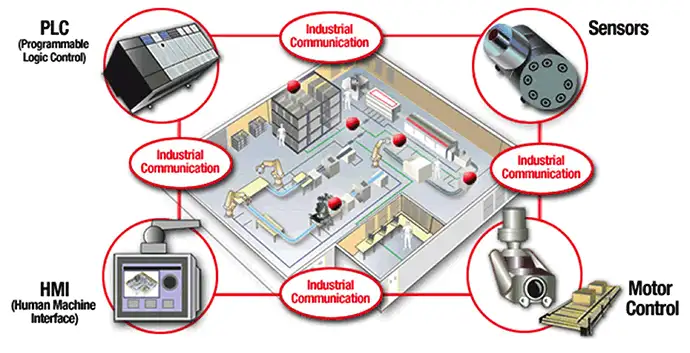
As sequences rely more on networked data, their reliability becomes inseparable from the realities of industrial automation communication. Latency, dropped values, or delayed updates can subtly distort the execution of logic, producing behavior that appears irrational unless communication dynamics are understood.
In these environments, robust sequences are those that tolerate imperfect data rather than assuming continuous, flawless communication.
Control sequences also act as long-term energy governors. They decide when systems relax, when they push harder, and how aggressively they recover from deviation. Facilities that achieve stable performance over the years tend to align sequence behavior with broader energy management objectives, rather than treating efficiency as an add-on layered over static logic.
This alignment requires judgment. Aggressive energy savings strategies embedded directly into sequences can backfire if they ignore occupant behavior or system inertia. Conversely, conservative logic may preserve comfort at the expense of persistent energy waste.
Control sequences rarely attract attention when they work well. They become visible only when something feels off, when operators start compensating manually, or when performance metrics refuse to improve despite equipment upgrades.
In reality, sequences are the behavioral contract between a building and its systems. They define how technology responds to uncertainty, variability, and human use. When written thoughtfully and maintained deliberately, they allow automation to absorb complexity quietly. When neglected or copied without context, they become a source of friction that no amount of hardware refinement can fully resolve.
Think you know Building Automation? Take our quick, interactive quiz and test your knowledge in minutes.
Advantages To Instructor-Led Training – Instructor-Led Course, Customized Training, Multiple Locations, Economical, CEU Credits, Course Discounts.
Request For QuotationWhether you would prefer Live Online or In-Person instruction, our electrical training courses can be tailored to meet your company's specific requirements and delivered to your employees in one location or at various locations.