Automation in Cybersecurity for OT Response and Substation Security
By Anthony Eshpeter, Chief Technology Officer, SUBNET Solutions Inc.
By Anthony Eshpeter, Chief Technology Officer, SUBNET Solutions Inc.
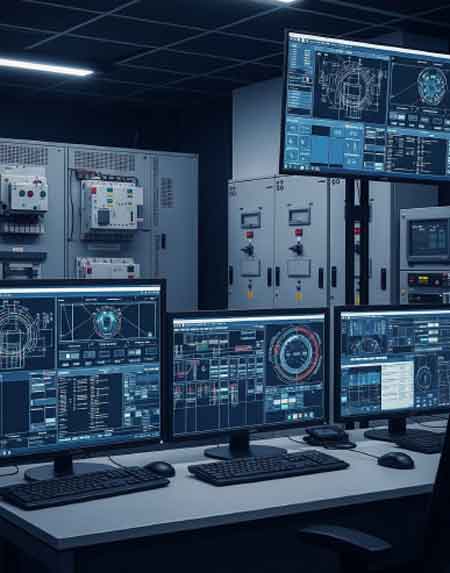

Automation in cybersecurity enables utilities to execute OT device response actions automatically using SIEM and SOAR integration, improving substation security, configuration control, and credential management across multi vendor environments while reducing response time and operational risk.
Automation in cybersecurity is the process of automatically executing security actions across OT devices once a threat is detected, enabling utilities to move from detection to containment without manual coordination between IT and OT teams.
In most utilities, cybersecurity detection happens in the SOC, but execution happens in substations. That separation creates a delay. The SOC can detect a compromised credential, but it cannot directly terminate sessions on protection relays or rotate passwords across device fleets.
The result is a response gap. Detection occurs in seconds, but action depends on human escalation across teams with different tools, priorities, and system knowledge. The longer that gap exists, the greater the risk to grid operations.
Automation in cybersecurity within substations depends on bridging IT systems that detect threats with OT systems that control devices. The presentation shows that IT security tools cannot directly interact with relays, RTUs, or controllers because they lack protocol support and operational context.
A normalization and execution layer is required to translate enterprise security events into device level actions. This layer communicates using native OT protocols such as DNP3, IEC 61850, and Modbus while exposing standardized APIs to enterprise tools.
The control flow follows a defined sequence. An event is detected in the SOC and correlated in the SIEM. A SOAR playbook evaluates the condition and determines the response. That response is executed through the integration layer, which communicates directly with substation devices using native protocols.
Download our FREE Electrical Training Catalog and explore a full range of expert-led electrical training courses.

This sequence eliminates the need for manual coordination between IT analysts and OT engineers during an incident.
When a compromised credential is detected, the SOC triggers a response workflow. The system automatically identifies affected devices, terminates active sessions, rotates credentials, and collects forensic logs.
This flow replaces a manual process that previously required multiple teams and hours of coordination. According to the presentation, actions that once took hours can now be completed in seconds.
A typical execution chain begins with SIEM detection, followed by SOAR orchestration, then device level execution through the integration platform. The result is a direct link from the SOC console to the substation equipment.
Substations contain devices from dozens of manufacturers, each using different communication protocols and configuration models. A SOC cannot integrate with each vendor individually.
Automation in cybersecurity depends on abstracting these differences through a normalization layer that converts vendor specific data into standardized events and commands. This allows a single response action to be applied consistently across a diverse device fleet.
Without this abstraction, automation cannot scale beyond a limited set of devices.
OT environments prioritize availability over security actions. Taking a device offline to contain a threat may interrupt protection schemes or grid operations.
This creates a deployment constraint. Security actions must be executed without introducing unintended operational impact. For example, isolating a device during a critical load condition may increase system risk rather than reduce it.
The presentation highlights that IT security models cannot be applied directly to OT because downtime has direct reliability consequences.
This constraint requires automation logic to incorporate operational awareness, not just security triggers.
Unauthorized configuration changes can lead to outages or unsafe operating conditions. Automation enables detection and rollback of these changes.
A baseline configuration is stored for each device. When a deviation is detected, the system can restore the previous configuration in under 90 seconds.
The tradeoff is that rollback must be carefully controlled. Reverting settings during active system conditions may conflict with legitimate operational changes.
Substation environments often contain thousands of devices with local accounts. Manual password rotation is slow and leads to shared credentials and dormant accounts.
Automation enables centralized credential management, just in time access, and automatic expiration of permissions. The presentation shows that password rotation across large device fleets can be reduced from weeks to minutes, resulting in over 90 percent time savings.
This reduces the risk of unauthorized access while maintaining operational access for field work.
A deeper implementation of device level control can be explored in SADM, which focuses on secure device management systems.
Not every anomaly represents a cyber event. A relay trip may indicate a fault, while repeated failed logins may indicate an attack.
Automation systems must distinguish between operational events and security events to avoid incorrect responses. For example, isolating a device due to a misinterpreted operational event could disrupt grid reliability.
The presentation shows that context is required to classify events correctly, such as differentiating between a single failed login and repeated attempts.
Automation in cybersecurity relies on integrating OT data into enterprise security platforms. Device logs, configuration changes, and access events are normalized and forwarded to the SIEM.
Think you know Grid Cybersecurity & Protection? Take our quick, interactive quiz and test your knowledge in minutes.
SOAR platforms then execute predefined playbooks that trigger actions such as credential rotation, session termination, or device isolation.
This integration enables the SOC to move from passive monitoring to active control of OT environments.
The role of detection and analysis is covered in cybersecurity analysis, which feeds the automation layer.
The architecture must support both connected and air gapped environments. Substation level components must operate autonomously when network connectivity is limited.
This introduces a tradeoff between centralized control and local autonomy. Fully centralized systems provide visibility but may fail in disconnected environments. Distributed execution provides resilience but increases system complexity.
Automation systems must balance these constraints to ensure reliable operation across the grid.
Utilities implementing broader cybersecurity programs can align this layer with cybersecurity for utilities, which defines the overall strategy.
If cybersecurity response in OT remains manual, containment speed is limited by human coordination rather than system capability.
In a threat scenario, delays between detection and action allow attackers to move laterally, modify configurations, or maintain persistent access.
Automation shifts response from human speed to machine speed, reducing exposure time and improving containment effectiveness.
This layer also supports domain specific applications such as DER cybersecurity, where distributed assets increase response complexity.
Advantages To Instructor-Led Training – Instructor-Led Course, Customized Training, Multiple Locations, Economical, CEU Credits, Course Discounts.
Request For QuotationWhether you would prefer Live Online or In-Person instruction, our electrical training courses can be tailored to meet your company's specific requirements and delivered to your employees in one location or at various locations.