Protection in Electrical System Architecture and Control
By Jose Ruiz, Doble
By Jose Ruiz, Doble
Our customized live online or in‑person group training can be delivered to your staff at your location.
Request for Quotation Service
Buyers Submit Free RFQs to top suppliers, no obligation.
Suppliers Browse real project RFQs directly from buyers.
Trust Electricity Forum 40 years connection buyers and suppliers.
Protection in electrical system refers to coordinated devices, relays, and control logic that detect faults, isolate damaged equipment, and maintain grid stability. Modern systems use digital relays, IEC 61850 communication, and centralized protection architectures.
Protection in electrical system refers to the coordinated application of sensing, communication, and decision logic to detect abnormal conditions and isolate affected equipment before damage propagates across the network.
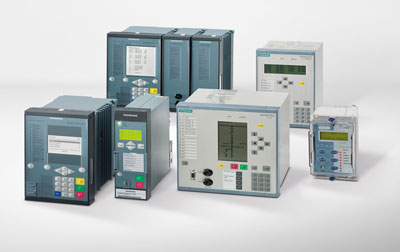
Traditional protection schemes were built around discrete devices such as fuses and electromechanical relays installed at each zone. Each device operated independently, using locally measured current and voltage to make trip decisions.
Modern protection shifts this model from device-level operation to system-level coordination. Protection is no longer defined only by individual relays but by how data, control logic, and switching devices operate together across the substation.
Protection in electrical system design must account for how detection, communication, and tripping functions interact across the entire electrical system rather than at a single device level.
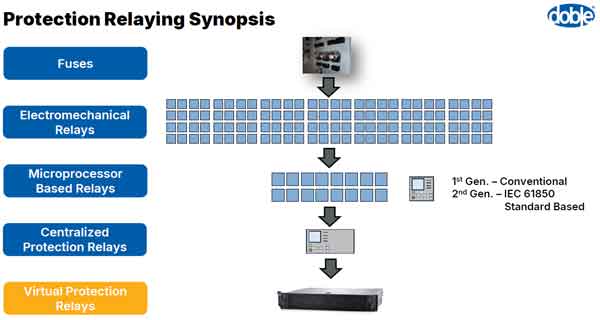
Protection systems evolved from simple fuses to electromechanical relays, then to microprocessor-based relays, and now toward centralized and virtualized architectures.
In early systems, protection logic was fixed within each device. Any change requires rewiring or hardware replacement. Microprocessor relays introduced programmable logic, allowing multiple functions within a single device, but the architecture remained distributed.
The current transition introduces centralized protection and control, in which decision-making is performed within a centralized system rather than across multiple devices. This shift is enabled by IEC 61850 communication, which replaces hardwired signals with digital data exchange.
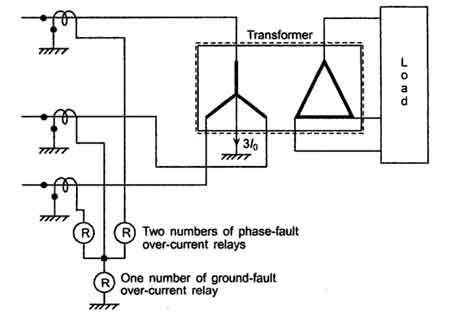
Modern protection systems must evaluate a wide range of fault conditions, including phase and ground faults, across different voltage levels and operating states. Measurement accuracy is critical, and systems rely on instrument transformers to provide scaled current and voltage signals that reflect actual system behavior, particularly in high-voltage environments where direct measurement is not feasible.
Stay informed with our FREE Electrical Protection Newsletter — get the latest news, breakthrough technologies, and expert insights, delivered straight to your inbox.
These inputs allow centralized logic to distinguish between normal load variations and abnormal conditions, ensuring that different types of functions respond correctly without unnecessary tripping or delayed fault isolation.
Modern protection systems collect current and voltage data via sensors or merging units and transmit it over a process bus to a centralized controller.
The controller evaluates system conditions using algorithms and determines whether a fault exists. If a fault is detected, it issues trip commands to circuit breakers to isolate the affected section.
This approach allows multiple protection functions, such as differential, distance, and overcurrent protection, to operate within a shared computational environment.
For foundational device-level operation, engineers reference What is Protective Relay to understand how measurement and tripping logic are implemented.
Centralized protection reduces the number of physical relays by consolidating protection, control, and measurement into a single system platform.
This architecture provides several operational advantages:
Reduced device count simplifies asset tracking and maintenance
Software-based logic allows rapid configuration changes
High processing capability improves accuracy
Fewer access points improve cybersecurity management
However, this design introduces system-level dependencies. A failure in the centralized platform can impact multiple protection functions, increasing the importance of redundancy and failover design.
Coordination between elements becomes more complex in centralized environments, requiring careful analysis as outlined in Relay and Circuit Breaker Coordination.
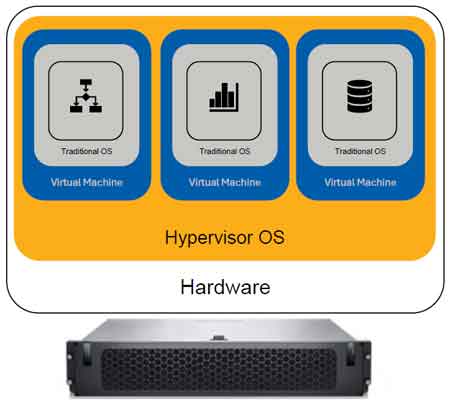
Virtualized protection systems extend centralization by decoupling functions from dedicated hardware. Protection applications run within virtual machines managed by a hypervisor.
This allows multiple functions to operate on shared computing infrastructure while remaining logically separate. Resources such as processing power and memory can be dynamically allocated based on system needs.
The key constraint is timing performance. Systems must operate within strict response windows, and virtualization layers must not introduce delays that compromise fault-clearing speed.
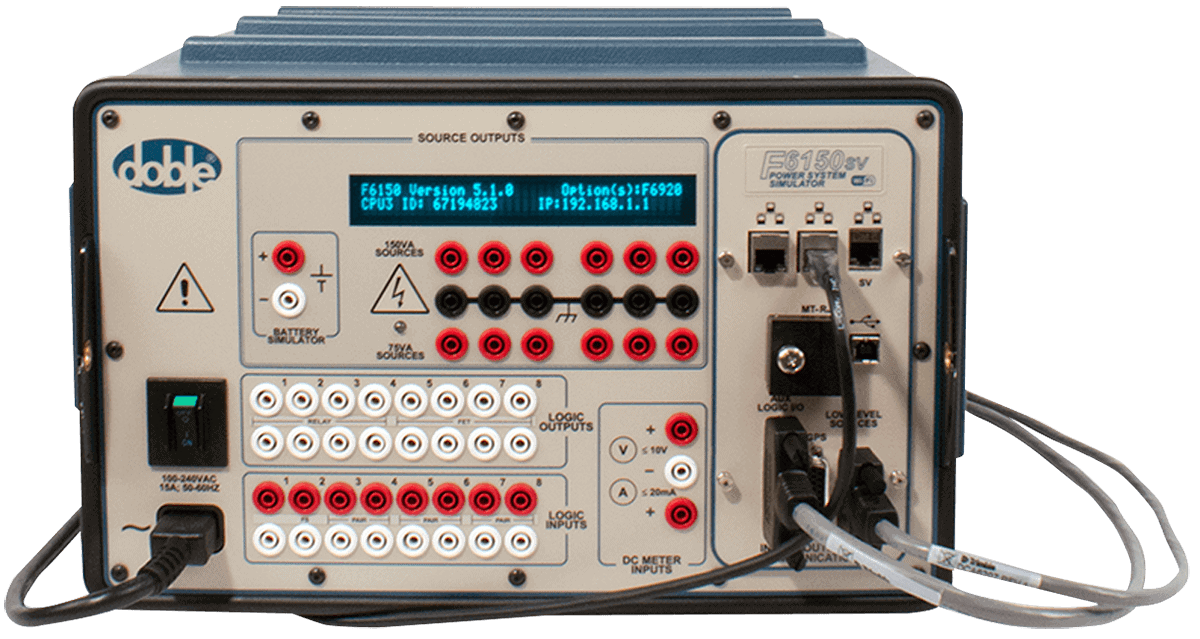
Testing must address both logic and computing infrastructure. Engineers rely on procedures such as those described in Protective Relay Testing to validate system performance.
Protection system design must balance several constraints:
Reliability and availability of protection functions
Maintainability of centralized systems
Scalability for system expansion
Interoperability between devices and communication standards
Testability of integrated systems
A key tradeoff exists between distributed and centralized protection. Distributed systems are easier to isolate during maintenance, while centralized systems offer flexibility and reduced hardware but require advanced system expertise.
An important edge case occurs when communication networks fail. In centralized architectures, loss of communication can limit visibility and disrupt coordination, necessitating backup protection strategies.
Accurate fault detection depends on system modeling and measurement integrity. Engineers assess this using concepts explained in Available Fault Current.
Protection decisions directly influence system reliability and equipment life. Delayed fault clearing increases thermal and mechanical stress, while incorrect settings can cause unnecessary trips and service interruptions.
Engineers must consider how protection interacts with load conditions, switching events, and distributed energy resources. These factors affect how logic interprets system behavior.
For system-wide strategies, Power System Protection provides additional context across transmission and distribution networks.
Final fault interruption depends on breaker performance, as detailed in "What is a Circuit Breaker"."
Protection in electrical system is not defined by individual devices but by how the entire electrical system responds to faults through coordinated sensing, communication, and control.

Explore 50+ live, expert-led electrical training courses –