Surge Protection for Electrical Panel: Why Placement Matters
By William Conklin, Associate Editor
By William Conklin, Associate Editor
Our customized live online or in‑person group training can be delivered to your staff at your location.
Request for Quotation Service
Buyers Submit Free RFQs to top suppliers, no obligation.
Suppliers Browse real project RFQs directly from buyers.
Trust Electricity Forum 40 years connection buyers and suppliers.
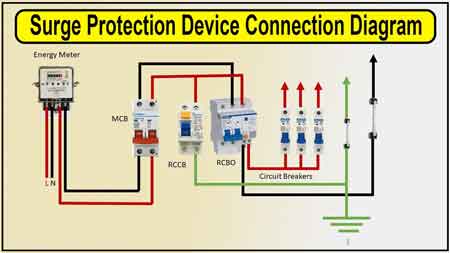
Surge protection for an electrical panel controls how transient voltages enter and spread through branch circuits inside the panel, limiting internal equipment damage when external or switching surges reach the distribution point, rather than assuming upstream protection is sufficient.
It is not about whether a surge device is installed, but whether it is positioned where surge energy actually enters and is redistributed within a system. Panels act as electrical crossroads. When surge protection is misunderstood as a general safeguard rather than a boundary control, sensitive branch circuits remain exposed even in buildings that appear “protected.” This is why surge damage is often misdiagnosed as a nuisance failure rather than an electrical fault design problem.
Most discussions of surge protection treat panels as mounting locations rather than as electrical environments. In practice, a panel is where incoming conductors, grounding paths, and downstream circuits converge. That convergence changes how transient energy behaves. A surge that passes upstream fault control does not dissipate harmlessly; it refracts through bus structures, breaker stabs, and parallel branch paths.
This is why facilities sometimes experience repeated electronic failures despite having surge protection elsewhere. The device exists, but the boundary it is meant to control has shifted. Panel-level fault control exists to manage that internal redistribution, not to replace upstream devices or downstream equipment fault control.
An electrical panel is not an electrically neutral territory. It is a junction where impedance changes abruptly, where grounding and bonding paths intersect, and where multiple circuits share a common reference. When transient voltage enters this space, it does not travel neatly down a single conductor.

Panel-level surge protection is intended to clamp voltage at this boundary, limiting how far a transient propagates into branch circuits. Without it, surges can appear simultaneously across multiple breakers, stressing devices that were never directly “hit” by an external event. This is why panel protection must be evaluated differently from general electrical surge protection concepts, which are addressed more broadly in your electrical surge protection overview.
A common assumption is that service-level or utility-side fault control eliminates the need for panel-level control. In reality, upstream devices are optimized for large events and grid-side exposure. They do not account for how transient energy redistributes once it crosses into a building’s internal topology.
Panels introduce short conductor lengths, parallel paths, and equipment proximity that amplify coupling effects. This is especially relevant in systems with modern electronics, variable loads, or dense breaker arrangements. Understanding how fault and surge energy behave once they enter the premises also ties into concepts such as available fault current, which influences how stresses manifest inside protective equipment.
Another frequent error is treating panel surge protection as a substitute for point-of-use protection. Panel-level devices reduce surge magnitude, but they do not eliminate residual energy or internal coupling effects. Sensitive equipment connected through long branch circuits can still experience damaging transients, particularly when grounding references shift during a surge event.
This distinction mirrors misunderstandings seen in other fault control domains, where the presence of a protective element is assumed to guarantee coverage. The same logic flaw appears in discussions around circuit protection devices, where devices are evaluated in isolation rather than as part of a coordinated protective scheme.
Not all panels behave the same way during transient events. Distribution panels feeding diverse loads experience different stress patterns than panels dedicated to specific systems. Long feeder conductors, shared neutrals, and mixed grounding references all influence how surge energy couples across circuits.
This is one reason surge strategies for specialized applications diverge sharply from general panel protection. Elevator systems, for example, introduce long vertical conductors and control electronics that alter surge dynamics entirely, which is why they are treated separately in your surge protection device analysis for elevators.
Surge protection at the panel cannot be evaluated independently of how other protective elements behave during abnormal conditions. Breakers, bonding paths, and protective devices all react differently under transient stress. When these reactions are uncoordinated, surge energy can be diverted into unintended paths, sometimes causing nuisance trips or latent damage rather than immediate failure.
This coordination challenge is conceptually related to issues explored in relay and circuit breaker coordination, even though surge protection operates on different timescales. The underlying risk remains the same: fault control elements acting independently rather than as a coherent boundary.
Failures are rarely dramatic. More often, they appear as intermittent control issues, unexplained equipment resets, or premature electronic degradation. Facilities then chase symptoms—replacing breakers, testing circuits, or blaming equipment—without revisiting the assumption that the panel itself was properly protected.
Understanding what constitutes an electrical disturbance versus a true fault also matters here, particularly when diagnosing repeated issues that do not align with overload or short-circuit behavior. That distinction is explored in what is an electrical fault, which helps clarify why surge-related problems are often misclassified.
The real question is not “Is there a surge device in the panel?” but “Is the panel acting as a controlled boundary during transient events?” Answering that requires stepping back from device presence to examine system behavior, grounding references, and how energy enters and redistributes within the panel.
Download our FREE Electrical Training Catalog and explore a full range of expert-led electrical training courses.

This decision-oriented framing aligns with the broader intent of your electrical protection framework, which emphasizes outcomes and consequences over component checklists.
Explore 50+ live, expert-led electrical training courses –