Autonomous Utility Networks for Deterministic Grid Operations
By Kenneth Rabedeau, DMTS, Head of Energy Segment, Nokia
By Kenneth Rabedeau, DMTS, Head of Energy Segment, Nokia
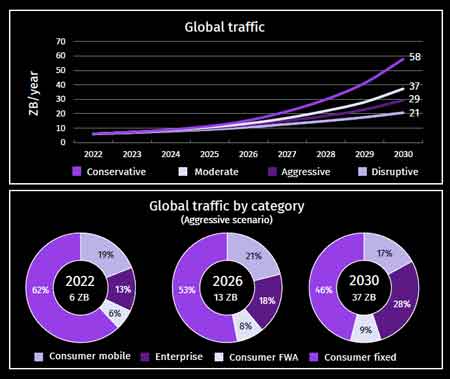

Autonomous Utility Networks preserve deterministic grid control by synchronizing SCADA telemetry, AI inferencing, utility WAN architecture, and DER cybersecurity to prevent latency drift, switching misoperation, and cascading operational instability under high traffic growth.
Autonomous Utility Networks define whether automated grid control remains deterministic when traffic growth, distributed AI workloads, and cyber exposure compress operational decision windows beyond human reaction time. The engineering decision is not whether to automate. The question is whether deterministic authority survives the scale of automation.
Traffic projections toward 2173 exabytes per month and sustained 20 percent WAN growth introduce timing pressure that traditional supervisory architectures were not designed to absorb. As latency compresses toward 1 to 10 milliseconds in edge inference models, state validation must occur inside bounded windows or switching logic becomes probabilistic.
In transmission and distribution environments saturated with distributed energy and inverter based flows, deterministic behavior depends on synchronized telemetry, authenticated communications, and threshold governance that prevents automation drift. Autonomous Utility Networks establish those boundaries.
Autonomous Utility Networks begin with time discipline. Every remote terminal unit, intelligent electronic device, and edge analytics node must operate under synchronized clock governance. If drift exceeds tolerance, breaker state reconstruction can misalign with physical topology within seconds.
The cascading consequence is measurable. A feeder fault during high DER backfeed conditions can trigger automated isolation based on stale topology data. The first switch misoperates. The second switch escalates load transfer. Voltage excursions propagate. What began as a contained disturbance becomes a regional restoration event.
This is why deterministic transport design, described in Utility WAN Architecture, is foundational. Redundancy without bounded arbitration introduces nondeterministic routing. Segmentation without latency governance introduces asymmetric delay. Deterministic autonomy requires both.
Think you know Grid Data Foundations & AI Infrastructure? Take our quick, interactive quiz and test your knowledge in minutes.
AI inferencing at the grid edge reduces job completion time and WAN bandwidth consumption, but it introduces a deployment tradeoff. Moving analytics closer to substations reduces latency, but it also multiplies edge attack surfaces and increases firmware governance complexity.
The Nokia projections show reliability expectations evolving toward 99.9999 percent availability and bounded latency of 1 to 10 milliseconds. Deterministic OT control must therefore sustain event processing at several times nominal telemetry during fault storms without packet loss or sequencing corruption.
If WAN utilization spikes during AI-assisted restoration, congestion can delay protection acknowledgments beyond safe tolerance. Deterministic automation then becomes conditional automation.
Governance alignment with Cybersecurity For Utilities becomes a timing discipline issue rather than a compliance issue. Encryption and inspection layers must not introduce unpredictable latency variance.
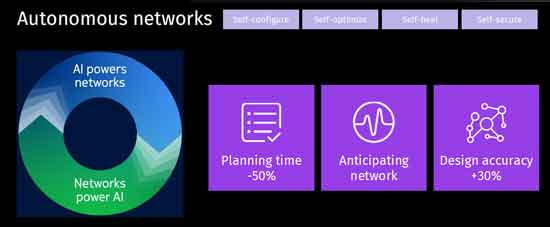
The TM Forum autonomy ladder defines progression from manual operations to full autonomous operations. Utility networks will not leap from L1 assisted operations to L5 full autonomy without passing through conditional autonomy, where human oversight remains critical.
A deployment constraint emerges here. Fully autonomous switching authority in a distribution grid with high inverter penetration can exceed model confidence if DER telemetry is delayed or distorted. The system may meet performance metrics under normal load yet fail under voltage oscillation events.
Edge case example: AI inferencing at the metro edge correctly anticipates load shift but misclassifies an abnormal harmonic injection as routine variation. Automated voltage regulation proceeds. Capacitor banks engage out of sequence. Harmonic resonance escalates.
Integration with DER Cybersecurity is therefore not optional. Endpoint validation must precede automation execution.
Autonomous Utility Networks must define explicit degradation thresholds. Acceptable latency variance, packet loss tolerance, and topology confidence margins must be codified. If exceeded, the automation authority must gracefully degrade rather than proceed silently.
Model uncertainty grows as AI workloads distribute across metro core, metro edge, and on premises environments. Projected traffic distribution shifts for 2033 show a significant migration toward edge nodes. Each additional inference node introduces clock discipline and synchronization risk.
Alignment with SCADA Cybersecurity ensures that telemetry validation precedes control execution. Deterministic control depends on knowing not only what the system reports, but whether the reporting path remained uncompromised.
One sentence increases decision gravity: If deterministic boundaries are not explicitly engineered, autonomy will scale faster than operational accountability.
Autonomous Utility Networks are not defined by self configuration or self healing features. They are defined by whether automation preserves bounded behavior under traffic growth, power constraints, and AI-driven inferencing expansion.
The quantified signal is clear. With AI bandwidth growth approaching 100 percent in certain segments and data center power demand projected to increase 2.6 times, communication networks must absorb exponential stress without compromising switching determinism.
This requires architecture discipline across WAN transport, SCADA timing, DER validation, and cyber inspection layers. It requires measurable latency ceilings. It requires event processing capacity multiples during disturbance events.
The engineering decision is singular. Either autonomy is bounded by deterministic thresholds and synchronized telemetry, or it becomes probabilistic control masked by AI acceleration.
Autonomous Utility Networks serve as the structural mechanism for preserving deterministic operations at AI scale. Their success is not measured by the percentage of automation. It is measured by whether switching authority remains predictable when the grid is least stable.
Download our FREE Electrical Training Catalog and explore a full range of expert-led electrical training courses.

Advantages To Instructor-Led Training – Instructor-Led Course, Customized Training, Multiple Locations, Economical, CEU Credits, Course Discounts.
Request For QuotationWhether you would prefer Live Online or In-Person instruction, our electrical training courses can be tailored to meet your company's specific requirements and delivered to your employees in one location or at various locations.