Grid Reliability In Electric Power System Performance
By Yuhsin Hawig, Ph.D., Vice President, Southwire
By Yuhsin Hawig, Ph.D., Vice President, Southwire
Grid reliability ensures the stable operation of power systems by maintaining a continuous electricity supply, voltage control, and frequency balance across transmission and distribution networks under normal conditions and disturbances, such as faults, equipment failures, and load variations.
Grid reliability is the ability of an interconnected electric power system to deliver continuous electrical energy while maintaining system stability, acceptable voltage levels, and frequency balance during normal conditions and credible disturbances.
It applies across generation, transmission, and distribution systems operating as a synchronized network. Reliability is defined by whether the system remains stable and controllable under stress, not just whether power is delivered at a specific location.
At this level, reliability is a system property. It reflects coordinated performance across infrastructure, protection systems, and operating limits rather than isolated equipment behavior.
Bulk system reliability refers to the performance of the transmission network and generation resources that maintain system balance and stability across large geographic regions.
Distribution reliability refers to the performance of local delivery systems that serve customers. Failures at this level often result in outages without indicating instability in the bulk system.
This distinction explains why customers may lose power even when the broader system remains stable. For service-level performance, see Utility Reliability, which focuses on outage frequency and restoration rather than system-wide stability.
System stability is the ability of the grid to remain synchronized and return to steady-state operation following a disturbance. This includes voltage control, frequency response, and transient behavior.
Service continuity refers to whether customers experience an uninterrupted supply. Protection systems often isolate faults to preserve stability, thereby interrupting service locally while maintaining overall system integrity.
Stay informed with our FREE Storm, Risk & Grid Resilience Newsletter — get the latest news, breakthrough technologies, and expert insights, delivered straight to your inbox.
This relationship is quantified through Electric Utility Reliability Metrics, which measure outage performance rather than system stability.
Grid reliability is governed by planning and operational standards that define acceptable system performance under contingency conditions. These standards require the system to remain stable following defined failure events.
Operators maintain reliability by preserving a margin between actual system conditions and operational limits such as thermal loading and voltage thresholds. These margins allow the system to absorb disturbances without cascading failures.
Operational coordination is supported by systems such as Outage Management System, which improve visibility and restoration response but do not determine system reliability itself.
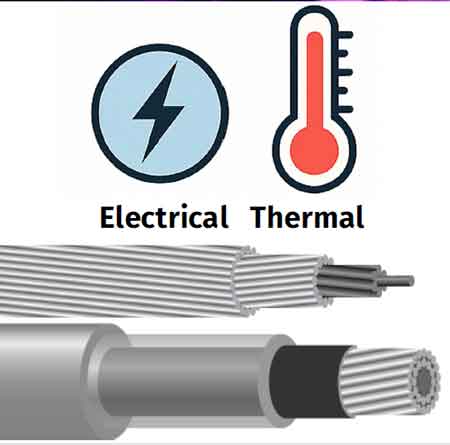
Grid reliability is not determined only by system balance and contingency response. It is also driven by how physical components behave under electrical, thermal, and mechanical stress.
Conductor design directly affects fault probability. Covered conductors reduce unintended phase contact and limit interaction with vegetation. This lowers the likelihood of arcing faults and prevents disturbances that would otherwise initiate outages or cascade into larger system events.
Insulation performance determines how well cables and conductors withstand environmental exposure and electrical stress. Upgraded insulation systems reduce degradation from heat, moisture, and contamination, thereby lowering failure rates and improving long-term system continuity.
Thermal limits define how much current a conductor or cable can carry before performance degrades. When thermal capacity is exceeded, conductor sag increases and clearances are reduced, raising the risk of contact faults. Maintaining thermal margin is therefore a direct reliability control, not just an operational constraint.
Mechanical durability influences how infrastructure responds to wind, vibration, and external forces. Stronger materials and improved construction reduce damage from physical stress, thereby lowering outage frequency and preventing fault initiation under adverse conditions.
These factors operate together. A conductor operating near its thermal limit may experience increased sag, which raises the probability of contact with vegetation. If insulation is degraded or absent, that contact can cause a fault that propagates into a broader disturbance. Reliability at the system level is therefore directly tied to the physical condition and design of the underlying infrastructure.
Grid reliability depends on more than electrical balance. It is influenced by thermal limits, mechanical conditions, material properties, and environmental exposure. The presentation emphasizes that reliability spans the electrical, thermal, mechanical, and physical domains.
For example, conductor temperature limits determine allowable loading, while mechanical factors such as sag and tension affect clearance and fault risk. Insulation quality influences resistance to environmental stress and the probability of failure.
Infrastructure improvements, such as covered conductors, reduce the occurrence of faults caused by vegetation contact and phase interaction. These physical changes reduce the likelihood of disturbances and directly improve system reliability.
Environmental exposure is further addressed in Wildfire Risk Reduction, where fault prevention becomes critical in high-risk operating conditions.
A common grid reliability failure begins with a heavily loaded transmission line tripping due to a fault or protection action. Power flow is redistributed to adjacent lines, increasing their loading and thermal stress.
If these lines approach their limits, additional trips may occur to prevent equipment damage. This creates a cascade in which each outage increases system stress, potentially leading to voltage collapse or frequency instability.
System performance under these conditions depends on design margins and redundancy, which are core aspects of Grid Resiliency when considering system flexibility.
Think you know Storm, Risk & Grid Resilience? Take our quick, interactive quiz and test your knowledge in minutes.
Transmission constraints are a major limitation on grid reliability. As demand grows and generation sources shift, the ability to transfer power between regions becomes restricted.
Limited transfer capability reduces system flexibility and increases the impact of disturbances. In constrained systems, even minor events can have broader effects because there is insufficient capacity to redistribute power.
These limitations are closely tied to long-term planning decisions discussed in Power Grid Resilience, where system adaptation strategies are evaluated.
Grid reliability improves with redundancy in transmission paths, transformers, and protection systems. Additional pathways allow power to reroute during disturbances, reducing the risk of cascading outages.
However, redundancy increases cost and system complexity. Engineers must balance reliability targets against economic constraints, ensuring sufficient margin without excessive overbuilding.
In high-risk environments, this balance extends to infrastructure decisions such as conductor selection and system hardening, which are formalized in Utility Wildfire Mitigation Plans.
A standard planning requirement is that the system withstand the loss of a single major component without widespread impact. This is commonly referred to as an N-1 contingency condition.
When transmission lines operate above 85 percent of thermal capacity, available margin is reduced. Under these conditions, a single contingency can push remaining elements beyond limits, increasing the probability of cascading outages.
When grid reliability is insufficient, disturbances propagate rather than being contained. This allows localized faults to escalate into large-scale outages, increases restoration complexity, and can result in system instability beyond operator control.
Explore 50+ live, expert-led electrical training courses –