Outage Management System for Utility Outage Detection
By Bryan Ferguson, President, Habersham EMC
By Bryan Ferguson, President, Habersham EMC
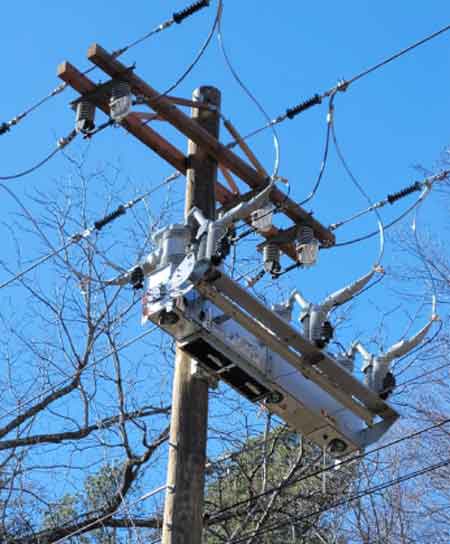

An outage management system detects outages, predicts fault location, and coordinates restoration using SCADA, GIS, AMI, and CIS data to reduce outage duration, improve crew dispatch, and maintain grid reliability during fault events.
An outage management system is a utility control platform that detects outages, predicts fault location, and coordinates restoration using real time integration of SCADA, GIS, AMI, and customer information systems.
In a control room environment, OMS converts incomplete and often conflicting data into a working model of the distribution system state. It does not operate field devices. It determines where the outage is, how many customers are affected, and what actions are required to restore service.
Operators depend on OMS to make decisions before full information is available. Dispatch decisions are often made before fault-location confidence is fully validated, as waiting increases outage duration and customer impact.
Without OMS, outage response becomes reactive and fragmented, leading to delayed restoration and inefficient crew deployment.
OMS identifies outages by correlating multiple data sources that rarely agree in real time. SCADA indicates upstream device operations, AMI meters provide outage signals with varying latency, and customer calls confirm service loss after the fact.
The system uses network topology to estimate fault location, but accuracy depends on signal completeness. When telemetry gaps occur, fault prediction error increases rapidly rather than gradually, meaning small data loss can produce large location errors.
In heavily vegetated systems, where external contact events dominate outage causes, distinguishing between temporary disturbances and sustained faults becomes more difficult. Incorrect clustering of outage signals can shift the predicted fault location to the wrong segment.
Download our FREE Electrical Training Catalog and explore a full range of expert-led electrical training courses.

This directly impacts Grid reliability, because even correct switching actions cannot compensate for incorrect fault identification.
OMS tracks system state changes during restoration, but does not perform switching. It interprets switching outcomes and determines what portions of the system remain out of service.
During a sectionalizing event, automated devices may isolate the fault and restore service to large portions of the feeder within seconds. OMS must recognize these changes and update the outage model to prevent unnecessary dispatch.
In one operational scenario, proper sectionalizing reduced the number of affected customers from over 300 to approximately 135 and shortened outage duration by nearly half. OMS visibility is required to translate that switching action into accurate restoration decisions.
A cascading failure condition occurs when OMS does not correctly interpret the switching status. If restored sections are still marked as out of service, crews may be dispatched to the wrong location while the actual fault remains unresolved.
This coordination layer supports system performance expectations tied to Utility reliability.
OMS operation requires a continuous tradeoff between rapid response and correct decision making.
Early fault prediction allows faster dispatch but increases the probability of sending crews to the wrong location. Delayed validation improves accuracy but extends outage duration.
Operators must choose between acting on incomplete data or waiting for confirmation. This tradeoff becomes critical during major events when system visibility degrades and the cost of delay increases.
The outcome of this decision is reflected in Electric utility reliability metrics, which measure both outage duration and restoration efficiency.
OMS performance is constrained by the systems it depends on. Incomplete GIS models, missing connectivity data, and inconsistent device mapping reduce the accuracy of fault prediction.
AMI systems introduce additional limitations. Meter signals may be delayed, grouped, or lost entirely, forcing OMS to rely on partial visibility of the network.
Integration between SCADA, GIS, AMI, and CIS must be synchronized. When these systems are misaligned, OMS operates on conflicting data, reducing confidence in outage detection and restoration planning.
These constraints become more significant in environments focused on Power grid resilience, where outage response must scale during widespread disruptions.
A critical edge case occurs when a communication failure is interpreted as an outage event.
If AMI meters stop reporting due to network issues rather than electrical faults, OMS may identify a large outage that does not exist. This can trigger unnecessary dispatch and distort operational awareness.
This failure mode is difficult to detect because the system appears to function correctly while operating on incorrect data inputs.
In wildfire-prone systems, this misinterpretation can delay response to actual fault conditions, affecting Wildfire risk reduction strategies.
OMS directly affects outage duration, customer impact, and restoration efficiency.
Accurate fault prediction reduces unnecessary crew movement and lowers operational costs by eliminating redundant field verification. It also shortens restoration time by directing crews to the correct location on the first dispatch.
Utilities that integrate OMS into coordinated outage response strategies improve performance across system recovery functions associated with Grid resiliency.
OMS also supports planning and response coordination used in Utility wildfire mitigation plans, where outage detection and response speed influence risk exposure.
Think you know Storm, Risk & Grid Resilience? Take our quick, interactive quiz and test your knowledge in minutes.
Explore 50+ live, expert-led electrical training courses –