Comment: Alberta's Electricity Woes Continue

By Edmonton Journal


High Voltage Maintenance Training Online

Our customized live online or in‑person group training can be delivered to your staff at your location.

  • Live Online
  • 12 hours Instructor-led
  • Group Training Available
Regular Price:
$599
Coupon Price:
$499
Reserve Your Seat Today
Watching the Alberta government twitch and jerk through the shocks of electricity deregulation, I'm reminded of Ernest Hemingway's definition of courage as grace under pressure.

There's certainly plenty of pressure on the government. Klein must feel like a deep-sea diver some days. But he and his colleagues are showing as much grace as a herd of three-legged elephants.

Premier Klein, who's usually as deft on his feet as a young Muhammad Ali, looks a little punch drunk.

During question period on Monday, Klein's response to Liberal leader Ken Nicol was spectacularly nonsensical.

Nicol wanted to know "how many more key decisions about electricity deregulation will be made behind closed doors ...?" It was a typical rhetorical question, one designed to make a point about how this government routinely makes crucial decisions on public policy without public debate.

It was particularly apt in light of Energy Minister Murray Smith's recent declaration that consumers will pay the whole cost of building new transmission lines. It was a U-turn from the original plan approved by the Alberta Energy and Utilities Board to have the costs shared equally between consumers and generating companies.

It was a classic behind-closed-door government decision, one that called into question the relevancy and authority of the AEUB.

Klein's answer to Nicol?

"I would remind the honourable leader that his caucus meets behind closed doors," said Klein. "They strategize with their constituents behind closed doors."

It's pretzel logic. How can he compare the opposition to the government? The Liberals are seven powerless MLAs meeting privately to plot pea-shooting attacks against a Kevlar government. The Liberals could meet to pass motions killing deregulation, sending out rebate checks and firing Murray Smith. They might as well pass a motion to outlaw the West Nile virus. It doesn't matter.

What the massive 74-member Conservatives' caucus does behind closed doors, does. They are debating the laws and direction of the province. After 32 years of Conservative government, the caucus tends to make the big decisions behind closed doors and treat the legislative process as a rubber stamp.

Albertans don't mind, as long as the government seems to be managing things well. On deregulation and transmission-line costs, it's not. Consumers hit with rising bills -- particularly those in rural areas served by Epcor/Aquila -- are angry and are complaining loudly to their government MLAs. There's a strong argument to be made that problems with deregulation are much more a rural issue than urban.

However, skepticism seems widespread. Klein reinforced the public's uncertainty by ordering a probe into power bills, rather than a full-fledged investigation of deregulation itself.

A Journal "Straw Poll" -- not scientific but interesting -- indicated almost 82 per cent of the public sees the probe as a "tactic to deflect criticism of deregulation."

Opposition politicians see it as another time-gobbler for the government, an attempt to put off real debate on the merits of deregulation until the next election when Klein will perhaps issue rebates (if they're needed), or find some other ways to buy our acquiescence. Instead of looking at voters as partners with a voice, we're treated as courtesans every four years or so.

Patience is wearing thin among consumers. They're demanding answers. So far, they're not getting them. Smith is trying. The problem is that deregulation is so complicated, Smith can't answer in 10-second sound bites. Or, for that matter, in 60-second sound bites.

The Conservatives have set up a system that could indeed work for everyone everywhere. But we still don't know at what cost. Or how long it will take. Or how much tinkering it will take. Some consumers who expected "rate riders" to come off their bills at the end of this year are now being told the extra cost won't come off until the end of 2004.

It's not just deregulation. There's the matter of consumers paying for new transmission lines. That'll cost about $1.5 billion. It might be spread over 20 years, or seven. That's going to make a big difference on your power bill.

The Liberals and New Democrats have finally found a bit of a soft spot in the government's armour. It's about time. The government, though, complains the opposition questions are loaded, unfair and warped. No more than some of the government answers, I'd have to say.

His answers in question period regularly point out he has 74 seats, while the opposition has only nine. It's a petty response. What he forgets is that he didn't win 90 per cent of the vote. More than one-third of Albertans did not vote for his government.

On deregulation the government doesn't have the answers, or is having trouble articulating them. The same with the newest issue of teacher layoffs being blamed on government underfunding. Klein says he's doing his best, but under pressure he gets worked up. In question period on Tuesday, he demanded the Liberals "open up your ears and listen" and told them to "go back to elementary school."

Speaker Ken Kowalski reminded Klein there were students in the public gallery and asked for "a greater attempt at decorum." In other words, some grace under pressure.

Related News
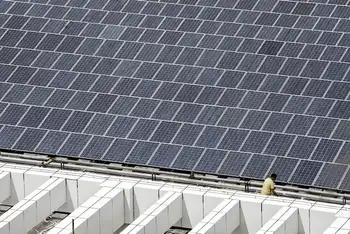
Berlin urged to remove barriers to PV

Germany Solar Cap Removal would accelerate photovoltaics, storage, and renewables, replacing coal and nuclear during phaseout with 10GW per year toward 162GW by 2030, boosting grid resilience, O&M jobs, and domestic clean energy growth.


Key Points

A policy change to scrap the 52GW limit, enabling 10GW/year PV and storage to replace coal and nuclear capacity.

✅ Scrap 52GW cap to prevent post-2020 market slump

✅ Add 10GW PV annually; scale residential, commercial, grid storage

✅ Create jobs in planning, installation, and O&M through 2030


The German Solar Association (BSW) has called on the government to remove barriers to the development of new solar power capacity in Germany and storage capacity needed to replace coal and nuclear generation that is being phased out.

A 52GW cap should be scrapped, otherwise there is a risk that a market slump will occur in the solar industry after 2020, BSW said, especially as U.S. solar expansion plans signal accelerating global demand.

BSW managing director Carsten Körnig said: “Time is running out, and further delays are irresponsible. The 52GW mark will already be reached within a few months.”
A new report from BSW, in cooperation with Bonn-based marketing and social research company EuPD Research and The smarter E Europe initiative, said 10GW a year is needed as well as an increase in battery storage capacity.

This would lead to cumulative photovoltaic capacity of 162GW and 15GW residential, commercial and grid storage systems by 2030, in line with global renewable records being set, leading to new job opportunities.

The number of jobs in the domestic photovoltaic and storage industries could increase to 78,000 by the end of the next decade from today’s level of 26,400, aligning with forecasts of wind and solar reaching 50% by mid-century, said 'The Energy Transition in the Context of the Nuclear and Coal Phaseout – Perspectives in the Electricity Market to 2040' study.

Job growth would take place for the most part in the fields of planning, installation and operations and maintenance of PV systems, as solar uptake in Poland increases, the report said.

In maintenance alone, employment would increase from 9,200 to 26,000, with additional opened up by tapping into the market potential of medium- to long-term storage systems, alongside changing electricity prices in Northern Europe that favor flexibility, it said.

The report added that industry revenue could grow from €5bn to €12.5bn in the coming decade.

The report was supported by BayWa Re E3/DC, Fronius, Goldbeck Solar, IBC Solar, Panasonic, Sharp, Siemens, Sonnen, Suntech, Tesvolt and Varta.


Related News

View more

After Quakes, Puerto Rico's Electricity Is Back On For Most, But Uncertainty Remains

Puerto Rico Earthquakes continue as a seismic swarm with aftershocks, landslides near Pef1uelas, damage in Ponce and Guayanilla, grid outages from Costa Sur Plant, PREPA recovery, vulnerable buildings post-Hurricane Maria raising safety concerns.


Key Points

Recurring seismic events impacting Puerto Rico, causing damage, aftershocks, outages, and displacement.

✅ Seismic swarm with 6.4 and 5.9 magnitude quakes and ongoing aftershocks

✅ Costa Sur Plant offline; PREPA urges conservation amid grid repairs

✅ Older, code-deficient buildings and landslides raise safety risks


Some in Puerto Rico are beginning to fear the ground will never stop shaking. The island has been pummeled by hundreds of earthquakes in recent weeks, including the recent 5.9 magnitude temblor, where there were reports of landslides in the town of Peñuelas along the southern coast, rattling residents already on edge from the massive 6.4 magnitude quake, and raising wider concerns about climate risks to the grid in disaster-prone regions.

That was the largest to strike the island in more than a century causing hundreds of structures to crumble, forcing thousands from their homes and leaving millions without power, a scenario echoed by Texas power outages during winter storms too. One person was killed and several others injured.

Utility says 99% of customers have electricity

Puerto Rico's public utility, PREPA, tweeted some welcome news Monday: that nearly all of the homes and businesses it serves have had electric power restored. Still it is urging customers to conserve energy amid utility supply-chain shortages that can slow critical repairs.

Reporting from the port city of Ponce, NPR's Adrian Florido said the Costa Sur Plant, which produces more than 40% of Puerto Rico's electricity, was badly damaged in last week's quake. It remains offline indefinitely, even as grid operators elsewhere have faced California blackout warnings during extreme heat.

He also reports many residents are still reeling from the devastation caused by Hurricane Maria, a deadly Category 4 storm that battered the island in September 2017. The storm exposed the fact that buildings across the island were not up to code, similar to how aging systems have contributed to PG&E power line fires in California. The series of earthquakes are only amplifying fears that structures have been further weakened.

"People aren't coping terribly well," Florido said on NPR's Morning Edition Monday, noting that households elsewhere have endured pandemic power shutoffs and burdensome bills.

Many earthquake victims sleeping outdoors

Florido spoke to one displaced resident, Leticia Espada, who said more than 50 homes in her town of Guayanilla, about an hour drive east of the port city of Ponce, had collapsed.

After sleeping outside for days on her patio following Tuesday's quake, she eventually came to her town's baseball stadium where she's been sleeping on one of hundreds of government-issued cots.

She's like so many others sleeping in open-air shelters, many unwilling to go back to their homes until they've been deemed safe, while even far from disaster zones, brief events like a Northeast D.C. outage show how fragile service can be.

"Thousands of people across several towns sleeping in tents or under tarps, or out in the open, protected by nothing but the shade of a tree with no sense of when these quakes are going to stop," Florido reports.


Related News

View more

Severe heat: 5 electricity blackout risks facing the entire U.S., not just Texas

Texas power grid highlights ERCOT reliability strains from extreme heat, climate change, and low wind, as natural gas and renewables balance tight capacity amid EV charging growth, heat pumps, and blackout risk across the U.S.


Key Points

Texas power grid is ERCOT-run and isolated, balancing natural gas and wind amid extreme weather and electrification.

✅ Isolated from other U.S. grids, limited import support

✅ Vulnerable to extreme heat, winter storms, low wind

✅ Demand growth from EVs and heat pumps stresses capacity


Texas has a unique state-run power grid facing a Texas grid crisis that has raised concerns, but its issues with extreme weather, and balancing natural gas and wind, hold lessons for an entire U.S. at risk for power outages from climate change.

Grid operator the Electric Reliability Council of Texas, or ERCOT, which has drawn criticism from Elon Musk recently, called on consumers to voluntarily reduce power use on Monday when dangerous heat gripped America’s second-most populous state.

The action paid off as the Texas grid avoided blackouts — and a repeat of its winter crisis — despite record or near-record temperatures that depleted electric supplies amid a broader supply-chain crisis affecting utilities this summer, and risked lost power to more than 26 million customers. ERCOT later on Monday lifted the call for conservation.

For sure, it’s a unique situation, as the state-run power grid system runs outside the main U.S. grids. Still, all Americans can learn from Texas about the fragility of a national power grid that is expected to be challenged more frequently by hot and cold weather extremes brought on by climate change, including potential reliability improvements policymakers are weighing.

The grid will also be tested by increased demand to power electric vehicles (EVs) and conversions to electric heat pumps — all as part of a transition to a “greener” future.


Why is Texas different?
ERCOT, the main, but not only, Texas grid, is unique in its state-run, and not regional, format used by the rest of the country. Because it’s an energy-rich state, Texas has been able to set power prices below those seen in other parts of the country, and its independence gives it more pricing authority, while lawmakers consider market reforms to avoid blackouts. But during unusual strain on the system, such as more people blasting their air conditioners longer to combat a record heat wave, it also has no where else to turn.

A lethal winter power shortage in February 2021, during a Texas winter storm that left many without power and water, notoriously put the state and its independent utility in the spotlight when ERCOT failed to keep residents warm and pipes from bursting. Texas’s 2021 outage left more than 200 people dead and rang up $20 billion in damage. Fossil-fuel CL00, 0.80% backers pointed to the rising use of intermittent wind power, which generates 23% of Texas’s electricity. Others said natural-gas equipment was frozen under the extreme conditions.

This week, ERCOT is asking for voluntary conservation between 2 p.m. and 8 p.m. local time daily due to record high electricity demand from the projected heat wave, and also because of low wind. ERCOT said current projections show wind generation coming in at less than 10% of capacity. ERCOT stressed that no systemwide outages are expected, and Gov. Greg Abbott has touted grid readiness heading into fall, but it was acting preemptively.

A report late last year from the North American Electric Reliability Corp. (NERC) said the Texas system without upgrades could see a power shortfall of 37% in extreme winter conditions. NERC’s outlook suggested the state and ERCOT isn’t prepared for a repeat of weather extremes.


Related News

View more

Duke Energy reaffirms capital investments in renewables and grid projects to deliver cleaner energy, economic growth

Duke Energy Clean Energy Strategy advances renewables, battery storage, grid modernization, and energy efficiency to cut carbon, retire coal, and target net-zero by 2050 across the Carolinas with robust IRPs and capital investments.


Key Points

Plan to expand renewables, storage, and grid upgrades to cut carbon and reach net-zero electricity by 2050.

✅ 56B investment in renewables, storage, and grid modernization

✅ Targets 50% carbon reduction by 2030 and net-zero by 2050

✅ Retires coal units; expands energy efficiency and IRPs


Duke Energy says that the company will continue advancing its ambitious clean energy goals without the Atlantic Coast Pipeline (ACP) by investing in renewables, battery storage, energy efficiency programs and grid projects that support U.S. electrification efforts.

Duke Energy, the nation's largest electric utility, unveils its new logo. (PRNewsFoto/Duke Energy) (PRNewsfoto/Duke Energy)

Duke Energy's $56 billion capital investment plan will deliver significant customer benefits and create jobs at a time when policymakers at all levels are looking for ways to rebuild the economy in 2020 and beyond. These investments will deliver cleaner energy for customers and communities while enhancing the energy grid to provide greater reliability and resiliency.

"Sustainability and the reduction of carbon emissions are closely tied to our region's success," said Lynn Good, Duke Energy Chair, President and CEO. "In our recent Climate Report, we shared a vision of a cleaner electricity future with an increasing focus on renewables and battery storage in addition to a diverse mix of zero-carbon nuclear, natural gas, hydro and energy efficiency programs.

"Achieving this clean energy vision will require all of us working together to develop a plan that is smart, equitable and ensures the reliability and affordability that will spur economic growth in the region. While we're disappointed that we're not able to move forward with ACP, we will continue exploring ways to help our customers and communities, particularly in eastern North Carolina where the need is great," said Good.

Already a clean-energy leader, Duke Energy has reduced its carbon emissions by 39% from 2005 and remains on track to cut its carbon emissions by at least 50% by 2030, as peers like Alliant's carbon-neutral plan demonstrate broader industry momentum toward decarbonization. The company also has an ambitious clean energy goal of reaching net-zero emissions from electricity generation by 2050. 

In September 2020, Duke Energy plans to file its Integrated Resource Plans (IRP) for the Carolinas after an extensive process of working with the state's leaders, policymakers, customers and other stakeholders. The IRPs will include multiple scenarios to support a path to a cleaner energy future in the Carolinas, reflecting key utility trends shaping resource planning.

Since 2010, Duke Energy has retired 51 coal units totaling more than 6,500 megawatts (MW) and plans to retire at least an additional 900 MW by the end of 2024. In 2019, the company proposed to shorten the book lives of another approximately 7,700 MW of coal capacity in North Carolina and Indiana.

Duke Energy will host an analyst call in early August 2020 to discuss second quarter 2020 financial results and other business and financial updates. The company will also host its inaugural Environmental, Social and Governance (ESG) investor day in October 2020.


Duke Energy

Duke Energy is transforming its customers' experience, modernizing the energy grid, generating cleaner energy and expanding natural gas infrastructure to create a smarter energy future for the people and communities it serves. The Electric Utilities and Infrastructure unit's regulated utilities serve 7.8 million retail electric customers in six states: North Carolina, South Carolina, Florida, Indiana, Ohio and Kentucky. The Gas Utilities and Infrastructure unit distributes natural gas to 1.6 million customers in five states: North Carolina, South Carolina, Tennessee, Ohio and Kentucky. The Duke Energy Renewables unit operates wind and solar generation facilities across the U.S., as well as energy storage and microgrid projects.

Duke Energy was named to Fortune's 2020 "World's Most Admired Companies" list and Forbes' "America's Best Employers" list. More information about the company is available at duke-energy.com. The Duke Energy News Center contains news releases, fact sheets, photos, videos and other materials. Duke Energy's illumination features stories about people, innovations, community topics and environmental issues. Follow Duke Energy on Twitter, LinkedIn, Instagram and Facebook.


Forward-Looking Information

This document includes forward-looking statements within the meaning of Section 27A of the Securities Act of 1933 and Section 21E of the Securities Exchange Act of 1934. Forward-looking statements are based on management's beliefs and assumptions and can often be identified by terms and phrases that include "anticipate," "believe," "intend," "estimate," "expect," "continue," "should," "could," "may," "plan," "project," "predict," "will," "potential," "forecast," "target," "guidance," "outlook" or other similar terminology. Various factors may cause actual results to be materially different than the suggested outcomes within forward-looking statements; accordingly, there is no assurance that such results will be realized. These factors include, but are not limited to:

  • The impact of the COVID-19 electricity demand shift on operations and revenues;
  • State, federal and foreign legislative and regulatory initiatives, including costs of compliance with existing and future environmental requirements, including those related to climate change, as well as rulings that affect cost and investment recovery or have an impact on rate structures or market prices;
  • The extent and timing of costs and liabilities to comply with federal and state laws, regulations and legal requirements related to coal ash remediation, including amounts for required closure of certain ash impoundments, are uncertain and difficult to estimate;
  • The ability to recover eligible costs, including amounts associated with coal ash impoundment retirement obligations and costs related to significant weather events, and to earn an adequate return on investment through rate case proceedings and the regulatory process;
  • The costs of decommissioning nuclear facilities could prove to be more extensive than amounts estimated and all costs may not be fully recoverable through the regulatory process;
  • Costs and effects of legal and administrative proceedings, settlements, investigations and claims;
  • Industrial, commercial and residential growth or decline in service territories or customer bases resulting from sustained downturns of the economy and the economic health of our service territories or variations in customer usage patterns, including energy efficiency and demand response efforts and use of alternative energy sources, such as self-generation and distributed generation technologies;
  • Federal and state regulations, laws and other efforts designed to promote and expand the use of energy efficiency measures and distributed generation technologies, such as private solar and battery storage, in Duke Energy service territories could result in customers leaving the electric distribution system, excess generation resources as well as stranded costs;
  • Advancements in technology;
  • Additional competition in electric and natural gas markets and continued industry consolidation;
  • The influence of weather and other natural phenomena on operations, including the economic, operational and other effects of severe storms, hurricanes, droughts, earthquakes and tornadoes, including extreme weather associated with climate change;
  • The ability to successfully operate electric generating facilities and deliver electricity to customers including direct or indirect effects to the company resulting from an incident that affects the U.S. electric grid or generating resources;
  • The ability to obtain the necessary permits and approvals and to complete necessary or desirable pipeline expansion or infrastructure projects in our natural gas business;
  • Operational interruptions to our natural gas distribution and transmission activities;
  • The availability of adequate interstate pipeline transportation capacity and natural gas supply;
  • The impact on facilities and business from a terrorist attack, cybersecurity threats, data security breaches, operational accidents, information technology failures or other catastrophic events, such as fires, explosions, pandemic health events or other similar occurrences;
  • The inherent risks associated with the operation of nuclear facilities, including environmental, health, safety, regulatory and financial risks, including the financial stability of third-party service providers;
  • The timing and extent of changes in commodity prices and interest rates and the ability to recover such costs through the regulatory process, where appropriate, and their impact on liquidity positions and the value of underlying assets;
  • The results of financing efforts, including the ability to obtain financing on favorable terms, which can be affected by various factors, including credit ratings, interest rate fluctuations, compliance with debt covenants and conditions and general market and economic conditions;
  • Credit ratings of the Duke Energy Registrants may be different from what is expected;
  • Declines in the market prices of equity and fixed-income securities and resultant cash funding requirements for defined benefit pension plans, other post-retirement benefit plans and nuclear decommissioning trust funds;
  • Construction and development risks associated with the completion of the Duke Energy Registrants' capital investment projects, including risks related to financing, obtaining and complying with terms of permits, meeting construction budgets and schedules and satisfying operating and environmental performance standards, as well as the ability to recover costs from customers in a timely manner, or at all;
  • Changes in rules for regional transmission organizations, including FERC debates on coal and nuclear subsidies and new and evolving capacity markets, and risks related to obligations created by the default of other participants;
  • The ability to control operation and maintenance costs;
  • The level of creditworthiness of counterparties to transactions;
  • The ability to obtain adequate insurance at acceptable costs;
  • Employee workforce factors, including the potential inability to attract and retain key personnel;
  • The ability of subsidiaries to pay dividends or distributions to Duke Energy Corporation holding company (the Parent);
  • The performance of projects undertaken by our nonregulated businesses and the success of efforts to invest in and develop new opportunities;
  • The effect of accounting pronouncements issued periodically by accounting standard-setting bodies;
  • The impact of U.S. tax legislation to our financial condition, results of operations or cash flows and our credit ratings;
  • The impacts from potential impairments of goodwill or equity method investment carrying values; and
  • The ability to implement our business strategy, including enhancing existing technology systems.
  • Additional risks and uncertainties are identified and discussed in the Duke Energy Registrants' reports filed with the SEC and available at the SEC's website at sec.gov. In light of these risks, uncertainties and assumptions, the events described in the forward-looking statements might not occur or might occur to a different extent or at a different time than described. Forward-looking statements speak only as of the date they are made and the Duke Energy Registrants expressly disclaim an obligation to publicly update or revise any forward-looking statements, whether as a result of new information, future events or otherwise.


Related News

View more

Ontario explores possibility of new, large scale nuclear plants

Ontario Nuclear Expansion aims to meet rising electricity demand and decarbonization goals, complementing renewables with energy storage, hydroelectric, and SMRs, while reducing natural gas reliance and safeguarding grid reliability across the province.


Key Points

A plan to add large nuclear capacity to meet demand, support renewables, cut gas reliance, and maintain grid reliability

✅ Adds firm, low-carbon baseload to complement renewables

✅ Reduces reliance on natural gas during peak and outages

✅ Requires public and Indigenous engagement on siting


Ontario is exploring the possibility of building new, large-scale nuclear plants in order to meet increasing demand for electricity and phase out natural gas generation.

A report late last year by the Independent Electricity System Operator found that the province could fully eliminate natural gas from the electricity system by 2050, starting with a moratorium in 2027, but it will require about $400 billion in capital spending and more generation including new, large-scale nuclear plants.

Decarbonizing the grid, in addition to new nuclear, will require more conservation efforts, more renewable energy sources and more wind and solar power sources and more energy storage, the report concluded.

The IESO said work should start now to assess the reliability of new and relatively untested technologies and fuels to replace natural gas, and to set up large, new generation sources such as nuclear plants and hydroelectric facilities.

The province has not committed to a natural gas moratorium or phase-out, or to building new nuclear facilities other than its small modular reactor plans, but it is now consulting on the prospect.

A document recently posted to the government’s environmental registry asks for input on how best to engage the public and Indigenous communities on the planning and location of new generation and storage facilities.

Building new nuclear plants is “one pathway” toward a fully electrified system, Energy Minister Todd Smith said in an interview.

“It’s a possibility, for sure, and that’s why we’re looking for the feedback from Ontarians,” he said. “We’re considering all of the next steps.”

Environmental groups such as Environmental Defence oppose new nuclear builds, as well as the continued reliance on natural gas.

“The IESO’s report is peddling the continued use of natural gas under the guise of a decarbonization plan, and it takes as a given the ramping up of gas generation and continues to rely on gas generated electricity until 2050, which is embarrassingly late,” said Lana Goldberg, Environmental Defence’s Ontario climate program manager.

“Building new nuclear is absurd when we have safe and much cheaper alternatives such as wind and solar power.”

The IESO has said the flexibility natural gas provides, alongside new gas plants, is needed to keep the system stable while new and relatively untested technologies are explored and new infrastructure gets built, but also as an electricity supply crunch looms.

Ontario is facing a shortfall of electricity with the Pickering nuclear station set to be retired, others being refurbished, and increasing demands including from electric vehicles, new electric vehicle and battery manufacturing, electric arc furnaces for steelmaking, and growth in the greenhouse and mining industries.

The government consultation also asks whether “additional investment” should be made in clean energy in the short term in order to decrease reliance on natural gas, “even if this will increase costs to the electricity system and ratepayers.”

But Smith indicated the government isn’t keen on higher costs.

“We’re not going to sacrifice reliability and affordability,” he said. “We have to have a reliable and affordable system, otherwise we won’t have people moving to electrification.”

The former Liberal government faced widespread anger over high hydro bills _ highlighted often by the Progressive Conservatives, then in Opposition — driven up in part by long-term contracts at above-market rates with clean power producers secured to spur a green energy transition.


Related News

View more

Parsing Ontario's electricity cost allocation

Ontario Global Adjustment and ICI balance hydro rates, renewable cost shift, and peak demand. Class A and Class B customers face demand response decisions amid pandemic occupancy uncertainty and volatile GA charges through 2022.


Key Points

A pricing model where GA costs and ICI peak allocation shape Class A/B bills, driven by renewables cost shifts.

✅ Renewable cost shift trims GA; larger Class A savings expected.

✅ Class A peak strategy returns; occupancy uncertainty persists.

✅ Class B faces volatile GA; limited levers beyond efficiency.


Ontario’s large commercial electricity customers can approach the looming annual decision about their billing structure for the 12 months beginning July 1 with the assurance of long-term relief on a portion of their costs, amid changes coming for electricity consumers that could affect planning. That’s to be weighed against uncertainties around energy demand and whether a locked-in cost allocation formula that looked favourable in pre-pandemic times will remain so until June 30, 2022.

“The biggest unknown is we just don’t know when the people are coming back,” Jon Douglas, director of sustainability with Menkes Property Management Services, reflected during a webinar sponsored by the Building Owners and Managers Association (BOMA) of Greater Toronto last week. “The occupancy in our office buildings this fall, and going into the new year, could really impact the outcome of the decision.”

After a year of operational upheaval and more modifications to provincial electricity pricing policies, BOMA Toronto’s regularly scheduled workshop ahead of the June 15 deadline for eligible customers to opt into the Industrial Conservation Initiative (ICI) program had a lot of ground to cover. Notably, beginning in January, all commercial customers have seen a reduction in the global adjustment (GA) component of their monthly hydro bills after the Ontario government shifted costs associated with contracted non-hydroelectric renewable supply to reduce the burden on industrial ratepayers from electricity rates to the general provincial account — a move that trims approximately $258 million per month from the total GA charged to industrial and commercial customers. However, they won’t garner the full benefit of that until 2022 since they’re currently repaying about $333 million in GA costs that were deferred in April, May and June of 2020.

Renewable cost shift pares the global adjustment
For now, Ontario government officials estimate the renewable cost shift equates to a 12 per cent discount relative to 2020 prices, even as typical bills may rise about 2% as fixed pricing ends in some cases. Once last year’s GA deferral is repaid at the end of 2021, they project the average Class A customer participating in the ICI program should realize a 16 per cent saving on the total hydro bill, while Class B customers paying the GA on a volumetric per kilowatt-hour (kWh) basis will see a slightly more moderate 15 per cent decrease.

“This is the biggest change to electricity pricing that’s happened since the introduction of ICI,” Tim Christie, director of electricity policy, economics and system planning for Ontario’s Ministry of Energy, Northern Development and Mines, told online workshop attendees. “The government is funding the out-of-market costs of renewables. It does tail off into the 2030s as those contracts (for wind, solar and biomass generation) expire, but over the next eight-ish years, it’s pretty steady at around just over $3 billion per year.”

Extrapolating from 2020 costs, he pegged average electricity costs at roughly 9.1 cents/kWh for Class A commercial customers and 13.2 cents/kWh for Class B, a point of concern for Ontario manufacturers facing high rates as well. However, energy management specialists suggest actual 2021 numbers haven’t proved that out.

“In commercial buildings, we’re averaging 10 to 12 cents for Class A in 2021, and we’re seeing more than that for about 14, 15 cents for Class B,” reported Scott Rouse, managing partner with the consulting firm, Energy@Work.

GA costs for Class B customers dropped nearly 30 per cent in the first four months of 2021 compared to the last four months of 2020, when they averaged 11.8 cents/kWh. Thus far, though, there have been significant month-to-month fluctuations, with a low of 5.04 cents/kWh in February and a high of 10.9 cents/kWh in April contributing to the four-month average of 8.3 cents/kWh.

“In 2020, system-wide GA very often averaged more than $1 billion per month,” Rouse said. “This February it dropped to $500 million, which was really quite surprising. So it is a very volatile cost.”

Although welcome, the renewable cost shift does alter the payback on energy-saving investments, particularly for demand response mechanisms like energy storage. When combined with pandemic-related uncertainty and a series of policy and program reversals alongside calls to clean up Ontario’s hydro policy in recent years, the industry’s appetite for some more capital-intensive technologies appears to be flagging.

“Volatility puts a pause on some of the innovation,” said Terry Flynn, general manager with BentallGreenOak and chair of BOMA Toronto’s energy committee. “It could be a leading edge, but it might be a bleeding edge that won’t bear any fruit because the way the commodity costs are structured will change.”

“There’s kind of a wait-and-see approach on some of these bigger investments,” Douglas concurred.

Industrial Conservation Initiative underpins commercial class divide
Turning to the ICI, Class A customers — defined as those with average monthly energy demand of at least 1 megawatt (MW) — encountered some unexpected changes to the program rules during 2020. Meanwhile, Class B customers — encompassing the vast share of commercial properties smaller than about 350,000 square feet — confront the persistent reality of electricity cost allocation that offloads the burden from larger players onto them.

Through the ICI, participating Class A customers pay a share of the global adjustment that’s prorated to their energy use during the five hours of the period from May 1 to April 30 when the highest overall system demand is recorded. This gives Class A customers the opportunity to lock in a favourable factor for calculating their share of monthly system-wide global adjustment costs if they can successful project and curtail energy loads during those five hours of peak demand. On the flipside, Class B customers pay the remainder of those system-wide costs, on a straightforward per-kWh basis, once Class A payments have been reconciled.

“Class B has sometimes been regarded as the forgotten middle child of the customer classes in Ontario where all the shifted costs in the system kind of pile up,” acknowledged Mark Olsheski, vice president, energy and environment, with Sussex Strategy Group. “Likewise, there can be big unpredictable and uncontrollable swings in the global adjustment rate from month to month and, outside of pure energy efficiency, there really is precious little opportunity or empowerment for a Class B customer to take actions to lower their bills.”

Nevertheless, COVID-19 presents a few extra hiccups for Class A customers this year. Conventionally, late May is when they receive notification of the cost allocation factor that would be used to determine their GA for the upcoming July 1 to June 30 period. This year, though, all current ICI participants will retain the factor they secured by responding to the five hours of peak demand during the 12 months from May 1, 2019 to April 30, 2020 after the Ontario government placed a temporary halt on the peak demand response aspect of the program last summer. Regardless, eligible ICI participants must formally opt into the program by June 15 or they will be billed as Class B customers.

Peak chasing resumes for summer 2021
Since peak demand hours conventionally occur from June to September, Class A customers will once again be studying forecasts intently and preparing to respond via Peak Perks as the heat wave season sets in. That should help alleviate some of the system stresses that arose last summer — prompting policy-makers to reject lobbying for a continued pause on peak demand response.

“The policy rationale was to allow consumers to focus on their operations when recovering from COVID as opposed to reducing peaks. The other issue was that we did not expect the peaks to be high last summer given COVID shutdowns,” Christie recounted. “But due to some hot weather, more people at home and also the lack of ICI response, we saw peaks we haven’t seen in many, many years come up last summer. So the peak hiatus has ended and this summer we’ll be back to responding to ICI as per normal.”

Among Class A customers, owners/managers of office and retail facilities generally have the most to lose from a billing formula tied to the energy demand of more densely occupied buildings in the summer of 2019. However, they could be much more competitively positioned for 2022-23 if their buildings remain below full occupancy and energy demand stays lower than usual this summer.

“Where we can improve is the IESO (Independent Electricity System Operator) and the LDCs (local distribution companies) need to help customers get their real-time data, especially in light of the phantom demand issue, interpret their bills and their Class A versus B scenarios much more easily and comprehensively,” urged Lee Hodgkinson, vice president, technical services, sustainability and ESG, with Dream Unlimited. “ I look for APIs (application programming interface) and direct data flow from the LDCs to the building owners so that we can access that data really easily.”

Given Class A’s historic advantages, few eligible ICI participants are expected to migrate out to Class B. From a sustainability perspective, there’s perhaps more cause to question how the ICI’s 1-MW threshold encourages strategies to move in the other direction.

“You could jack up demand in some buildings and get them into Class A basically by firing up the chillers on the weekend and then pouring cooling outside to get rid of it,” Douglas noted. “That has nothing to do with climate change strategy or sustainability, but it’s a cost- saving strategy, and, sometimes, when you look at the math, it’s hundreds of thousands of dollars you can save.”

Brian Hewson, vice president, consumer protection and industry performance with the Ontario Energy Board (OEB), confirmed the OEB is currently scrutinizing the discrepancy that leaves Class B as the only consumer group with no flexibility to curtail energy load during higher-priced periods, and will be providing advice to the Ministry of Energy. In the interim, that status does, at least, simplify tactics.

“Just reduce your kWh and it doesn’t matter what time of day because you’re paying that fixed rate for 24 hours a day. So if you can curb your demand at night, you get a big bang for your dollar,” Rouse advised.

“We do talk about rates a lot, but if you’re not using it, you’re not paying for it,” Flynn agreed. “A lot of our focus is still on really to try to reduce the number of kilowatts that we use. That seems to be the best thing to do.”


Related News

View more

Sign Up for Electricity Forum’s Newsletter

Stay informed with our FREE Newsletter — get the latest news, breakthrough technologies, and expert insights, delivered straight to your inbox.

Electricity Today T&D Magazine Subscribe for FREE

Stay informed with the latest T&D policies and technologies.
  • Timely insights from industry experts
  • Practical solutions T&D engineers
  • Free access to every issue

Download the 2025 Electrical Training Catalog

Explore 50+ live, expert-led electrical training courses –

  • Interactive
  • Flexible
  • CEU-cerified