By Stancil said comments on the application for the project must be received by the EAO by Sept. 23


CSA Z463 Electrical Maintenance -

Our customized live online or in‑person group training can be delivered to your staff at your location.

  • Live Online
  • 6 hours Instructor-led
  • Group Training Available
Regular Price:
$249
Coupon Price:
$199
Reserve Your Seat Today
-- The province's Environmental Assessment Office has already received many comments on the application to build a gas-fired electrical generation plant at Duke Point although the public comment period only began on Wednesday.

Daphne Stancil, EAO's project committee chair, said most of the comments so far about BC Hydro's plans for the $370-million 265-megawatt plant are concerned with the environmental review process.

"Some of the comments state the public comment period should be longer and some state there should be two stages of review," she said.

"Most of the comments are against the building of the plant but that's normal as those who don't have any problems with a project usually say nothing. All the comments we receive from now until Sept. 23 will be recorded and placed on our Web site (www.eao.gov.bc.ca) as part of the process."

Stancil said the EAO and BC Hydro, will hold a public meeting on the environmental assessment process and the project at the Port Theatre next Tuesday from 7 p.m. to 9:30 p.m.

"At the meeting, we'll determine if the public would like more public meetings on the issue, have specific-issue workshops, or whether they would like to make submissions to the project committee," she said.

Stancil said comments can be sent to her by e-mail at Daphne.Stancil@gems6.gov.bc.ca, by fax at (250) 356-7483, by phoning (250) 356-7483, or by writing to the Environmental Assessment Office at P.O. Box 9426, Station Provincial Government, Victoria, B.C., V8W-9V1

Related News

Tesla CEO Elon Musk slams Texas energy agency as unreliable: "not earning that R"

ERCOT Texas Power Grid Crisis disrupts millions amid a winter storm, with rolling blackouts, power outages, and energy demand; Elon Musk criticizes ERCOT as Tesla owners use Camp Mode while wind turbines face icing


Key Points

A Texas blackout during a winter storm, exposing ERCOT failures, rolling blackouts, and urgent grid resilience measures.

✅ Millions without power amid record cold and energy demand

✅ Elon Musk criticizes ERCOT over grid reliability failures

✅ Tesla Camp Mode aids warmth during extended outages


Tesla CEO Elon Musk on Wednesday slammed the Texas agency responsible for a statewide blackout amid a U.S. grid with frequent outages that has left millions of people to fend for themselves in a freezing cold winter storm.

Musk tweeted that Texas’ power grid manager, the Electricity Reliability Council of Texas (ERCOT), is not earning the “R” in the acronym, highlighting broader grid vulnerabilities that critics have noted.

Musk moved to Texas from California in December and is building a new Tesla factory in Austin. His critique of the state’s electrical grid operator came after multiple Tesla owners in the state said they had slept in their vehicles to keep warm amid the lingering power outage.

In 2019, Tesla released a vehicle with a “Camp Mode,” which enables owners to use the vehicle’s features – like lights and climate control – without significantly depleting the battery.

“We had the power go out for 6 hours last night. Our house does not have gas, and we ran out of firewood... what are we going to do,” one Reddit user wrote on “r/TeslaMotors.”

“So my wife my dog and my newborn daughter slept in the garage in our Model3 all nice and cozy. If I didn't have this car, it would have been a very rough night.”

More than two dozen people have died in the extreme weather this week, some while struggling to find warmth inside their homes. In the Houston area, one family succumbed to carbon monoxide from car exhaust in their garage. Another perished as they used a fireplace to keep warm.

Utilities from Minnesota to Texas and Mississippi have implemented rolling blackouts to ease the burden on power grids straining to meet extreme demand for heat and electricity, as longer, more frequent outages hit systems nationwide.

More than 3 million customers remained without power in Texas, Louisiana and Mississippi, more than 200,000 more in four Appalachian states, and nearly that many in the Pacific Northwest, according to poweroutage.us, which tracks utility outage reports, and advocates warn that millions could face summer shut-offs without protections.

ERCOT said early Wednesday that electricity had been restored to 600,000 homes and businesses by Tuesday night, though nearly 3 million homes and businesses remained without power, as California turns to batteries to help balance demand. Officials did not know when power would be restored.

ERCOT President Bill Magness said he hoped many customers would see at least partial service restored soon but could not say definitively when that would be.

Magness has defended ERCOT’s decision, saying it prevented an “even more catastrophic than the terrible events we've seen this week."

Utility crews raced Wednesday to restore power to nearly 3.4 million customers around the U.S. who were still without electricity in the aftermath of a deadly winter storm, even as officials urge residents to prepare for summer blackouts that could tax systems further, and another blast of ice and snow threatened to sow more chaos.

The latest storm front was expected to bring more hardship to states that are unaccustomed to such frigid weather — parts of Texas, Arkansas and the Lower Mississippi Valley — before moving into the Northeast on Thursday.

"There's really no letup to some of the misery people are feeling across that area," said Bob Oravec, lead forecaster with the National Weather Service, referring to Texas.

Sweden, known for its brutally cold climate, has offered some advice to Texans unaccustomed to such freezing temperatures, as Canadian grids are increasingly exposed to harsh weather that strains reliability. Stefan Skarp of the Swedish power company told Bloomberg on Tuesday: “The problem with sub-zero temperatures and humid air is that ice will form on the wind turbines.”

“When ice freezes on to the wings, the aerodynamic changes for the worse so that wings catch less and less wind until they don't catch any wind at all,” he said.


Related News

View more

Four Facts about Covid and U.S. Electricity Consumption

COVID-19 Impact on U.S. Electricity Consumption shows commercial and industrial demand dropped as residential use rose, with flattened peak loads, weekday-weekend convergence, Texas hourly data, and energy demand as a real-time economic indicator.


Key Points

It reduced commercial and industrial demand while raising residential use, shifting peaks and weekday patterns.

✅ Commercial electricity down 12%; industrial down 14% in Q2 2020

✅ Residential use up 10% amid work-from-home and lockdowns

✅ Peaks flattened; weekday-weekend loads converged in Texas


This is an important turning point for the United States. We have a long road ahead. But one of the reasons I’m optimistic about Biden-Harris is that we will once again have an administration that believes in science.

To embrace this return to science, I want to write today about a fascinating new working paper by Tufts economist Steve Cicala.

Professor Cicala has been studying the effect of Covid on electricity consumption since back in March, when the Wall Street Journal picked up his work documenting an 18% decrease in electricity consumption in Italy.

The new work, focused on the United States, is particularly compelling because it uses data that allows him to distinguish between residential, commercial, and industrial sectors, against a backdrop of declining U.S. electricity sales over recent years.

Without further ado, here are four facts he uncovers about Covid and U.S. electricity demand during COVID-19 and consumption.


Fact #1: Firms Are Using Less
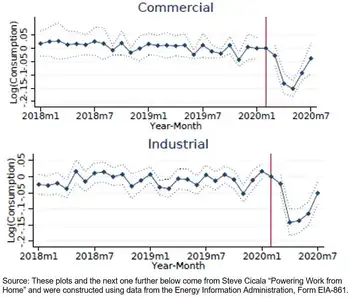
U.S. commercial electricity consumption fell 12% during the second quarter of 2020. U.S. industrial electricity consumption fell 14% over the same period.

This makes sense. The second quarter was by some measures, the worst quarter for the U.S. economy in over 145 years!

Economic activity shrank. Schools closed. Offices closed. Factories closed. Restaurants closed. Malls closed. Even health care offices closed as patients delayed going to the dentist and other routine care. All this means less heating and cooling, less lighting, less refrigeration, less power for computers and other office equipment, less everything.

The decrease in the industrial sector is a little more surprising. My impression had been that the industrial sector had not fallen as far as commercial, but amid broader disruptions in coal and nuclear power that strained parts of the energy economy, the patterns for both sectors are quite similar with the decline peaking in May and then partially rebounding by July. The paper also shows that areas with higher unemployment rates experienced larger declines in both sectors.


Fact #2: Households Are Using More
While firms are using less, households are using more. U.S. residential electricity consumption increased 10% during the second quarter of 2020. Consumption surged during March, April, and May, a reflection of the lockdown lifestyle many adopted, and then leveled off in June and July – with much less of the rebound observed on the commercial/industrial side.

This pattern makes sense, too. In Professor Cicala’s words, “people are spending an inordinate amount of time at home”. Many of us switched over to working from home almost immediately, and haven’t looked back. This means more air conditioning, more running the dishwasher, more CNN (especially last week), more Zoom, and so on.

The paper also examines the correlates of the decline. Areas in the U.S. where more people can work from home experienced larger increases. Unemployment rates, however, are almost completely uncorrelated with the increase.


Fact #3: Firms are Less Peaky
The paper next turns to a novel dataset from Texas, where Texas grid reliability is under active discussion, that makes it possible to measure hourly electricity consumption by sector.

As the figure above illustrates, the biggest declines in commercial/industrial electricity consumption have occurred Monday through Friday between 9AM and 5PM.

The dashed line shows the pattern during 2019. Notice the large spikes in electricity consumption during business hours. The solid line shows the pattern during 2020. Much smaller spikes during business hours.


Fact #4: Everyday is Like Sunday
Finally, we have what I would like to nominate as the “Energy Figure of the Year”.

Again, start with the pattern for 2019, reflected by the dashed line. Prior to Covid, Texas households used a lot more electricity on Saturdays and Sundays.

Then along comes Covid, and turned every day into the weekend. Residential electricity consumption in Texas during business hours Monday-Friday is up 16%(!).

In the pattern for 2020, it isn’t easy to distinguish weekends from weekdays. If you feel like weekdays and weekends are becoming a big blur – you are not alone.


Conclusion
Researchers are increasingly thinking about electricity consumption as a real-time indicator of economic activity, even as flat electricity demand complicates utility planning and investment. This is an intriguing idea, but Professor Cicala’s new paper shows that it is important to look sector-by-sector.

While commercial and industrial consumption indeed seem to measure the strength of an economy, residential consumption has been sharply countercylical – increasing exactly when people are not at work and not at school.

These large changes in behavior are specific to the pandemic. Still, with the increased blurring of home and non-home activities we may look back on 2020 as a key turning point in how we think about these three sectors of the economy.

More broadly, Professor Cicala’s paper highlights the value of social science research. We need facts, data, and yes, science, if we are to understand the economy and craft effective policies on energy insecurity and shut-offs as well.


Related News

View more

BC Hydro rates going up 3 per cent

BC Hydro Rate Freeze Rejection details the BCUC decision enabling a 3% rate increase, citing revenue requirements, debt, and capital costs, affecting electricity bills, with NDP government proposing lifeline rates and low-income relief.


Key Points

It is the BCUC ruling allowing a 3% BC Hydro rate hike, citing cost recovery, debt, and capital needs.

✅ BCUC rejects freeze; 3% increase proceeds April 1, 2018

✅ Rationale: cost recovery, debt, capital expenditures

✅ Relief: lifeline rate, $600 grants, winter payment plan


The B.C. Utilities Commission has rejected a request by the provincial government to freeze rates at BC Hydro for the coming year, meaning a pending rate increase of three percent will come into effect as higher BC Hydro rates on April 1, 2018.

BC Hydro had asked for the three per cent increase, aligning with a rate increase proposal that would add about $2 a month, but, last year, Energy Minister Michelle Mungall directed the Crown corporation to resubmit its request in order to meet an NDP election promise.

"After years of escalating electricity costs, British Columbians deserve a break on their bills," she said at the time.

However, the utilities commission found there was "insufficient regulatory justification to approve the zero per cent rate increase."

"Even these increases do not fully recover B.C. Hydro's forecast revenue requirement, which includes items such as operating costs, new capital expenditures and carrying costs on capital expenditures," the commission wrote in a news release.

Mungall said she was disappointed by the decision.

"We were always clear we were going to the BCUC. We need to respect the role the BCUC has here for the ratepayers and for the public. I'm very disappointed obviously with their decision."

Mungall blamed the previous government for leaving BC Hydro in a financial state where a rate freeze was ultimately not possible.

Last month, Moody's Investors Service calculated BC Hydro's total debt at $22 billion and said it was one of the province's two credit challenges going forward.

"There's quite a financial mess that is a B.C. Liberal legacy after 16 years of government. We have the responsibility as a new government to clean that up."

B.C. Liberal leader Andrew Wilkinson said it was an example of the new government not living up to its campaign promises.

"British Columbians, particularly those on fixed incomes, believed the B.C. NDP when they promised a freeze on hydro bills. They planned accordingly and are now left in the lurch and face higher expenses. This is a government that stumbles into messes that cost all of us because they put rhetoric ahead of planning," he said.


Help on the way?

With the freeze being rejected, Mungall said the government would be going forward on other initiatives to help low-income ratepayers, as advocates' call for change after a fund surplus, including:

Legislating a "lifeline rate" program, allowing people with "demonstrated need" to apply for a lower rate for electricity.

Starting in May, providing an emergency grant of $600 for customers who have an outstanding BC Hydro bill.

Hydro's annual winter payment plan also allows people the chance to spread the payment of bills from December to February out over six months, and, with a two-year rate increase on the horizon, a new pilot program to help people paying their bills begins in July.

Mungall couldn't say whether the government would apply for rate freezes in the future.

"I don't have a crystal ball, and can't predict what might happen in two or three years from now, but we need to act swiftly now," she said.

"I appreciate the [BCUC's] rationale, I understand it, and we'll be moving forward with other alternatives for making life more affordable."


Related News

View more

US January power generation jumps 9.3% on year: EIA

US January power generation climbed to 373.2 TWh, EIA data shows, with coal edging natural gas, record wind output, record nuclear generation, rising hydro, and stable utility-scale solar amid higher Henry Hub prices.


Key Points

US January power generation hit 373.2 TWh; coal led gas, wind and nuclear set records, with solar edging higher.

✅ Coal 31.8% share; gas 29.4%; coal output 118.7 TWh, gas 109.6 TWh.

✅ Wind hit record 26.8 TWh; nuclear record 74.6 TWh.

✅ Total generation 373.2 TWh, highest January since 2014.


The US generated 373.2 TWh of power in January, up 7.9% from 345.9 TWh in December and 9.3% higher than the same month in 2017, Energy Information Administration data shows.

The monthly total was the highest amount in January since 377.3 TWh was generated in January 2014.

Coal generation totaled 118.7 TWh in January, up 11.4% from 106.58 TWh in December and up 2.8% from the year-ago month, consistent with projections of a coal-fired generation increase for the first time since 2014. It was also the highest amount generated in January since 132.4 TWh in 2015.

For the second straight month, more power was generated from coal than natural gas, as 109.6 TWh came from gas, up 3.3% from 106.14 TWh in December and up 19.9% on the year.

However, the 118.7 TWh generated from coal was down 9.6% from the five-year average for the month, due to the higher usage of gas and renewables and a rising share of non-fossil generation in the overall mix.

#google#

Coal made up 31.8% of the total US power generation in January, up from 30.8% in December but down from 33.8% in January 2017.

Gas` generation share was at 29.4% in the latest month, with momentum from record gas-fired electricity earlier in the period, down from 30.7% in December but up from 26.8% in the year-ago month.

In January, the NYMEX Henry Hub gas futures price averaged $3.16/MMBtu, up 13.9% from $2.78/MMBtu averaged in December but down 4% from $3.29/MMBtu averaged in the year-ago month.


WIND, NUCLEAR GENERATION AT RECORD HIGHS

Wind generation was at a record-high 26.8 TWh in January, up 29.3% from 22.8 TWh in December and the highest amount on record, according to EIA data going back to January 2001. Wind generated 7.2% of the nation`s power in January, as an EIA summer outlook anticipates larger wind and solar contributions, up from 6.6% in December and 6.1% in the year-ago month.

Utility-scale solar generated 3.3 TWh in January, up 1.3% from 3.1 TWh in December and up 51.6% on the year. In January, utility-scale solar generation made up 0.9% of US power generation, during a period when solar and wind supplied 10% of US electricity in early 2018, flat from December but up from 0.6% in January 2017.

Nuclear generation was also at a record-high 74.6 TWh in January, up 1.3% month on month and the highest monthly total since the EIA started tracking it in January 2001, eclipsing the previous record of 74.3 TWh set in July 2008. Nuclear generation made up 20% of the US power in January, down from 21.3% in December and 21.4% in the year-ago month.

Hydro power totaled 25.4 TWh in January, making up 6.8% of US power generation during the month, up from 6.5% in December but down from 8.2% in January 2017.


Related News

View more

China to build 525-MW hydropower station on Yangtze tributary

Baima Hydropower Station advances China renewable energy on the Wujiang River, a Yangtze tributary in Chongqing; a 525 MW cascade project approved by NDRC, delivering 1.76 billion kWh and improving river shipping.


Key Points

An NDRC-approved 525 MW project on Chongqing's Wujiang River, producing 1.76 billion kWh and improving navigation.

✅ 10.2 billion yuan investment; final cascade plant on Wujiang in Chongqing

✅ Expected output: 1.76 billion kWh; capacity 525 MW; NDRC approval

✅ Improves river shipping; relocation of 5,000 residents in Wulong


China plans to build a 525-MW hydropower station on the Wujiang River, a tributary of the Yangtze River, in Southwest China's Chongqing municipality, aligning with projects like the Lawa hydropower station elsewhere in the Yangtze basin.

The Baima project, the last of a cascade of hydropower stations on the section of the Wujiang River in Chongqing, has gotten the green light from the National Development and Reform Commission, China's state planning agency, even as some independent power projects elsewhere face uncertainty, such as the Siwash Creek project in British Columbia, the Chongqing Municipal Commission of Development and Reform said Monday.

The project, in Baima township of Wulong district, is expected to involve an investment of 10.2 billion yuan ($1.6 billion), as China explores compressed air generation to bolster grid flexibility, it said.

#google#

With a power-generating capacity of 525 MW, it is expected to generate 1.76 billion kwh of electricity a year, supporting efforts to reduce coal power production nationwide, and help improve the shipping service along the Wujiang River.

More than 5,000 local residents will be relocated to make room for the project, which forms part of a broader energy mix alongside advances in nuclear energy in China.


Related News

View more

Can California Manage its Solar Boom?

California Duck Curve highlights midday solar oversupply and steep evening peak demand, stressing grid stability. Solutions include battery storage, demand response, diverse renewables like wind, geothermal, nuclear, and regional integration to reduce curtailment.


Key Points

A mismatch between midday solar surplus and evening demand spikes, straining the grid without storage and flexibility.

✅ Midday solar oversupply forces curtailment and wasted clean energy.

✅ Evening ramps require fast, fossil peaker plants to stabilize load.

✅ Batteries, demand response, regional trading flatten the curve.


California's remarkable success in adopting solar power, including a near-100% renewable milestone, has created a unique challenge: managing the infamous "duck curve." This distinctive curve illustrates a growing mismatch between solar electricity generation and the state's energy demands, creating potential problems for grid stability and ultimately threatening to slow California's progress in the fight against climate change.


The Shape of the Problem

The duck curve arises from a combination of high solar energy production during midday hours and surging energy demand in the late afternoon and evening when solar power declines. During peak solar hours, the grid often has an overabundance of electricity, and curtailments are increasing as a result, while as the sun sets, demand surges when people return home and businesses ramp up operations. California's energy grid operators must scramble to make up this difference, often relying on fast-acting but less environmentally friendly power sources.


The Consequences of the Duck Curve

The increasing severity of the duck curve has several potential consequences for California:

  • Grid Strain: The rapid ramp-up of power sources to meet evening demand puts significant strain on the electrical grid. This can lead to higher operational costs and potentially increase the risk of blackouts during peak demand times.
  • Curtailed Energy: To avoid overloading the grid, operators may sometimes have to curtail excess solar energy during midday, as rising curtailment reports indicate, essentially wasting clean electricity that could have been used to displace fossil fuel generation.
  • Obstacle to More Solar: The duck curve can make it harder to add new solar capacity, as seen in Alberta's solar expansion challenges, for fear of further destabilizing the grid and increasing the need for fossil fuel-based peaking plants.


Addressing the Challenge

California is actively seeking solutions to mitigate the duck curve, aligning with national decarbonization pathways that emphasize practicality. Potential strategies include:

  • Energy Storage: Deploying large-scale battery storage can help soak up excess solar electricity during the day and release it later when demand peaks, smoothing out the duck curve.
  • Demand Flexibility: Encouraging consumers to shift their energy use to off-peak hours through incentives and smart grid technologies can help reduce late-afternoon surges in demand.
  • Diverse Power Sources: While solar is crucial, a balanced mix of energy sources, including geothermal, wind, and nuclear, can improve grid stability and reduce reliance on rapid-response fossil fuel plants.
  • Regional Cooperation: Integrating California's grid with neighboring states can aid in balancing energy supply and demand across a wider geographical area.


The Ongoing Solar Debate

The duck curve has become a central point of debate about the future of California's energy landscape. While acknowledging the challenge, solar advocates argue for continued expansion, backed by measures like a bill to require solar on new buildings, emphasizing the urgent need to transition away from fossil fuels. Grid operators and some utility companies call for a more cautious approach, emphasizing grid reliability and potential costs if the problem isn't effectively managed.


Balancing California's Needs and its Green Ambitions

Finding the right path forward is essential; it will determine whether California can continue to lead the way in solar energy adoption while ensuring a reliable and affordable electricity supply. Successfully navigating the duck curve will require innovation, collaboration, and a strong commitment to building a sustainable energy system, as wildfire smoke impacts on solar continue to challenge generation predictability.


Related News

View more

Sign Up for Electricity Forum’s Newsletter

Stay informed with our FREE Newsletter — get the latest news, breakthrough technologies, and expert insights, delivered straight to your inbox.

Electricity Today T&D Magazine Subscribe for FREE

Stay informed with the latest T&D policies and technologies.
  • Timely insights from industry experts
  • Practical solutions T&D engineers
  • Free access to every issue

Live Online & In-person Group Training

Advantages To Instructor-Led Training – Instructor-Led Course, Customized Training, Multiple Locations, Economical, CEU Credits, Course Discounts.

Request For Quotation

Whether you would prefer Live Online or In-Person instruction, our electrical training courses can be tailored to meet your company's specific requirements and delivered to your employees in one location or at various locations.