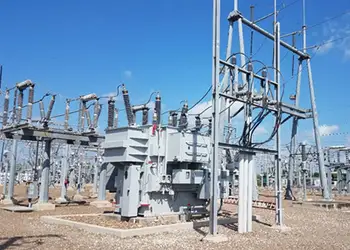
Substation Protection Training - Protect Transformers, Buses and Lines
Our customized live online or in‑person group training can be delivered to your staff at your location.
- Live Online
- 12 hours Instructor-led
- Group Training Available
Regular Price:
$799
Coupon Price:
$699
The 36 coal-burning power plants in Pennsylvania would be placed on a stepped-up schedule for removing toxic mercury from plant emissions under a proposed regulation announced by the state Department of Environmental Protection.
Owners of the power plants would be required to make an 80 percent reduction in mercury emissions by 2010, and a 90 percent reduction by 2015.
The state regulation would supersede one planned by the U.S. Environmental Protection Agency. The EPA regulation would require only a 70 percent reduction by 2018.
DEP spokesman Kurt Knaus said loopholes in the EPA regulation could mean a 70 percent reduction would not be achieved until 2026, "if at all."
No estimate of what it would cost utilities to comply with the state regulation was provided.
Utilities have bitterly opposed mercury regulations, even claiming no technology is available to remove mercury from power- plant emissions. Environmentalists scoff at that contention and say the danger of mercury, especially to the mental development of infants, requires action.
Mercury can accumulate in fish in streams and lakes.
"Based upon DEP's presentation today, it sounds like the regulation would clean up mercury much faster than the Bush administration's plan," said Jan Jarrett, vice president of Penn Future, a public policy group in Harrisburg that petitioned DEP for the regulation. "And with babies' brains at risk, we can't wait any longer."
Reaction from power-plant operators was muted Wednesday. Reliant Energy of Houston, which owns or co-owns eight of the 36 coal-fired power plants in Pennsylvania, said it would analyze the DEP proposal when more details were available. The company said both the DEP and EPA regulations would require significant reductions in mercury.
"When the regulations are finalized, Reliant Energy will do its part to help reduce mercury emissions in Pennsylvania and elsewhere," said Fred McGuire, the utility's vice president for environmental safety and health.
The DEP regulation aims to remove more mercury from the environment than the EPA regulation would require and to keep Pennsylvania bituminous coal economically competitive with low-sulfur coal from the Power River basin in Wyoming.
Knaus said plant owners would be barred from trading mercury emission-reduction credits, which they can do now with sulfur dioxide and nitrogen oxide, two other pollutants. The trading rule allows a utility that removes more pollution than the law requires to sell credits to other utilities who don't want to spend the greater amount of money needed to reduce pollution from their plants.
Environmentalists have tolerated the trading of emission credits for sulfur dioxide and nitrogen oxide, but they say doing so with mercury is unacceptable. Knaus said mercury, which is heavy, tends to concentrate near the power plants that emit it, creating toxic hot spots.
DEP is seeking to help the bituminous coal industry by allowing plants that install all required air-pollution-control technology to be considered in compliance with its mercury rule if the plant burns 100 percent bituminous coal.
Pennsylvania bituminous coal contains more mercury than Power River sub-bituminous coal, but it also contains more chlorine, which aids in mercury removal.
Related News

3 ways 2021 changed electricity - What's Next
U.S. Power Sector Outlook 2022 previews clean energy targets, grid reliability and resilience upgrades, transmission…
View more

E.ON to Commission 2500 Digital Transformer Stations
E.ON Digital Transformer Stations modernize distribution grids with smart grid monitoring, voltage control, and remote…
View more
Fixing California's electric grid is like repairing a car while driving
CAISO Clean Energy Transition outlines California's path to 100% carbon-free power by 2045, scaling renewables,…
View more
First US coal plant in years opens where no options exist
Alaska Coal-Fired CHP Plant opens near Usibelli mine, supplying electricity and district heat to UAF;…
View more

Mines found at Ukraine's Zaporizhzhia nuclear plant, UN watchdog says
Zaporizhzhia Nuclear Plant Mines reported by IAEA at the Russian-occupied site: anti-personnel devices in a…
View more

Canadian Scientists say power utilities need to adapt to climate change
Canada Power Grid Climate Resilience integrates extreme weather planning, microgrids, battery storage, renewable energy, vegetation…
View more
Sign Up for Electricity Forum’s Newsletter
Stay informed with our FREE Newsletter — get the latest news, breakthrough technologies, and expert insights, delivered straight to your inbox.
Electricity Today T&D Magazine Subscribe for FREE

Stay informed with the latest T&D policies and technologies.
- Timely insights from industry experts
- Practical solutions T&D engineers
- Free access to every issue
