The Institute of Electrical and Electronics Engineers (IEEE) Task Group assigned to explore the next-generation standard for 802.11 has finally ended months of bickering and late Thursday agreed on terms for a new wireless standard called 802.11g.
The consensus represents an eleventh-hour save for the Intersil-backed proposal. For months, Task Group "G" has been trying to come to terms on a modulation scheme that would allow 802.11 wireless LAN (WLAN) hardware to transmit data at speeds approaching a "wired" Ethernet. But after failing to do so earlier this week, the IEEE even considered scrapping the proposed standard (not to mention months of hard work) altogether.
"This is a huge win for the wireless industry for several reasons," said Gregory Williams, president and CEO of Intersil Corp. "First, it is backwards compatible with the large installed user base of over 11 million Wi-Fi products. Second, it meets our customers' demands for significant speed increases in the 2.4 GHz band, necessary for multi-channel DVD-quality video and CD-quality audio applications."
The first 802.11 standard of the mid-1990s gave birth to the current 802.11b standard, which was approved by the IEEE in 1999. As outlined by the 802.11b specification, chip sets would use a modulation scheme known as Complementary Code Keying (CCK) to transmit data signals at 11 megabits-per-second (Mbps) through an unlicensed portion of the spectrum found at about 2.4GHz. Considered revolutionary at the time (and by some measures...even still today), 802.11b gave way to a new generation of products that allowed an Ethernet connection to finally break free of wires but its speed was still only one-tenth that of its wired brethren.
In order to enhance the standard, the IEEE's overall Working Group that oversaw the development of 802.11 assigned individual tasks to several specialty groups -- each with the goal of further advancing the technology. The mission of 802.11g was to boost the data transmission to the so-called "turbo" rates of 54 Mbps while still maintaining interoperability to earlier specs. This way, consumers (and enterprise users, vendors, investors and just about everyone else) who bet on earlier versions of the technology would know how the market would eventually evolve.
But when the original 802.11b specification was approved in 1999, the IEEE concurrently approved the specs for 802.11a. These chip sets are designed to use the OFDM schema to transmit data at 54 Mbps through a separate portion of spectrum (located somewhere in the 5GHz range).
802.11a is currently only licensed for usage in North America as opposed to 802.11b which is accepted throughout Europe and Asia as well. But the main hurdle facing the end-user is that the two specs -- 802.11b and 802.11a -- were never meant to interoperate.
Still, several vendors from start-ups like Sunnyvale, Calif.-based Atheros Communications to household names like Intel and 3Com have already announced their support of 802.11a.
internet.com corp.
Related News

'That can keep you up at night': Lessons for Canada from Europe's power crisis
Canada Net-Zero Grid Lessons highlight Europe's energy transition risks: Germany's power prices, wind and solar…
View more
Philippines wants Canada's help to avoid China, U.S
Philippines-Canada Indo-Pacific Partnership strengthens ASEAN cooperation, maritime security, and South China Sea diplomacy, balancing U.S.-China…
View more

Sustainable Marine now delivering electricity to Nova Scotia grid from tidal energy
Sustainable Marine tidal energy delivers in-stream power to Nova Scotia's grid from Grand Passage, proving…
View more
Biden administration pushes to revitalize coal communities with clean energy projects
Coal-to-Clean Energy Hubs leverage Bipartisan Infrastructure Law and Inflation Reduction Act funding to repurpose mine…
View more
Trump's Vision of U.S. Energy Dominance Faces Real-World Constraints
U.S. Energy Dominance envisions deregulation, oil and gas growth, LNG exports, pipelines, and geopolitical leverage,…
View more
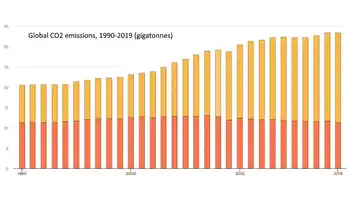
Global CO2 emissions 'flatlined' in 2019, says IEA
2019 Global CO2 Emissions stayed flat, IEA reports, as renewable energy growth, wind and solar…
View more
Sign Up for Electricity Forum’s Newsletter
Stay informed with our FREE Newsletter — get the latest news, breakthrough technologies, and expert insights, delivered straight to your inbox.
Electricity Today T&D Magazine Subscribe for FREE

Stay informed with the latest T&D policies and technologies.
- Timely insights from industry experts
- Practical solutions T&D engineers
- Free access to every issue
