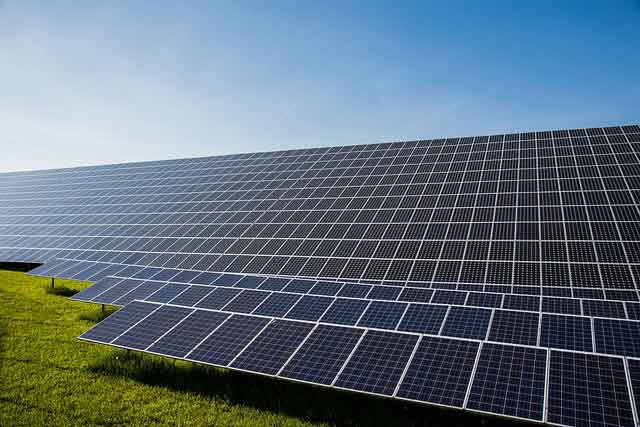
Maxim Power Building Plant in Germany

By Canadian Press


Electrical Testing & Commissioning of Power Systems

Our customized live online or in‑person group training can be delivered to your staff at your location.
  • Live Online
  • 12 hours Instructor-led
  • Group Training Available
Regular Price:
$599
Coupon Price:
$499
Reserve Your Seat Today
Maxim Power Corp. has struck a deal to build an alternative energy biogas power plant in Germany.

The plant is expected to cost $20 million and will be capable of processing 100,000 tonnes of agricultural wastes a year, the Calgary company announced. Construction is slated to begin later this year and the power produced will be sold to a local German utility under the country's renewable energy laws.

"Europe continues to offer Maxim numerous attractive project development and acquisition opportunities in cogeneration and renewable energy," John Bobenic, Maxim's president and chief executive, said in a release.

Based in Calgary, Maxim currently owns and operates 59 megawatts of generating capacity in Canada, Europe and Asia and has more than 100 megawatts of electricity generation under evaluation and development.

Related News
A new material made from carbon nanotubes can generate electricity by scavenging energy from its environment

Carbon Nanotube Solvent Electricity enables wire-free electrochemistry as organic solvents like acetonitrile pull electrons, powering alcohol oxidation and packed bed reactors, energy harvesting, and micro- and nanoscale robots via redox-driven current.


Key Points

Solvent-driven electron extraction from carbon nanotube particles generates current for electrochemistry.

✅ 0.7 V per particle via solvent-induced electron flow

✅ Packed bed reactors drive alcohol oxidation without wires

✅ Scalable for micro- and nanoscale robots; energy harvesting


MIT engineers have discovered a new way of generating electricity, alongside advances in renewable power at night that broaden what's possible, using tiny carbon particles that can create a current simply by interacting with liquid surrounding them.

The liquid, an organic solvent, draws electrons out of the particles, generating a current, unlike devices based on a cheap thermoelectric material that rely on heat, that could be used to drive chemical reactions or to power micro- or nanoscale robots, the researchers say.

"This mechanism is new, and this way of generating energy is completely new," says Michael Strano, the Carbon P. Dubbs Professor of Chemical Engineering at MIT. "This technology is intriguing because all you have to do is flow a solvent through a bed of these particles. This allows you to do electrochemistry, but with no wires."

In a new study describing this phenomenon, the researchers showed that they could use this electric current to drive a reaction known as alcohol oxidation—an organic chemical reaction that is important in the chemical industry.

Strano is the senior author of the paper, which appears today in Nature Communications. The lead authors of the study are MIT graduate student Albert Tianxiang Liu and former MIT researcher Yuichiro Kunai. Other authors include former graduate student Anton Cottrill, postdocs Amir Kaplan and Hyunah Kim, graduate student Ge Zhang, and recent MIT graduates Rafid Mollah and Yannick Eatmon.

Unique properties
The new discovery grew out of Strano's research on carbon nanotubes—hollow tubes made of a lattice of carbon atoms, which have unique electrical properties. In 2010, Strano demonstrated, for the first time, that carbon nanotubes can generate "thermopower waves." When a carbon nanotube is coated with layer of fuel, moving pulses of heat, or thermopower waves, travel along the tube, creating an electrical current that exemplifies turning thermal energy into electricity in nanoscale systems.

That work led Strano and his students to uncover a related feature of carbon nanotubes. They found that when part of a nanotube is coated with a Teflon-like polymer, it creates an asymmetry, distinct from conventional thermoelectric materials approaches, that makes it possible for electrons to flow from the coated to the uncoated part of the tube, generating an electrical current. Those electrons can be drawn out by submerging the particles in a solvent that is hungry for electrons.

To harness this special capability, the researchers created electricity-generating particles by grinding up carbon nanotubes and forming them into a sheet of paper-like material. One side of each sheet was coated with a Teflon-like polymer, and the researchers then cut out small particles, which can be any shape or size. For this study, they made particles that were 250 microns by 250 microns.

When these particles are submerged in an organic solvent such as acetonitrile, the solvent adheres to the uncoated surface of the particles and begins pulling electrons out of them.

"The solvent takes electrons away, and the system tries to equilibrate by moving electrons," Strano says. "There's no sophisticated battery chemistry inside. It's just a particle and you put it into solvent and it starts generating an electric field."

Particle power
The current version of the particles can generate about 0.7 volts of electricity per particle. In this study, the researchers also showed that they can form arrays of hundreds of particles in a small test tube. This "packed bed" reactor, unlike thin-film waste-heat harvesters for electronics, generates enough energy to power a chemical reaction called an alcohol oxidation, in which an alcohol is converted to an aldehyde or a ketone. Usually, this reaction is not performed using electrochemistry because it would require too much external current.

"Because the packed bed reactor is compact, it has more flexibility in terms of applications than a large electrochemical reactor," Zhang says. "The particles can be made very small, and they don't require any external wires in order to drive the electrochemical reaction."

In future work, Strano hopes to use this kind of energy generation to build polymers using only carbon dioxide as a starting material. In a related project, he has already created polymers that can regenerate themselves using carbon dioxide as a building material, in a process powered by solar energy and informed by devices that generate electricity at night as a complement. This work is inspired by carbon fixation, the set of chemical reactions that plants use to build sugars from carbon dioxide, using energy from the sun.

In the longer term, this approach could also be used to power micro- or nanoscale robots. Strano's lab has already begun building robots at that scale, which could one day be used as diagnostic or environmental sensors. The idea of being able to scavenge energy from the environment, including approaches that produce electricity 'out of thin air' in ambient conditions, to power these kinds of robots is appealing, he says.

"It means you don't have to put the energy storage on board," he says. "What we like about this mechanism is that you can take the energy, at least in part, from the environment."


Related News

View more

Alberta breaks summer electricity record, still far short of capacity

Alberta Electricity Peak Demand surged to 10,638 MW, as AESO reported record summer load from air conditioning, Stampede visitors, and heatwave conditions, with ample generation capacity, stable grid reliability, and conservation urged during 5-7 p.m.


Key Points

It is the record summer power load in Alberta, reaching 10,638 MW, with evening conservation urged by AESO.

✅ Record 10,638 MW at 4 pm; likely to rise this week

✅ Drivers: A/C use, heat, Stampede visitors

✅ AESO reports ample capacity; conserve 5-7 pm


Consumer use hit 10,638 MW, blowing past a previous high of 10,520 MW set on July 9, 2015, said the Alberta Electric System Operator (AESO).

“We hit a new summer peak and it’s likely we’ll hit higher peaks as the week progresses,” said AESO spokeswoman Tara De Weerd.

“We continue to have ample supply, and as Alberta's electricity future trends toward more wind, our generators are very confident there aren’t any issues.”

That new peak was set at 4 p.m. but De Weerd said it was likely to be exceeded later in the day.

Heightened air conditioner use is normally a major driver of such peak electricity consumption, said De Weerd.

She also said Calgary’s big annual bash is also likely playing a role.

“It’s the beginning of Stampede, you have an influx of visitors so you’ll have more people using electricity,” she said.

Alberta’s generation capacity is 16,420 MW, said the AESO, with wind power increasingly outpacing coal in the province today.

There are no plans, she said, for any of the province’s electricity generators to shut down any of their plants for maintenance or other purposes in the near future as demand rises.

The summer peak is considerably smaller than that reached in the depths of Alberta’s winter.

Alberta’s winter peak usage was recorded last year and was 11,458 MW.

Though the province’s capacity isn’t being strained by the summer heat, De Weerd still encouraged consumers to go easy during the peak use time of the day, between 5 and 7 p.m.

“We don’t have to be running all of our appliances at once,” she said.

Alberta exports an insignificant amount of electricity to Montana, B.C. and Saskatchewan, where demand recently set a new record.

The weather forecast calls for temperatures to soar above 30C through the weekend.

In northern Canada, Yukon electricity demand recently hit a record high, underscoring how extreme temperatures can strain systems.


Related News

View more

Hydro One Q2 profit plunges 23% as electricity revenue falls, costs rise

Hydro One Q2 Earnings show lower net income and EPS as mild weather curbed electricity demand; revenue missed Refinitiv estimates, while tree-trimming costs rose and the dividend remained unchanged for Ontario's grid operator.


Key Points

Hydro One Q2 earnings fell to $155M, EPS $0.26, revenue $1.41B; costs rose, demand eased, dividend held at $0.2415.

✅ Net income $155M; EPS $0.26 vs $0.34 prior year

✅ Revenue $1.41B; missed $1.44B estimate

✅ Dividend steady at $0.2415 per share


Hydro One Ltd.'s (H.TO 0.25%) second-quarter profit fell by nearly 23 per cent from last year to $155 million as the electricity utility reported spending more on tree-trimming work due to milder temperatures that also saw customers using less power, notwithstanding other periods where a one-time court ruling gain shaped quarterly results.

The Toronto-based company - which operates most of Ontario's power grid - and whose regulated rates are subject to an OEB decision, says its net earnings attributable to shareholders dropped to 26 cents per share from 34 cents per share when Hydro One had $200 million in net income.

Adjusted net income was also 26 cents per share, down from 33 cents per diluted share in the second quarter of 2018, while executive pay, including the CEO salary, drew public scrutiny during the period.

Revenue was $1.41 billion, down from $1.48 billion, while revenue net of purchased power was $760 million, down from $803 million, and across the sector, Manitoba Hydro's debt has surged as well.

Separately, Ontario introduced a subsidized hydro plan and tax breaks to support economic recovery from COVID-19, which could influence consumption patterns.

Analysts had estimated $1.44 billion of revenue and 27 cents per share of adjusted income, and some investors cite too many unknowns in evaluating the stock, according to financial markets data firm Refinitiv.

The publicly traded company, which saw a share-price drop after leadership changes and of which the Ontario government is the largest shareholder, says its quarterly dividend will remain at 24.15 cents per share for its next payment to shareholders in September.


Related News

View more

Ontario government wants new gas plants to boost electricity production

Ontario Gas Plant Expansion aims to boost grid reliability as nuclear refurbishments proceed, using natural gas to meet electricity demand, despite critics urging renewables, energy storage, and efficiency to reduce carbon emissions, protecting investment growth.


Key Points

Ontario plan to expand gas plants for reliability during nuclear outages, sparking debate on emissions and clean options.

✅ IESO data: gas share rose from 4% (2017) to 10.4% (2022).

✅ Government cites nuclear refurbishments and demand growth.

✅ Critics propose storage, wind, solar, and efficiency.


The Ontario government is preparing to expand gas-fired power plants in Ontario; a move critics say will make the province's electricity system dirtier and could eventually leave taxpayers on the hook.

The province is currently soliciting bids for additional gas-fired electricity generation, which means new gas plants get built, or existing gas plants get expanded. 

It's poised to be Ontario's biggest increase in the gas-fired power supply in more than a decade since the previous Liberal government scrapped two gas plants, in Mississauga and Oakville, at a cost the auditor general pegged at around $1 billion. 

Doug Ford's energy minister, Todd Smith, says Ontario needs gas plants now to help meet an expected surge in demand for electricity as the province faces a supply shortfall in the coming years and to provide power while some units of the province's nuclear stations are down for refurbishment. 

"It's really important to have natural gas as an insurance policy to keep the lights on and provide the reliability that we need," Smith said in an interview. 

"We need natural gas for the short term, especially to get us through these refurbishments."

The portion of Ontario's electricity supply that comes from natural gas matters for the environment and the province's economy. Manufacturing companies increasingly seek clean power that emits as little carbon dioxide as possible. 

The portion of Ontario's electricity supply that comes from natural gas matters for the environment and the province's economy. Manufacturing companies increasingly seek a power supply that emits as little carbon dioxide as possible. 

Increasing the amount of gas-fired generation in the electricity system puts Ontario's ability to attract such investments at risk as it complicates balancing demand and emissions across the grid, says Evan Pivnick, program manager with Clean Energy Canada, a think tank. 

"Building new natural gas (power plants) in Ontario today should be seen as an absolute last resort for meeting our energy needs," said Pivnick in an interview. 

Ontario's electricity system has among the lowest rates of CO2 emissions in North America, with roughly half of the annual supply provided by nuclear power, one-quarter from hydro dams, and one-tenth from wind turbines. 

However, Ontario's gas plants have produced a growing amount of electricity in recent years, despite an early report exploring a gas halt by the minister, and that trend will continue if new gas plants are built. 

In 2017, gas- and oil-fired generation provided just four percent of Ontario's electricity supply, according to figures from the provincial agency that manages the grid, the Independent Electricity System Operator (IESO). 

By 2022, that figure reached 10.4 percent. 

Ontario doesn't need new gas plants to meet the electricity demand, says Bryan Purcell, vice president of policy and programs at The Atmospheric Fund. This agency invests in low-carbon projects in the Greater Toronto and Hamilton Area. 

"We're quite concerned about where Ontario's electric grid is going," said Purcell. "Thankfully, there's still time to adjust course and look at other options." 

According to Purcell and Pivnick, those options to avoid gas could include power storage (in which excess generated energy is stored for later use when electricity demand rises), wind and solar projects, or energy efficiency and conservation programs.


Related News

View more

Covid-19 puts brake on Turkey’s solar sector

Turkey Net Metering Suspension freezes regulator reviews, stalling rooftop solar permits and grid interconnections amid COVID-19, pausing licensing workflows, EPC pipelines, and electricity bill credits that drive commercial and household prosumer adoption.


Key Points

A pause on technical reviews freezing net metering applications and slowing rooftop solar deployment in Turkey.

✅ Monthly technical committee meetings suspended indefinitely

✅ Rooftop solar permits and grid interconnections on hold

✅ EPC firms urge remote evaluations for transparency


The decision by the Turkish Energy Market Regulatory Authority to halt part of the system of processing net metering applications risks bringing the only vibrant segment of the nation’s solar industry to a grinding halt, a risk amplified as global renewables face Covid-19 disruptions across markets.

The regulator has suspended monthly meetings of the committee which makes technical evaluations of net metering applications, citing concerns about the spread of Covid-19, which has already seen U.S. utility-scale solar face delays this year.

The availability of electricity bill credits for net-metering-approved households which inject surplus power into the grid, similar to how British households can sell power back to energy firms, has seen the rooftop projects the scheme is typically associated with remain the only source of new solar generation capacity in Turkey of late.

However the energy regulator’s decision to suspend technical evaluation committee meetings until further notice has seen the largely online licensing process for new solar systems practically cease; by contrast, Berlin is being urged to remove PV barriers to keep projects moving.

The Turkish solar industry has claimed the move is unnecessary, with solar engineering, procurement and construction services businesses pointing out the committee could meet to evaluate projects remotely. It has been argued such a move would streamline the application process and make it more transparent, regardless of the current public health crisis.


Net metering 

Turkey introduced net metering for rooftop installations last May and pv magazine has reported the specifics of the scheme, amid debates like New England's grid upgrade costs over who pays.

National grid operator Teias confirmed recently the country added 109 MW of new solar capacity in the first quarter, most of it net-metered rooftop systems, even as Australian distributors warn excess solar can strain local networks.

Net metering has been particularly attractive to commercial electricity users because the owners of small and medium-sized businesses pay more for power, as solar reshapes electricity prices in Northern Europe, than either households or large scale industrial consumers.

Until the recent technical committee decision by the regulator, the chief obstacle to net metering adoption had been the nation’s economic travails. The Turkish lira has lost 14% of its value since January and around 36% over the last two years. The central bank has been using its foreign reserves to support state lenders and the lira but the national currency slipped near an all-time low on Friday and foreign analysts predict the central bank reserves could run dry in July.

The level of exports shipped last month was down 41% on April last year and imports fell 28% by the same comparison, further depressing the willingness of companies to make capital investments such as rooftop solar.


Related News

View more

New Hampshire rejects Quebec-Massachusetts transmission proposal

Northern Pass Project faces rejection by New Hampshire regulators, halting Hydro-Quebec clean energy transmission lines to Massachusetts; Eversource vows appeal as the Site Evaluation Committee cites development concerns and alternative routes through Vermont and Maine.


Key Points

A project to transmit Hydro-Quebec power to Massachusetts via New Hampshire, recently rejected by state regulators.

✅ New Hampshire SEC denied the transmission application

✅ Up to 9.45 TWh yearly from Hydro-Quebec to Massachusetts

✅ Eversource plans appeal; alternative routes via Vermont, Maine


Regulators in the state of New Hampshire on Thursday rejected a major electricity project being piloted by Quebec’s hydro utility and its American partner, Eversource.

Members of New Hampshire’s Site Evaluation Committee unanimously denied an application for the Northern Pass project a week after the state of Massachusetts green-lit the proposal.

Both states had to accept the project, as the transmission lines were to bring up to 9.45 terawatt hours of electricity per year from Quebec’s hydroelectric plants to Massachusetts as part of Hydro-Quebec’s export bid to New England, through New Hampshire.

The 20-year proposal was to be the biggest export contract in Hydro-Quebec’s history, in a region where Connecticut is leading a market overhaul that could affect pricing, and would generate up to $500 million in annual revenues for the provincial utility.

Hydro-Quebec’s U.S. partner, Eversource, said in a new release it was “shocked and outraged” by the New Hampshire regulators’ decision and suggested it would appeal.

“This decision sends a chilling message to any energy project contemplating development in the Granite State,” said Eversource. “We will be seeking reconsideration of the SEC’s decision, as well as reviewing all options for moving this critical clean energy project forward, including lessons from electricity corridor construction in Maine.”

The New Hampshire Union Leader reported Thursday the seven members of the evaluation committee said the project’s promoters couldn’t demonstrate the proposed energy transport lines wouldn’t interfere with the region’s orderly development.

Hydro-Quebec spokesman Serge Abergel said the decision wasn’t great news but it didn’t put a end to the negotiations between the company and the state of Massachusetts.

The hydro utility had proposed alternatives routes through Vermont and Maine amid a 145-mile transmission line debate over the corridor should the original plan fall through.

“There is a provision included in the process in the advent of an impasse, which allows Massachusetts to go back and choose the next candidate on the list,” Abergel said in an interview. “There are still cards left on the table.”


Related News

View more

Sign Up for Electricity Forum’s Newsletter

Stay informed with our FREE Newsletter — get the latest news, breakthrough technologies, and expert insights, delivered straight to your inbox.

Electricity Today T&D Magazine Subscribe for FREE

Stay informed with the latest T&D policies and technologies.
  • Timely insights from industry experts
  • Practical solutions T&D engineers
  • Free access to every issue

Live Online & In-person Group Training

Advantages To Instructor-Led Training – Instructor-Led Course, Customized Training, Multiple Locations, Economical, CEU Credits, Course Discounts.

Request For Quotation

Whether you would prefer Live Online or In-Person instruction, our electrical training courses can be tailored to meet your company's specific requirements and delivered to your employees in one location or at various locations.