
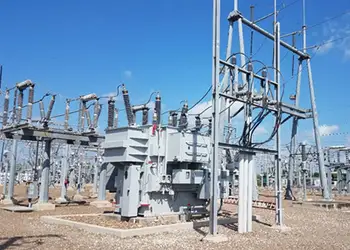
Substation Relay Protection Training
Our customized live online or in‑person group training can be delivered to your staff at your location.
- Live Online
- 12 hours Instructor-led
- Group Training Available
Regular Price:
$699
Coupon Price:
$599
ATLANTA
—
NERC Level 3 Alert on Data Centers flags grid reliability risks from computational loads, mandating seven actions to manage AI and crypto mining load losses, oscillations, modeling gaps, and commissioning needs in planning and operations.
Essential Takeaways
-
Rare Level 3 alert targets computational loads
-
Seven actions mandated with Aug. 3, 2026 deadline
-
Entities include planners, operators, coordinators
-
Focus on modeling, commissioning, dynamic recording
-
Data center growth drives 24% peak demand outlook
The North American Electric Reliability Corporation has issued a rare Level 3 alert focused on data center behavior and other computational loads, elevating the matter to its highest tier of urgency for bulk power system reliability. The alert responds to reports of facilities abruptly dropping load or producing rapid oscillations that can destabilize operations, and it directs specific grid entities to implement defined actions on a set timetable.
Transmission planners and operators, planning coordinators, and balancing authorities are called out to act, with responses due by Aug. 3, 2026, after acknowledging receipt in May. The focus is squarely on how fast-growing computational uses, including artificial intelligence training and high?density server farms, interface with utility planning and real-time operations. Additional context appears in us data centers strain grid, underscoring the operational lens utilities are applying today.
NERC cites instances where data centers disconnected unexpectedly or where their demand oscillated quickly, creating immediate risks to the grid. The alert follows an earlier warning that found many entities lacked sufficient processes to manage these emerging loads. Computational loads also include cryptocurrency operations, reflected in ercot texas crypto mining, a dimension that heightens attention to ramp rates, protection settings, and fault performance.
Looking ahead, NERC points to significant growth in peak demand over the next decade, with data centers accounting for much of the anticipated increase. For market and siting perspectives on this expansion, see data center demand booms, which complements the reliability lens of today's alert.
The Level 3 directive lists seven required steps. Among them: planners and coordinators are to specify and collect detailed modeling inputs from computational facilities, including minimum and maximum consumption and the split between IT and non-IT loads. Operators are to incorporate those data needs into facility interconnection requirements. Entities are to revise study triggers and criteria so local protection reviews and stability analyses explicitly account for computational loads.
On the operations and commissioning side, the alert calls for a structured commissioning process for these facilities. Where practical, testing should exercise facilities at full load and no load, and include a voltage step of at least 10% from nominal to observe performance. Operators are also directed to install and use dynamic fault recording so disturbances yield actionable evidence for studies and setting reviews.
NERC emphasizes that these actions address immediate risks while longer-term standards work proceeds. The goal is to close gaps in modeling, studies, protection, and control so grid responses remain predictable as load profiles evolve. For additional perspective on contingency planning and resource posture, see texas authorizes emergency grid backup power, which examines emergency strategies at the system level.
The alert also follows a prior Level 2 communication and arrives amid continuing reliability discussions involving inverter-based resources and fast-changing demand. Broader regional stressors inform those discussions; for related reading on weather-driven system impacts, see canadian harsh weather grid impact, which adds context to planning horizons and resiliency considerations.
Related News
The Rise of Data Centers in Alberta
Alberta Data Centers fuel the digital economy with cloud computing, AI, and streaming, leveraging renewable…
View more
G20 energy ministers back infrastructure and supply-chain initiatives
G20 Energy Consensus delivers four outcomes on energy access, permitting reform, water reuse and critical…
View more
Why Is Georgia Importing So Much Electricity?
Georgia Electricity Imports October 2017 surged as hydropower output fell and thermal power plants underperformed;…
View more

China, Cambodia agree to nuclear energy cooperation
Cambodia-CNNC Nuclear Energy MoU advances peaceful nuclear cooperation, human resources development, and Belt and Road…
View more

PG&E Supports Local Communities as It Pays More Than $230 Million in Property Taxes to 50 California Counties
PG&E property tax payments bolster counties, education, public safety, and infrastructure across Northern and Central…
View more

EVs could drive 38% rise in US electricity demand, DOE lab finds
EV-Driven Electricity Demand Growth will reshape utilities through electrification, EV adoption, grid modernization, and ratebasing…
View more
Sign Up for Electricity Forum’s Newsletter
Stay informed with our FREE Newsletter — get the latest news, breakthrough technologies, and expert insights, delivered straight to your inbox.
Electricity Today T&D Magazine Subscribe for FREE

Stay informed with the latest T&D policies and technologies.
- Timely insights from industry experts
- Practical solutions T&D engineers
- Free access to every issue

