By Canadian Press


NFPA 70b Training - Electrical Maintenance

Our customized live online or in‑person group training can be delivered to your staff at your location.

  • Live Online
  • 12 hours Instructor-led
  • Group Training Available
Regular Price:
$699
Coupon Price:
$599
Reserve Your Seat Today
-- A fire at a utility plant last Saturday blacked out power for tens of thousands of people in a swath of lower Manhattan and snarled transportation around the city. Crews had restored electricity by early evening, largely ending an emergency that brought back disconcerting memories of the days after Sept. 11.

During Saturday's outage, residents around the fallen World Trade Center again found themselves navigating dark hallways and descending gloomy stairwells for dozens of floors as sirens wailed outside.

National Guardsmen, a fixture on the streets after the terrorist attack, returned, helping police direct traffic on roads crowded with onlookers. A stretch of Franklin D. Roosevelt Drive, a major highway along the east side of Manhattan, was closed.

Most subway traffic through downtown was suspended or rerouted. Smoke could be seen for kilometres.

There was no evidence, though, that the midafternoon fire was caused by anything other than an accident, Mayor Michael Bloomberg said.

The apparent cause was a transformer explosion at the plant, which provides power for much of lower Manhattan, said Joe Petta, a Consolidated Edison spokesman.

"It sounded like a jet plane crashing and then a big thing of black smoke went up in the air," witness Michael Koster said.

"First we heard a big noise then we saw the black smoke," deli owner Alex Darwish said.

About 63,000 customers lost power in areas south of 14th Street to the lower tip of Manhattan, the utility said. The neighbourhoods affected included Greenwich Village, SoHo and Tribeca.

Nurses were seen working with flashlights at St. Vincent's Hospital, but administrators said critical care was not affected.

"Having gone through previous disasters such as 9-11, we are a pretty well-oiled machine," said hospital vice president William Grice.

Shops in the blacked-out areas began shutting their doors shortly after losing power.

"We have no choice, we have to close. Can't open the register, can't give anybody a receipt," said Jimmy Vejerano, manager of a discount store. "Plus the lights are out. It's a safety hazard. Nobody can see where they're going."

Consolidated Edison said some of its workers were inside the plant at the time of the explosion. No injuries were reported.

The utility said once the fire was out, workers would assess the damage to equipment and what repairs will be needed.

Related News

Canadian Solar and Tesla contribute to resilient electricity system for Puerto Rico school

SunCrate Solar Microgrid delivers resilient, plug-and-play renewable power to Puerto Rico schools, combining Canadian Solar PV, Tesla Powerwall battery storage, and Black & Veatch engineering to ensure off-grid continuity during outages and disasters.


Key Points

A compact PV-and-battery system for resilient, diesel-free power and microgrid backup at schools and clinics.

✅ Plug-and-play, modular PV, inverter, and battery architecture

✅ Tesla Powerwall storage; Canadian Solar 325 W panels

✅ Scales via daisy-chain for higher loads and microgrids


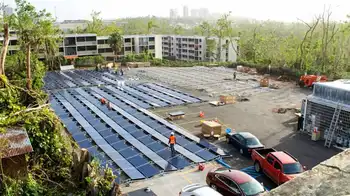
Eleven months since their three-building school was first plunged into darkness by Hurricane Maria, 140 students in Puerto Rico’s picturesque Yabucoa district have reliable power. Resilient electricity service was provided Saturday to the SU Manuel Ortiz school through an innovative scalable, plug-and-play solar system pioneered by SunCrate Energy with Black & Veatch support. Known as a “SunCrate,” the unit is an effective mitigation measure to back up the traditional power supply from the grid. The SunCrate can also provide sustainable power in the face of ongoing system outages and future natural disasters without requiring diesel fuel.

The humanitarian effort to return sustainable electricity to the K-8 school, found along the island’s hard-hit southeastern coast, drew donated equipment and expertise from a collection of North American companies. Additional support for the Yabucoa project came from Tesla, Canadian Solar and Lloyd Electric, reflecting broader efforts to build a solar-powered grid in Puerto Rico after Hurricane Maria.

“We are grateful for this initiative, which will equip this school with the technology needed to become a resilient campus and not dependent on the status of the power grid. This means that if we are hit with future harmful weather events, the school will be able to open more quickly and continue providing services to students,” Puerto Rico Secretary of Education Julia Keleher said.

The SunCrate harnesses a scalable rapid-response design developed by Black & Veatch and manufactured by SunCrate Energy. Electricity will be generated by an array of 325-W CS6U-Poly modules from Canadian Solar. California-based Tesla contributed advanced battery energy storage through various Powerwall units capable of storing excess solar power and delivering it outside peak generation periods, with related experience from a virtual power plant in Texas informing deployment.  Lloyd Electric Co. of Wichita Falls, Texas, partnered to support delivery and installation of the SunCrate.

“As families in the region begin to prepare for the school year, this community is still impacted by the longest U.S. power outage in history,” said Dolf Ivener, a Midwestern entrepreneur who owns King of Trails Construction and SunCrate Energy, which is donating the SunCrate. “SunCrate, with its rapid deployment and use of renewable energy, should give this school peace of mind and hopefully returns a touch of long-overdue normalcy to students and their parents. When it comes to consistent power, SunCrate is on duty.”

The SunCrate is a portable renewable energy system conceived by Ivener and designed and tested by Black & Veatch. Its modular design uses solar PV panels, inverters and batteries to store and provide electric power in support of critical services such as police, fire, schools, clinics and other community level facilities.

A SunCrate can generate 23 to 156 kWh per day, and store 10 kWh to 135 kWh depending on configuration. A SunCrate’s power generation and storage capacity can be easily scaled through daisy-chained configurations to accommodate larger buildings and loads. Leveraging resources from Tesla, Canadian Solar, Lloyd Electric and Lord Electric, the unit in Yabucoa will provide an estimated 52 kWh of storable power without requiring use of costlier diesel-powered generators and cutting greenhouse gas emissions. Its capabilities allow the school to strengthen its function as a designated Community Emergency Response Center in the event of future natural disasters.

“Canadian Solar has a long history of using solar power to support humanitarian efforts aiding victims of social injustice and natural disasters, including previous donations to Puerto Rico after Hurricane Maria,” said Dr. Shawn Qu, Chairman and Chief Executive Officer of Canadian Solar. “We are pleased to make the difference for these schoolchildren in Yabucoa who have been without reliable power for too long.”

The SunCrate will also substantially lower the school’s ongoing electricity costs by providing a reliable source of renewable energy on site, as falling costs of solar batteries improve project economics overall.

“Through our experience providing engineering services in Puerto Rico for nearly 50 years, including dozens of specialized projects for local government and industrial clients, we see great potential for SunCrate as a source of resilient power for the Commonwealth’s remote schools and communities at large, underscoring the importance of electricity resilience across critical infrastructure,” said Charles Moseley, a Program Director in Black & Veatch’s water business. “We hope that the deployment of the SunCrate in Yabucoa sets a precedent for facility and municipal level migro-grid efforts on the island and beyond.”

SunCrate also has broad potential applications in conflict/post-conflict environments and in rural electrification efforts in the developing world, serving as a resilient source of electricity within hours of its arrival on site and could enable peer-to-peer energy within communities. Of particular benefit, the system’s flexibility cuts fuel costs to a fraction of a generator’s typical consumption when they are used around the clock with maintenance requirements.


Related News

View more

Nonstop Records For U.S. Natural-Gas-Based Electricity

U.S. Natural Gas Power Demand is surging for electricity generation amid summer heat, with ERCOT, Texas grid reserves tight, EIA reporting coal and nuclear retirements, renewables intermittency, and pipeline expansions supporting combined-cycle capacity and prices.


Key Points

It is rising use of natural gas for power, driven by summer heat, plant retirements, and new combined-cycle capacity.

✅ ERCOT reserve margin 9%, below 14% target in Texas

✅ Gas share of U.S. power near 40-43% this summer

✅ Coal and nuclear retirements shift capacity to combined cycle


As the hot months linger, it will be natural gas that is leaned on most to supply the electricity that we need to run our air conditioning loads on the grid and keep us cool.

And this is surely a great and important thing: "Heat causes most weather-related deaths, National Weather Service says."

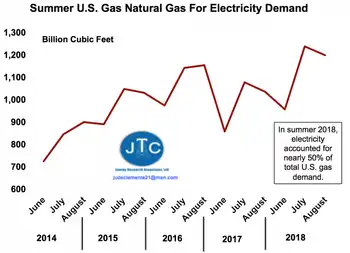
Generally, U.S. gas demand for power in summer is 35-40% higher than what it was five years ago, with so much more coming (see Figure).

The good news is regions across the country are expected to have plenty of reserves to keep up with power demand.

The only exception is ERCOT, covering 90% of the electric load in Texas, where a 9% reserve margin is expected, below the desired 14%.

Last summer, however, ERCOT’s reserve margin also was below the desired level, yet the grid operator maintained system reliability with no load curtailments.

Simply put, other states are very lucky that Texas has been able to maintain gas at 50% of its generation, despite being more than justified to drastically increase that.

At about 1,600 Bcf per year, the flatness of gas for power demand in Texas since 2000 has been truly remarkable, especially since Lone Star State production is up 50% since then.

Increasingly, other U.S. states (and even countries) are wanting to import huge amounts of gas from Texas, a state that yields over 25% of all U.S. output.

Yet if Texas justifiably ever wants to utilize more of its own gas, others would be significantly impacted.

At ~480 TWh per year, if Texas was a country, it would be 9th globally for power use, even ahead of Brazil, a fast growing economy with 212 million people, and France, a developed economy with 68 million people.

In the near-term, this explains why a sweltering prolonged heat wave in July in Texas, with a hot Houston summer setting new electricity records, is the critical factor that could push up still very low gas prices.

But for California, our second highest gas using state, above-average snowpack should provide a stronger hydropower for this summer season relative to 2018.

Combined, Texas and California consume about 25% of U.S. gas, with Texas' use double that of California.


Across the U.S., gas could supply a record 40-43% of U.S. electricity this summer even as the EIA expects solar and wind to be larger sources of generation across the mix

Our gas used for power has increased 35-40% over the past five years, and January power generation also jumped on the year, highlighting broad momentum.

Our gas used for power has increased 35-40% over the past five years. DATA SOURCE: EIA; JTC

Indeed, U.S. natural gas for electricity has continued to soar, even as overall electricity consumption has trended lower in some years, at nearly 10,700 Bcf last year, a 16% rise from 2017 and easily the highest ever.

Gas is expected to supply 37% of U.S. power this year, even as coal-fired generation saw a brief uptick in 2021 in EIA data, versus 27% just five years ago (see Figure).

Capacity wise, gas is sure to continue to surge its share 45% share of the U.S. power system.

"More than 60% of electric generating capacity installed in 2018 was fueled by natural gas."

We know that natural gas will continue to be the go-to power source: coal and nuclear plants are retiring, and while growing, wind and solar are too intermittent, geography limited, and transmission short to compensate like natural gas can.

"U.S. coal power capacity has fallen by a third since 2010," and last year "16 gigawatts (16,000 MW) of U.S. coal-fired power plants retired."

This year, some 2,000 MW of coal was retired in February alone, with 7,420 MW expected to be closed in 2019.

Ditto for nuclear.

Nuclear retirements this year include Pilgrim, Massachusetts’s only nuclear plant, and Three Mile Island in Pennsylvania.

This will take a combined ~1,600 MW of nuclear capacity offline.

Another 2,500 MW and 4,300 MW of nuclear are expected to be leaving the U.S. power system in 2020 and 2021, respectively.

As more nuclear plants close, EIA projects that net electricity generation from U.S. nuclear power reactors will fall by 17% by 2025.

From 2019-2025 alone, EIA expects U.S. coal capacity to plummet nearly 25% to 176,000 MW, with nuclear falling 15% to 83,000 MW.

In contrast, new combined cycle gas plants will grow capacity almost 30% to around 310,000 MW.

Lower and lower projected commodity prices for gas encourage this immense gas build-out, not to mention non-stop increases in efficiency for gas-based units.

Remember that these are official U.S. Department of Energy estimates, not coming from the industry itself.

In other words, our Department of Energy concludes that gas is the future.

Our hotter and hotter summers are therefore more and more becoming: "summers for natural gas"

Ultimately, this shows why the anti-pipeline movement is so dangerous.

"Affordable Energy Coalition Highlights Ripple Effect of Natural Gas Moratorium."

In April, President Trump signed two executive orders to promote energy infrastructure by directing federal agencies to remove bottlenecks for gas transport into the Northeast in particular, where New England oil-fired generation has spiked, and to streamline federal reviews of border-crossing pipelines and other infrastructure.

Builders, however, are not relying on outside help: all they know is that more U.S. gas demand is a constant, so more infrastructure is mandatory.

They are moving forward diligently: for example, there are now some 27 pipelines worth $33 billion already in the works in Appalachia.


Related News

View more

Ireland and France will connect their electricity grids - here's how

Celtic Interconnector, a subsea electricity link between Ireland and France, connects EU grids via a high-voltage submarine cable, boosting security of supply, renewable integration, and cross-border trade with 700 MW capacity by 2026.


Key Points

A 700 MW subsea link between Ireland and France, boosting security, enabling trade, and supporting renewables.

✅ Approx. 600 km subsea cable from East Cork to Brittany

✅ 700 MW capacity; powers about 450,000 homes

✅ Financed by EIB, banks, CEF; Siemens Energy and Nexans


France and Ireland signed contracts on Friday to advance the Celtic Interconnector, a subsea electricity link to allow the exchange of electricity between the two EU countries. It will be the first interconnector between continental Europe and Ireland, as similar UK interconnector plans move forward in parallel. 

Representatives for Ireland’s electricity grid operator EirGrid and France’s grid operator RTE signed financial and technical agreements for the high-voltage submarine cable, mirroring developments like Maine’s approved transmission line in North America for cross-border power. The countries’ respective energy ministers witnessed the signing.

European commissioner for energy Kadri Simson said:

In the current energy market situation, marked by electricity price volatility, and the need to move away from imports of Russian fossil fuels, European energy infrastructure has become more important than ever.

The Celtic Interconnector is of paramount importance as it will end Ireland’s isolation from the Union’s power system, with parallels to Cyprus joining the electricity highway in the region, and ensure a reliable high-capacity link improving the security of electricity supply and supporting the development of renewables in both Ireland and France.

EirGrid and RTE signed €800 million ($827 million) worth of financing agreements with Barclays, BNP Paribas, Danske Bank, and the European Investment Bank, similar to the Lake Erie Connector investment that blends public and private capital.

In 2019, the project was awarded a Connecting Europe Facility (CEF) grant worth €530.7 million to support construction works and align with a broader push for electrification in Europe under climate strategies. The CEF program also provided €8.3 million for the Celtic Interconnector’s feasibility study and initial design and pre-consultation.

Siemens Energy will build converter stations in both countries, and Paris-based global cable company Nexans will design and install a 575-km-long cable for the project.

The cable will run between East Cork, on Ireland’s southern coast, and northwestern France’s Brittany coast and will connect into substations at Knockraha in Ireland and La Martyre in France.

The Celtic Interconnector, which is expected to be operational by 2026, will be approximately 600 km (373 miles) long and have a capacity of 700 MW, similar to cross-border initiatives such as Quebec-to-New York power exports expected in 2025, which is enough to power 450,000 households.


Related News

View more

What 2018 Grid Edge Trends Reveal About 2019

2019 Grid Edge Trends highlight evolving demand response, DER orchestration, real-time operations, AMI data, and EV charging, as wholesale markets seek flexibility and resiliency amid tighter reserve margins and fossil baseload retirements.


Key Points

Shifts toward DER-enabled demand response and real-time, behind-the-meter flexibility.

✅ Real-time DER dispatch enhances reliability during tight reserves

✅ AMI and ICT improve forecasting, monitoring, and control of resources

✅ Demand response shifts toward aggregated behind-the-meter orchestration


Which grid edge trends will continue into 2019 as the digital grid matures and what kind of disruption is on the horizon in the coming year?

From advanced metering infrastructure endpoints to electric-vehicle chargers, grid edge venture capital investments to demand response events, hundreds of data points go into tracking new trends at the edge of the grid amid ongoing grid modernization discussions across utilities.

Trends across these variables tell a story of transition, but perhaps not yet transformation. Customers hold more power than ever before in 2019, with utilities and vendors innovating to take advantage of new opportunities behind the meter. Meanwhile, external factors can always throw things off-course, including the data center boom that is posing new power challenges, and reliability is top of mind in light of last year's extreme weather events. What does the 2018 data say about 2019?

For one thing, demand response evolved, enabled by new information and communications technology. Last year, wholesale market operators increasingly sought to leverage the dispatch of distributed energy resource flexibility in close to real time. Three independent system operators and regional transmission organizations called on demand response five times in total for relief in the summer of 2018, including the NYISO.

The demand response events called in the last 18 months send a clear message: Grid operators will continue to call events year-round. This story unfolds as reserve margins continue to tighten, fossil baseload generation retirements continue, and system operators are increasingly faced with proving the resiliency and reliability of their systems while efforts to invest in a smarter electricity infrastructure gain momentum across the country.

In 2019, the total amount of flexible demand response capacity for wholesale market participation will remain about the same. However, the way operators and aggregators are using demand response is changing as information and communications technology systems improve and utilities are using AI to adapt to electricity demands, allowing the behavior of resources to be more accurately forecasted, monitored and controlled.

These improvements are allowing customer-sited resources to offer  flexibility services closer to real-time operations and become more reactive to system needs. At the same time, traditional demand response will continue to evolve toward the orchestration of DERs as an aggregate flexible resource to better enable growing levels of renewable energy on the grid.


Related News

View more

Electricity Prices Surge to Record as Europe Struggles to Keep Lights on

France Electricity Crisis drives record power prices as nuclear outages squeeze supply, forcing energy imports, fuel oil and coal generation, amid gas market shocks, weak wind output, and freezing weather straining the grid.


Key Points

A French power shortfall from nuclear outages, record prices, heavy imports, and oil-fired backup amid cold weather.

✅ EDF halted reactors; 10% capacity offline, 30% by January

✅ Imports surge; fuel oil and coal units dispatched

✅ Prices spike as gas reverses flow and wind output drops


Electricity prices surged to a fresh record as France scrambled to keep its lights on, sucking up supplies from the rest of Europe.

France, usually an exporter of power, is boosting electricity imports and even burning fuel oil, and has at times limited nuclear output due to high river temperatures during heatwaves. The crunch comes after Electricite de France SA said it would halt four reactors accounting for 10% of the nation’s nuclear capacity, straining power grids already facing cold weather. Six oil-fired units were turned on in France on Tuesday morning, according to a filing with Entsoe.

“It’s illustrating how severe it is when they’re actually starting to burn fuel oil and importing from all these countries,” said Fabian Ronningen, an analyst at Rystad Energy. The unexpected plant maintenance “is reflected in the market prices,” he said

Europe is facing an energy crisis, with utilities relying on coal and oil. Almost 30% of France’s nuclear capacity will be offline at the beginning of January, leaving the energy market at the mercy of the weather. To make matters worse, Germany is closing almost half of its nuclear capacity before the end of the year, as Europe loses nuclear power just when it really needs energy.

German power for delivery next year surged 10% to 278.50 euros a megawatt-hour, while the French contract for January added 9.5% to a record 700.60 euros. Prices also gained, under Europe’s marginal pricing system, as gas jumped after shipments from Russia via a key pipeline reversed direction, flowing eastward toward Poland instead.

Neighboring countries are boosting their exports to France this week to cover for lost nuclear output, with imports from Germany rising to highest level in at least four years. In the U.K., four coal power units were operating on Tuesday with as much as 1.5 gigawatts of hourly output being sent across the channel. 

The power crisis is so severe that the French government has asked EDF to restart some nuclear reactors earlier than planned amid outage risks for nuclear-powered France. Ecology Minister Barbara Pompili said last weekend that, in addition to the early reactor restarts and past river-temperature limits, the country had contracts with some companies in which they agreed to cut production during peak demand hours in exchange for payments from the government.

Higher energy prices threaten to derail Europe’s economic recovery just as the coronavirus omicron variety is spreading. Trafigura Group’s Nyrstar will pause production at its zinc smelter in France in the first week of January because of rising electricity prices. Norwegian fertilizer producer Yara International, which curbed output earlier this year, said it would continue to monitor the situation closely and curtail production where necessary.

Freezing weather this week is also sending short-term power prices surging as renewables can’t keep up, even though wind and solar overtook gas in the EU last year. German wind output plunged to a five-week low on Tuesday.


Related News

View more

Ontario First Nations urge government to intervene in 'urgently needed' electricity line

East-West Transmission Project Ontario connects Thunder Bay to Wawa, facing OEB bidding, Hydro One vs NextBridge, First Nations consultation, environmental assessment, Pukaskwa National Park route, and reliability needs for Northwestern Ontario industry and communities.


Key Points

A 450 km Thunder Bay-Wawa power line proposal facing OEB bidding, Hydro One competition, and First Nations consultation.

✅ Competing bids: Hydro One vs NextBridge under OEB rules

✅ First Nations cite duty to consult and environmental review gaps

✅ Route debate: Pukaskwa Park vs bypass; jobs and reliability at stake


Leaders of six First Nations are urging the Ontario government to "clean up" the bureaucratic process that determines who will build an "urgently needed" high-capacity power transmission line to service northern Ontario.

The proposed 450 kilometre East-West Transmission Project is set to stretch from Thunder Bay to Wawa, providing much-needed electricity to northern Ontario. NextBridge Infrastructure, in partnership with Bamkushwada Limited Partnership (BLP) — an entity the First Nations created in order to become co-owners and active participants in the economic development of the line — have been the main proponents of the project since 2012 and were awarded the right to construct.

In 2018, Hydro One appealed to the previous Liberal government with a proposal to build the transmission line with lower maintenance costs. On Dec. 20, the Ontario Energy Board (OEB) issued a decision that said it will issue the contract to construct the project to the company with the lowest bid, even as a Manitoba Hydro line delay followed a board recommendation in a comparable case.

The transmission regime in Ontario allows competing bids at the beginning of a project to designate a transmitter, and then again at the end of the project to award leave to construct.

As a result, the Hydro One was permitted to submit a competing bid, five years after it was first proposed. The chiefs of the six First Nations say that will delay the project by two years, impede their land and violate their rights. The former Liberal government under which the project was initiated "left the door open" for competition to enter this late in the construction, according to the community leaders.

"The former government created this mess and Hydro One has taken advantage of this loophole," Fort William First Nation Chief Peter Collins said in a Queen's Park news conference on Thursday. "Hydro One is an interloper coming in at the last minute, trying taking over the project and all the hard work that has been done, without doing the work it needs to do."


Mess will explode, says chief

According to Collins, the Ontario Energy Board is likely to choose Hydro One's late submission in February, "causing this mess to explode." The electricity and distribution utility has not completed any of the legal requirements demanded by a project of this magnitude, Collins said, including extensive consultations with First Nations, such as oral traditional evidence hearings that inform regulators, and thorough environment assessments. He speculated that by ignoring these two things, even though in B.C. Ottawa did not oppose a Site C work halt pending a treaty rights challenge, Hydro One's bid will be the lowest cost.

"Hydro One's interference is a big problem," said Collins. He was flanked by the leaders of the Pic Mobert First Nation, Opwaaganasiniing (also known as the Red Rock Indian Band), Michipicoten, Biigtigong Nishnaabeg — or Pic River First Nation — and Pays Plat First Nation.

Collins also highlighted that Hydro One's proposed route for the transmission line will go through Pukaskwa National Park on which there are Aboriginal title claims, and noted that an opponent of the Site C dam has been sharing concerns with northerners, underscoring the need for meaningful engagement. NextBridge's proposal, Collins said, will go around the park.

If Hydro One is awarded the construction project, at risk, too, are as many as 1,000 job opportunities in northern Ontario (including the Ring of Fire) that are expected from NextBridge's proposal, as well as the "many millions" in contracting opportunities for the communities, Collins said.

"That companies such as Hydro One can do this and dissolve all that has been developed by NextBridge and our [partnership] and all the opportunities we have created will signal to ... everyone in Ontario that Ontario's not open for business, at least fair business," Collins said.


Ontario Energy Minister 'disappointed' by OEB's decision

In an email statement to National Observer, Energy Minister Greg Rickford's press secretary said the government acknowledged the concerns of the First Nations leaders, and is "disappointed that the OEB continues to stall on this important project."

"The East-West Tie project is a priority for Ontario because it is needed to provide a reliable and adequate supply of electricity to northwestern Ontario to support economic growth," she wrote.

In October, Rickford wrote to the OEB outlining his expectation that a prompt decision would be made through an efficient and fair process.

Despite the minister’s request, the OEB delayed a decision on this project in December — as in B.C., a utilities watchdog has pressed for answers on Site C dam stability — pushing the service date back to at least 2021. In 2017, NextBridge said that, pending OEB approval, it would start construction in 2018, with completion scheduled for 2020.

Without the transmission line, the community faces a higher likelihood of power outages and less reliable electricity overall.

"Our government takes the duty to consult seriously and it is committed to ensuring that all Indigenous communities are properly consulted and kept informed regardless of the result of the OEB process," Rickford's office's statement said.

In a letter sent to Premier Doug Ford, Rickford and to Environment Minister Rod Phillips, all members of the Bamkushwada Limited Partnership said they will be compelled to appeal the OEB's decision if the right to construct is given to Hydro One.

The entire situation, they wrote in their letter, is "an undeniable mess" that requires government intervention.

"If the Ontario government can correct this looming outcome, it is incumbent on the Ontario government to do so," they wrote, urging the government to "take all legal means to prevent the OEB from rendering an unconstitutional and unjust decision."

"Our First Nations and the north have waited five long years for this transmission project," Collins said. "Enough is enough."


Related News

View more

Sign Up for Electricity Forum’s Newsletter

Stay informed with our FREE Newsletter — get the latest news, breakthrough technologies, and expert insights, delivered straight to your inbox.

Electricity Today T&D Magazine Subscribe for FREE

Stay informed with the latest T&D policies and technologies.
  • Timely insights from industry experts
  • Practical solutions T&D engineers
  • Free access to every issue

Live Online & In-person Group Training

Advantages To Instructor-Led Training – Instructor-Led Course, Customized Training, Multiple Locations, Economical, CEU Credits, Course Discounts.

Request For Quotation

Whether you would prefer Live Online or In-Person instruction, our electrical training courses can be tailored to meet your company's specific requirements and delivered to your employees in one location or at various locations.