By -- Source, Canadian Corporate News


CSA Z463 Electrical Maintenance -

Our customized live online or in‑person group training can be delivered to your staff at your location.

  • Live Online
  • 6 hours Instructor-led
  • Group Training Available
Regular Price:
$249
Coupon Price:
$199
Reserve Your Seat Today
TORONTO, ONTARIO -- Concerns from the Communications, Energy and Paperworkers Union of Canada, one of the two unions that went to court to stop the sale of Hydro One, were echoed by the TEMBEC corporation, today, at Energy Minister Chris Stockwell's "Ontario Electricity Restructuring Forum".

Ontario Region Vice-President Cec Makowski's presentation on behalf of CEP was accompanied by a written statement signed by Frank Dottori, President of TEMBEC, a leading integrated forest products company with annual sales of more than $3 billion.

Both statements strongly oppose the Ontario government's planned privatization of the electrical transmission grid, stressing the implications of the privatization plan under the NAFTA agreement and the threat of job loss for Ontario workers.

Makowski called on forum participants to take note that "opposition to the government's privatization is coming from a broad cross section of Ontarians and it is so strong that even groups who are not always on the same side of issues are banding together out of concern for the future of our province."

"Privatizing Hydro One is destabilizing to basic industry in this province, said Makowski. "It will be a job killer. It will eliminate one of the most important tools that government has to save jobs."

Makowski also stressed that the government has created mass confusion with its various pronouncements on the issue of hydro privatization over the last week.

"Frankly, we are not quite sure what today's proposal from the government regarding Hydro One is," he said. "We heard from Premier Eves last week that an IPO offering of Hydro One shares is off the table for the immediate future, and that privatization of Hydro One is now only one of several options.

"If we understood the Premier correctly, this is a big step back from the edge of a disaster, and we congratulate you for that.

"But Mr. Minister it appears that you are still on the roof of a Bay Street tower, looking over the edge and thinking about jumping. Down below there are men in suits shouting "jump." I suspect there are few more men in suits on the roof with you who want to push you over.

"If this consultation means anything at all other than crude political theatre to give the illusion that you have heard the critics, you must listen carefully to what we are saying and to give equal consideration to canceling the privatization of Hydro One, in any form."

Related News

Cal ISO Warns Rolling Blackouts Possible, Calls For Conservation As Power Grid Strains

Cal ISO Flex Alert urges Southern California energy conservation as a Stage 2 emergency strains the power grid, with potential rolling blackouts during peak hours from 3 to 10 p.m., if demand exceeds supply.


Key Points

A statewide call to conserve power during high demand, issued by the grid operator to prevent rolling blackouts.

✅ Stage 2 emergency signals severe grid strain

✅ Peak Flex Alert hours: 3 to 10 p.m. statewide

✅ Set thermostats to 78 and avoid major appliances


Residents and businesses across Southern California were urged to conserve power Tuesday afternoon amid ongoing electricity inequities across the state as the manager of the state’s power grid warned rolling blackouts could be imminent for some power customers.

The California Independent System Operator (Cal ISO), which manages the state power grid, declared a Stage 2 emergency as of 2:30 p.m., indicating severe strain on the electrical system, similar to a recent grid alert in Alberta that relied on reserves.

ADVERTISING

Rolling blackouts for some customers could occur in a Stage 3 emergency, distinct from the intentional shut-offs some utilities use to reduce wildfire risk.

Cal ISO issued a statewide Flex Alert in effect from 3 to 10 p.m. Tuesday and Wednesday, with conservation considered especially critical during those hours, a concern heightened by pandemic-era grid operations this year.

Officials told reporters rolling blackouts might be avoided Tuesday evening if residents repeat the level of conservation seen Monday.
“If we can get the same sort of response we got yesterday, we can minimize this, or perhaps avoid it altogether,” Cal-ISO President/CEO Steve Berberich said, noting that some operators have even planned staff lockdowns during COVID-19 to maintain reliability.

Cal-ISO controls roughly 80% of the state’s power grid through Southern California Edison, Pacific Gas and Electric Co., with the utility recently restoring power after shut-offs in affected communities, and San Diego Gas & Electric.

Residents are urged to set thermostats at 78 in the afternoon and evening hours and avoiding the use of air conditioning and major appliances during the Flex Alert hours, as utilities like PG&E prepare for winter storms to improve resilience.


Related News

View more

Solar Now ‘cheaper Than Grid Electricity’ In Every Chinese City, Study Finds

China Solar Grid Parity signals unsubsidized industrial and commercial PV, rooftop solar, and feed-in tariff guarantees competing with grid electricity and coal power prices, driven by cost declines, policy reform, and technology advances.


Key Points

Point where PV in China meets or beats grid electricity, enabling unsubsidized industrial and commercial solar.

✅ City-level analysis shows cheaper PV than grid in 344 cities.

✅ 22% can beat coal power prices without subsidies.

✅ Soft-cost, permitting, and finance reforms speed uptake.


Solar power has become cheaper than grid electricity across China, a development that could boost the prospects of industrial and commercial solar, according to a new study.

Projects in every city analysed by the researchers could be built today without subsidy, at lower prices than those supplied by the grid, and around a fifth could also compete with the nation’s coal electricity prices.

They say grid parity – the “tipping point” at which solar generation costs the same as electricity from the grid – represents a key stage in the expansion of renewable energy sources.

While previous studies of nations such as Germany, where solar-plus-storage costs are already undercutting conventional power, and the US have concluded that solar could achieve grid parity by 2020 in most developed countries, some have suggested China would have to wait decades.

However, the new paper published in Nature Energy concludes a combination of technological advances, cost declines and government support has helped make grid parity a reality in Chinese today.

Despite these results, grid parity may not drive a surge in the uptake of solar, a leading analyst tells Carbon Brief.


Competitive pricing

China’s solar industry has rapidly expanded from a small, rural program in the 1990s to the largest in the world, with record 2016 solar growth underscoring the trend. It is both the biggest generator of solar power and the biggest installer of solar panels.

The installed capacity of solar panels in China in 2018 amounted to more than a third of the global total, with the country accounting for half the world’s solar additions that year.

Since 2000, the Chinese government has unveiled over 100 policies supporting the PV industry, and technological progress has helped make solar power less expensive. This has led to the cost of electricity from solar power dropping, as demonstrated in the chart below.
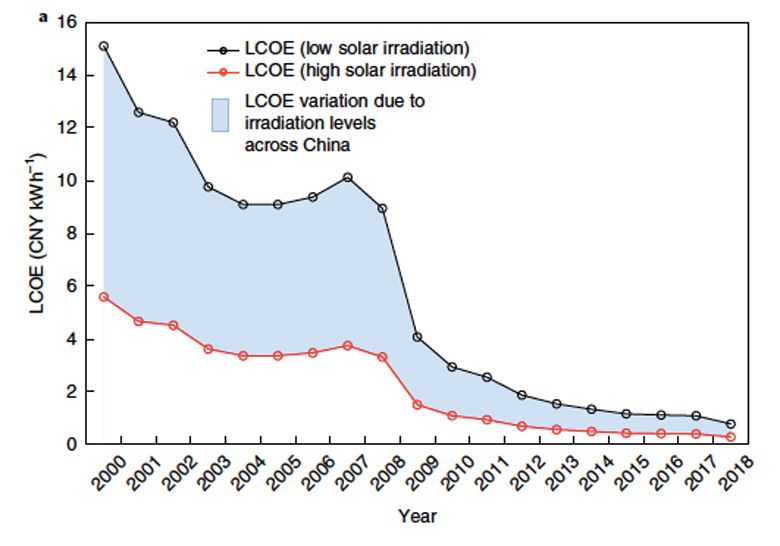


In their paper, Prof Jinyue Yan of Sweden’s Royal Institute of Technology and his colleagues explain that this “stunning” performance has been accelerated by government subsidies, but has also seen China overinvesting in what some describe as a clean energy's dirty secret of “redundant construction and overcapacity”. The authors write:

“Recently, the Chinese government has been trying to lead the PV industry onto a more sustainable and efficient development track by tightening incentive policies with China’s 531 New Policy.”

The researchers say the subsidy cuts under this policy in 2018 were a signal that the government wanted to make the industry less dependent on state support and shift its focus from scale to quality.

This, they say, has “brought the industry to a crossroads”, with discussions taking place in China about when solar electricity generation could achieve grid parity.

In their analysis, Yan and his team examined the prospects for building industrial and commercial solar projects without state support in 344 cities across China, attempting to gauge where or whether grid parity could be achieved.

The team estimated the total lifetime price of solar energy systems in all of these cities, taking into account net costs and profits, including project investments, electricity output and trading prices.

Besides establishing that installations in every city tested could supply cheaper electricity than the grid, they also compared solar to the price of coal-generated power. They found that 22% of the cities could build solar systems capable of producing electricity at cheaper prices than coal.


Embracing solar

Declining costs of solar technology, particularly crystalline silicon modules, mean the trend in China is also playing out around the world, with offshore wind cost declines reinforcing the shift. In May, the International Renewable Energy Agency (IRENA) said that by the beginning of next year, grid parity could become the global norm for the solar industry, and shifting price dynamics in Northern Europe illustrate the market impact.

Kingsmill Bond, an energy strategist at Carbon Tracker, says this is the first in-depth study he has seen looking at city-level solar costs in China, and is encouraged by this indication of solar becoming ever-more competitive, as seen in Germany's recent solar boost during the energy crisis. He tells Carbon Brief:

“The conclusion that industrial and commercial solar is cheaper than grid electricity means that the workshop of the world can embrace solar. Without subsidy and its distorting impacts, and driven by commercial gain.”

On the other hand, Jenny Chase, head of solar analysis at BloombergNEF, says the findings revealed by Yan and his team are “fairly old news” as the competitive price of rooftop solar in China has been known about for at least a year.

She notes that this does not mean there has been a huge accompanying rollout of industrial and commercial solar, and says this is partly because of the long-term thinking required for investment to be seen as worthwhile.
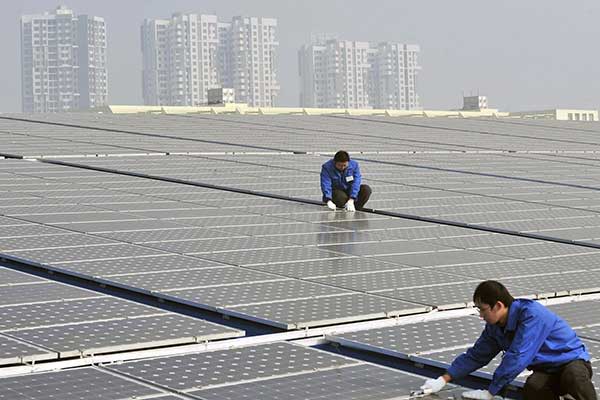


The lifetime of a PV system tends to be around two decades, whereas the average lifespan of a Chinese company is only around eight years, according to Chase. Furthermore, there is an even simpler explanation, as she explains to Carbon Brief:

“There’s also the fact that companies just can’t be bothered a lot of the time – there are roofs all over Europe where solar could probably save money, but people are not jumping to do it.”

According to Chase, a “much more exciting” development came earlier this year, when the Chinese government developed a policy for “subsidy-free solar”.

This involved guaranteeing the current coal-fired power price to solar plants for 20 years, creating what is essentially a low feed-in tariff and leading to what she describes as “a lot of nice, low-risk projects”.

As for the beneficial effects of grid parity, based on how things have played out in countries where it has already been achieved, Chase says it does not necessarily mean a significant uptake of solar power will follow:

“Grid parity solar is never as popular as subsidised solar, and ironically you don’t generally have a rush to build grid parity solar because you may as well wait until next year and get cheaper solar.”


Policy proposals

In their paper, Yan and his team lay out policy changes they think would help provide an economic incentive, in combination with grid parity, to encourage the uptake of solar power systems.

Technology costs may have fallen for smaller solar projects of the type being deployed on the rooftops of businesses, but they note that the so-called “soft costs” – including installation and maintenance – tend to be “very impactful”.

Specifically, they say aspects such as financing, land acquisition and grid accommodation, which make up over half the total cost, could be cut down:

“Labour costs are not significant [in China] because of the relatively low wages of direct labour and related installation overhead. Customer acquisition has largely been achieved in China by the mature market, with customers’ familiarity with PV systems, and with the perception that PV systems are a reliable technology. However, policymakers should consider strengthening the targeted policies on the following soft costs.”

Among the measures they suggest are new financing schemes, an effort to “streamline” the complicated procedures and taxes involved, and more geographically targeted government policies, alongside innovations like peer-to-peer energy sharing that can improve utilization.

As their analysis showed the price of solar electricity had fallen further in some cities than others, the researchers recommend targeting future subsidies at the cities that are performing less well – keeping costs to a minimum while still providing support when it is most needed.


Related News

View more

B.C. government freezes provincial electricity rates

BC Hydro Rate Freeze delivers immediate relief on electricity rates in British Columbia, reversing a planned 3% hike, as BCUC oversight, a utility review, and Site C project debates shape provincial energy policy.


Key Points

A one-year provincial policy halting BC Hydro electricity rate hikes while a utility review finds cost savings.

✅ Freeze replaces planned 3% hike approved by BCUC.

✅ Government to conduct comprehensive BC Hydro review.

✅ Critics warn $150M revenue loss impacts capital projects.


British Columbia's NDP government has announced it will freeze BC Hydro rates effective immediately, fulfilling a key election promise.

Energy, Mines and Petroleum Resources Minister Michelle Mungall says hydro rates have gone up by more than 24 per cent in the last four years and by more than 70 per cent since 2001, reflecting proposals such as a 3.75% increase over two years announced previously.

"After years of escalating electricity costs, British Columbians deserve a break on their bills," Mungall said in a news release.

BC Hydro had been approved by the B.C. Utilities Commission to increase the rate by three per cent next year, but Mungall said it will pull back its request in order to comply with the freeze.

In the meantime, the government says it will undertake a comprehensive review of the utility meant to identify cost-savings measures for customers often asked to pay an extra $2 a month on electricity bills.

The Liberal critic, Tracy Redies, says the one year rate freeze is going to cost BC Hydro, calling it a distraction from the bigger issue of the future of the Site C project and the oversight of a BC Hydro fund surplus as well.

"A one year rate freeze costs Hydro $150 million," Redies said. "That means there's $150 million less to invest in capital projects and other investments that the utility needs to make."

"This is putting off decisions that should be made today to the future."

Recommendations from the review — including possible new rates — will be implemented starting in April 2019.


Related News

View more

California proposes income-based fixed electricity charges

Income Graduated Fixed Charge aligns CPUC billing with utility fixed costs, lowers usage rates, supports electrification, and shifts California investor-owned utilities' electric bills by income, with CARE and Climate Credit offsets for low-income households.


Key Points

A CPUC proposal: an income-based monthly fixed fee with lower usage rates to align costs and aid low-income customers.

✅ Income-tiered fixed fees: $0-$42; CARE: $14-$22, by utility territory

✅ Usage rates drop 16%-22% to support electrification and cost-reflective billing

✅ Lowest-income save ~$10-$20; some higher earners pay ~$10+ more monthly


The Public Advocates Office (PAO) for the California Public Utilities Commission (CPUC) has proposed adding a monthly income-based fixed charge on electric utility bills based on income level.  

The rate change is designed to lower bills for the lowest-income residents while aligning billing more directly with utility costs. 

PAO’s recommendation for the Income Graduated Fixed Charge places fees between $22 and $42 per month in the three major investor-owned utilities’ territories, including an SDG&E minimum charge debate under way, for customers not enrolled in the California Alternative Rates for Energy (CARE) program. As seen below, CARE customers would be charged between $14 per month and $22 a month, depending on income level and territory.

For households earning $50,000 or less per year, the fixed charge would be $0, but only if the California Climate Credit is applied to offset the fixed cost.

Meanwhile, usage-based electricity rates are lowered in the PAO proposal, part of major changes to electric bills statewide. Average rates would be reduced between 16% to 22% for the three major investor-owned utilities.

The lowest-income bracket of Californians is expected to save roughly $10 to $20 a month under the proposal, while middle-income customers may see costs rise by about $20 a month, even as lawmakers seek to overturn income-based charges in Sacramento.

“We anticipate the vast majority of low-income customers ($50,000 or less per year) will have their monthly bills decrease by $10 or more, and a small proportion of the highest income earners ($100,000+ per year) will see their monthly bills rise by $10 or more,” said the PAO.

The charges are an effort to help suppress ever-increasing electricity generation and transmission rates, which are among the highest in the country, with soaring electricity prices reported across California. Rates are expected to rise sharply as wildfire mitigation efforts are implemented by the utilities found at fault for their origin.

“We are very concerned. However, we do not see the increases stopping at this point,” Linda Serizawa, deputy director for energy, PAO, told pv magazine. “We think the pace and scale of the [rate] increases is growing faster than we would have anticipated for several years now.”

Consumer advocates and regulators face calls for action on surging electricity bills across the state.

The proposed changes are also meant to more directly couple billing with the fixed charges that utilities incur, as California considers revamping electricity rates to clean the grid. For example, activities like power line maintenance, energy efficiency programs, and wildfire prevention are not expected to vary with usage, so these activities would be funded through a fixed charge.

Michael Campbell of the PAO’s customer programs team, and leader of the proposed program, likened paying for grid enhancements and other social programs with utility rate increases to “paying for food stamps by taxing food.” Instead, a fixed charge would cover these costs.

PAO said the move to lower rates for usage should help encourage electrification as California moves to replace heating and cooling, appliances, and gas combustion cars with electrified counterparts. In addition, lower rates mean the cost burden of running these devices is improved.


Related News

View more

Why Canada's Energy Security Hinges on Renewables

Renewable Energy Security strengthens affordability and grid reliability through electrification, wind, and solar, reducing fossil fuel volatility exposed by the Ukraine crisis, aligning with IEA guidance and the Paris Agreement to deliver resilient, low-cost power.


Key Points

Renewable energy security is reliable, affordable power from electrification, wind and solar, cutting fossil fuel risk.

✅ Wind and solar now outcompete gas for new power capacity.

✅ Diversifies supply and reduces fossil price volatility.

✅ Requires grid flexibility, storage, and demand response.


Oil, gas, and coal have been the central pillar of the global energy system throughout the 20th century. And for decades, these fossil fuels have been closely associated with energy security.  

The perception of energy security, however, is rapidly changing. Renewables form an increasing share of energy sectors worldwide as countries look to deliver on the Paris Agreement and mitigate the effects of climate change, with IEA clean energy investment now significantly outpacing fossil fuels. Moreover, Russia’s invasion of Ukraine has demonstrated how relying on fossil fuels for power, heating, and transport has left many countries vulnerable or energy insecure.  

The International Energy Agency (IEA) defines energy security as “the uninterrupted availability of energy sources at an affordable price” (IEA, 2019a). This definition hardly describes today’s global energy situation, with the cancellation of natural gas deliveries and skyrocketing prices for oil and gas products, and with supply chain challenges in clean energy that also require attention. These circumstances have cascading effects on electricity prices in countries like the United Kingdom that rely heavily on natural gas to produce electricity. In Europe, energy insecurity has been even further amplified since the Russian corporation Gazprom recently cut off gas supplies to several countries.  

As a result, energy security has gained new urgency in Canada and worldwide, creating opportunities in the global electricity market for Canada. Recent events provide a stark reminder of the volatility and potential vulnerability of global fossil fuel markets and supply chains. Even in Canada, as one of the largest producers of oil and gas in the world, the price of fuels depends on global and regional market forces rather than government policy or market design. Thus, the average monthly price for gasoline in Canada hit a record high of CAD 2.07 per litre in May 2022 (Figure 1), and natural gas prices surged to a record CAD 7.54 per MMBtu in May 2022 (Figure 2).  

Energy price increases of this magnitude are more than enough to strain Canadian household budgets. But on top of that, oil and gas prices have accelerated inflation more broadly as it has become more expensive to produce, transport, and store goods, including food and other basic commodities (Global News, 2022).  


Renewable Energy Is More Affordable 

In contrast to oil and gas, renewable energy can reliably deliver affordable energy, as shown by falling wholesale electricity prices in markets with growing clean power. This is a unique and positive aspect of today’s energy crisis compared to historical crises: options for electrification and renewable-based electricity systems are both available and cost-effective.  

For new power capacity, wind and solar are now cheaper than any other source, and wind power is making gains as a competitive source in Canada. According to Equinor (2022), wind and solar were already cheaper than gas-based power in 2020. This means that renewable energy was already the cheaper option for new power before the recent natural gas price spikes. As illustrated in Figure 3, the cost of new renewable energy has dropped so dramatically that, for many countries, it is cheaper to install new solar or wind infrastructure than to keep operating existing fossil fuel-based power plants (International Renewable Energy Agency, 2021). This means that replacing fossil-based electricity generation with renewables would save money and reduce emissions. Wind and solar prices are expected to continue their downward trends as more countries increase deployment and learn how to best integrate these sources into the grid. 


Renewable Energy Is Reliable 

To deliver on the uninterrupted availability side of the energy security equation, renewable power must remain reliable even as more variable energy sources, like wind and solar, are added to the system, and regional leaders such as the Prairie provinces will help anchor this transition. For Canada and other countries to achieve high energy security through electrification, grid system operations must be able to support this, and pathways to zero-emissions electricity by 2035 are feasible.  


Related News

View more

Heating and Electricity Costs in Germany Set to Rise

Germany 2025 Energy Costs forecast electricity and heating price trends amid gas volatility, renewables expansion, grid upgrades, and policy subsidies, highlighting impacts on households, industries, efficiency measures, and the Energiewende transition dynamics.


Key Points

Electricity stabilizes, gas-driven heating stays high; renewables, subsidies, and efficiency measures moderate costs.

✅ Power prices stabilize above pre-crisis levels

✅ Gas volatility keeps heating bills elevated

✅ Subsidies and efficiency upgrades offset some costs


As Germany moves into 2025, the country is facing significant shifts in heating and electricity costs. With a variety of factors influencing energy prices, including geopolitical tensions, government policies, and the ongoing transition to renewable energy sources, consumers and businesses alike are bracing for potential changes in their energy bills. In this article, we will explore how heating and electricity costs are expected to evolve in Germany in the coming year and what that means for households and industries.

Energy Price Trends in Germany

In recent years, energy prices in Germany have experienced notable fluctuations, particularly due to the aftermath of the global energy crisis, which was exacerbated by the Russian invasion of Ukraine. This geopolitical shift disrupted gas supplies, which in turn affected electricity prices and strained local utilities across the country. Although the German government introduced measures to mitigate some of the price increases, many households have still felt the strain of higher energy costs.

For 2024, experts predict that electricity prices will likely stabilize but remain higher than pre-crisis levels. While electricity prices nearly doubled in 2022, they have gradually started to decline, and the market has adjusted to the new realities of energy supply and demand. Despite this, the cost of electricity is expected to stay elevated as Germany continues to phase out coal and nuclear energy while ramping up the use of renewable sources, which often require significant infrastructure investments.

Heating Costs: A Mixed Outlook

Heating costs in Germany are heavily influenced by natural gas prices, which have been volatile since the onset of the energy crisis. Gas prices, although lower than the peak levels seen in 2022, are still considerably higher than in the years before. This means that households relying on gas heating can expect to pay more for warmth in 2024 compared to previous years.

The government has implemented measures to cushion the impact of these increased costs, such as subsidies for vulnerable households and efforts to support energy efficiency upgrades. Despite these efforts, consumers will still feel the pinch, particularly in homes that use older, less efficient heating systems. The transition to more sustainable heating solutions, such as heat pumps, remains a key goal for the German government. However, the upfront cost of such systems can be a barrier for many households.

The Role of Renewable Energy and the Green Transition

Germany has set ambitious goals for its energy transition, known as the "Energiewende," which aims to reduce reliance on fossil fuels and increase the share of renewable energy sources in the national grid. In 2024, Germany is expected to see further increases in renewable energy generation, particularly from wind and solar power. While this transition is essential for reducing carbon emissions and improving long-term energy security, the shift comes with its own challenges already documented in EU electricity market trends reports.

One of the main factors influencing electricity costs in the short term is the intermittency of renewable energy sources. Wind and solar power are not always available when demand peaks, requiring backup power generation from fossil fuels or stored energy. Additionally, the infrastructure needed to accommodate a higher share of renewables, including grid upgrades and energy storage solutions, is costly and will likely contribute to rising electricity prices in the near term.

On a positive note, Germany's growing investment in renewable energy is expected to make the country less reliant on imported fossil fuels, particularly natural gas, which has been a major source of price volatility. Over time, as the share of renewables in the energy mix grows, the energy system should become more stable and less susceptible to geopolitical shocks, which could lead to more predictable and potentially lower energy costs in the long run.

Government Interventions and Subsidies

To help ease the burden on consumers, the German government has continued to implement various measures to support households and businesses. One of the key programs is the reduction in VAT (Value Added Tax) on electricity, which has been extended in some regions. This measure is designed to make electricity more affordable for all households, particularly those on fixed incomes facing EU energy inflation pressures that have hit the poorest hardest.

Moreover, the government has been providing financial incentives for households and businesses to invest in energy-efficient technologies, such as insulation and energy-saving heating systems, complementing the earlier 200 billion euro energy shield announced to buffer surging prices. These incentives are intended to reduce overall energy consumption, which could offset some of the rising costs.

The outlook for heating and electricity costs in Germany for 2024 is mixed, even as energy demand hit a historic low amid economic stagnation. While some relief from the extreme price spikes of 2022 may be felt, energy costs will still be higher than they were in previous years. Households relying on gas heating will likely see continued elevated costs, although those who invest in energy-efficient solutions or renewable heating technologies may be able to offset some of the increases. Similarly, electricity prices are expected to stabilize but remain high due to the country’s ongoing transition to renewable energy sources.

While the green transition is crucial for long-term sustainability, consumers must be prepared for potentially higher energy costs in the short term. Government subsidies and incentives will help alleviate some of the financial pressure, but households should consider strategies to reduce energy consumption, such as investing in more efficient heating systems or adopting renewable energy solutions like solar panels.

As Germany navigates these changes, the country’s energy future will undoubtedly be shaped by a delicate balance between environmental goals and the economic realities of transitioning to a greener energy system.


Related News

View more

Sign Up for Electricity Forum’s Newsletter

Stay informed with our FREE Newsletter — get the latest news, breakthrough technologies, and expert insights, delivered straight to your inbox.

Electricity Today T&D Magazine Subscribe for FREE

Stay informed with the latest T&D policies and technologies.
  • Timely insights from industry experts
  • Practical solutions T&D engineers
  • Free access to every issue

Download the 2025 Electrical Training Catalog

Explore 50+ live, expert-led electrical training courses –

  • Interactive
  • Flexible
  • CEU-cerified