By


NFPA 70b Training - Electrical Maintenance

Our customized live online or in‑person group training can be delivered to your staff at your location.

  • Live Online
  • 12 hours Instructor-led
  • Group Training Available
Regular Price:
$699
Coupon Price:
$599
Reserve Your Seat Today
Progress toward letting consumers choose their electric supplier has virtually ground to a halt in the United States, the latest edition of the Retail Energy Deregulation Index (RED Index) shows. As an alternative, however, experiments with "virtual choice" in regulated markets are picking up.

The fourth edition of the RED Index, issued by the Center for the Advancement of Energy Markets (CAEM) at the Edison Electric Institute's National Accounts Conference, shows that California's well-publicized troubles, the Enron collapse and the financial crisis in the energy industry have all but halted progress on electricity competition in the U.S. The most positive development in retail energy competition is the emergence of the North American Energy Standards Board (NAESB), the RED Index says. The report notes that Texas continues to lead the U.S. in electricity restructuring, while progress continues in Canada, England, Australia and New Zealand. The stall in consumer choice of supplier, the RED Index says, has led some states to experiment with "virtual choice," allowing consumers to choose from a richer menu of options added to the distribution utility's traditional offerings. Oregon has taken the lead on virtual choice by offering mass- market customers a portfolio of regulated supply options that include renewable energy plans that rely on existing geothermal and wind sources, contributions to salmon-habitat restoration, the purchase of new wind resources and time-of-use rates. Other distributors have begun to offer weather-hedged or term products as well as green energy and metering options. Ken Malloy, CEO of CAEM, commented, "While direct access is being refined in other jurisdictions, more skeptical jurisdictions can begin to both prepare customers for the eventuality of choice and support the development in the supplier community of innovative service and product offerings." CAEM will issue a new series of white papers, the Retail Energy Developments Report, to analyze emerging developments relating both to direct choice of supplier and virtual choice at the distribution company level. Eight states lead the U.S. in giving customers the option of supplier choice. Texas is ahead with a score of 69 out of 100, giving it a third-place ranking internationally. Pennsylvania, Maine, New York, the District of Columbia, Michigan, Maryland and New Jersey all have scores over 50.

The most positive development in retail energy competition is the emergence of the North American Energy Standards Board (NAESB), the RED Index says.

The report notes that Texas continues to lead the U.S. in electricity restructuring, while progress continues in Canada, England, Australia and New Zealand.

The stall in consumer choice of supplier, the RED Index says, has led some states to experiment with "virtual choice," allowing consumers to choose from a richer menu of options added to the distribution utility's traditional offerings. Oregon has taken the lead on virtual choice by offering mass- market customers a portfolio of regulated supply options that include renewable energy plans that rely on existing geothermal and wind sources, contributions to salmon-habitat restoration, the purchase of new wind resources and time-of-use rates. Other distributors have begun to offer weather-hedged or term products as well as green energy and metering options.

Ken Malloy, CEO of CAEM, commented, "While direct access is being refined in other jurisdictions, more skeptical jurisdictions can begin to both prepare customers for the eventuality of choice and support the development in the supplier community of innovative service and product offerings." CAEM will issue a new series of white papers, the Retail Energy Developments Report, to analyze emerging developments relating both to direct choice of supplier and virtual choice at the distribution company level.

Eight states lead the U.S. in giving customers the option of supplier choice. Texas is ahead with a score of 69 out of 100, giving it a third-place ranking internationally. Pennsylvania, Maine, New York, the District of Columbia, Michigan, Maryland and New Jersey all have scores over 50.

Related News

Energy Department Announces 20 New Competitors for the American-Made Solar Prize

American-Made Solar Prize Round 3 accelerates DOE-backed solar innovation, empowering entrepreneurs and domestic manufacturing with photovoltaics and grid integration support via National Laboratories, incubators, and investors to validate products, secure funding, and deploy backup power.


Key Points

A DOE challenge fast-tracking solar innovation to market readiness, boosting US manufacturing and grid integration.

✅ $50,000 awards to 20 teams for prototype validation

✅ Access to National Labs, incubators, investors, and mentors

✅ Focus on PV advances and grid integration solutions


The U.S. Department of Energy (DOE) announced the 20 competitors who have been invited to advance to the next phase of the American-Made Solar Prize Round 3, a competition designed to incentivize the nation’s entrepreneurs to strengthen American leadership in solar energy innovation and domestic manufacturing, a key front in the clean energy race today.

The American-Made Solar Prize is designed to help more American entrepreneurs thrive in the competitive global energy market. Each round of the prize brings new technologies to pre-commercial readiness in less than a year, ensuring new ideas enter the marketplace. As part of the competition, teams will have access to a network of DOE National Laboratories, technology incubators and accelerators, and related DOE efforts like next-generation building upgrades, venture capital firms, angel investors, and industry. This American-Made Network will help these competitors raise private funding, validate early-stage products, or test technologies in the field.

Each team will receive a $50,000 cash prize and become eligible to compete in the next phase of the competition. Through a rigorous evaluation process, teams were chosen based on the novelty of their ideas and how their solutions address a critical need of the solar industry. The teams were selected from 120 submissions and represent 11 states. These projects will tackle challenges related to new solar applications, like farming, as well as show how solar can be used to provide backup power when the grid goes down, aided by increasingly affordable batteries now reaching scale. Nine teams will advance solar photovoltaic technologies, and 11 will address challenges related to how solar integrates with the grid. The projects are as follows:

Photovoltaics:

  • Durable Antireflective and Self-Cleaning Glass (Pittsburgh, PA)
  • Pursuit Solar - More Power, Less Hassle (Denver, NC)
  • PV WaRD (San Diego, CA)
  • Remotely Deployed Solar Arrays (Charlottesville, VA)
  • Robotics Changing the Landscape for Solar Farms (San Antonio, TX)
  • TrackerSled (Chicago, IL)
  • Transparent Polymer Barrier Films for PV (Bristol, PA)
  • Solar for Snow (Duluth, MN)
  • SolarWall Power Tower (Buffalo, NY)


Systems Integration:

  • Affordable Local Solar Storage via Utility Virtual Power Plants (Parker, TX)
  • Allbrand Solar Monitor (Detroit, MI)
  • Beyond Monitoring – Next Gen Software and Hardware (Atlanta, GA)
  • Democratizing Solar with Artificial Intelligence Energy Management (Houston, TX)
  • Embedded, Multi-Function Maximum Power Point Tracker for Smart Modules (Las Vegas, NV)
  • Evergrid: Keep Solar Flowing When the Grid Is Down (Livermore, CA)
  • Inverter Health Scan (San Jose, CA)
  • JuiceBox: Integrated Solar Electricity for Americans Transitioning out of Homelessness and Recovering from Natural Disasters (Claremont, CA)
  • Low-Cost Parallel-Connected DC Power Optimizer (Blacksburg, VA)
  • Powerfly: A Plug-and-Play Solar Monitoring Device (Berkeley, CA)
  • Simple-Assembly Storage Kit (San Antonio, TX)

Read the descriptions of the projects to see how they contribute to efforts to improve solar and wind power worldwide.

Over the next six months, these teams will fast-track their efforts to identify, develop, and test disruptive solutions amid record solar and storage growth projected nationwide. During a national demonstration day at Solar Power International in September 2020, a panel of judges will select two final winners who will receive a $500,000 prize. Learn more at the American-Made Solar Prize webpage.

The American-Made Challenges incentivize the nation's entrepreneurs to strengthen American leadership in energy innovation and domestic manufacturing. These new challenges seek to lower the barriers U.S.-based innovators face in reaching manufacturing scale by accelerating the cycles of learning from years to weeks while helping to create partnerships that connect entrepreneurs to the private sector and the network of DOE’s National Laboratories across the nation, alongside recent wind energy awards that complement solar innovation.

Go here to learn how this work aligns with a tenfold solar expansion being discussed nationally.

https://www.energy.gov/eere/solar/solar-energy-technologies-office


Related News

View more

The crisis in numbers: How COVID-19 has reshaped Saskatchewan

Saskatchewan COVID-19 economic impact: real-time data shows drops in electricity demand, oil well licensing, traffic and tickets, plus spikes in internet usage, government site visits, remote work, and alcohol wholesale volumes.


Key Points

COVID-19 reduced energy use, drilling and traffic, while pushing activity online; jobs, rents and sales show strain.

✅ Electricity demand down 6.7%; residential usage up

✅ Oil well license applications fell 15-fold in April

✅ Internet traffic up 16%-46%; wireless LTE up 34%


We’re only just beginning to grasp how COVID-19 has upended Saskatchewan’s economy, its government and all of our lives.

The numbers that usually make headlines — job losses, economic contraction, bankruptcies — are still well behind the pace of the virus and its toll.

But other numbers change more quickly. Saskatchewan people are using less power, and the power industry is adopting on-site staffing plans to ensure reliability as conditions evolve. We’re racking up fewer speeding tickets. And as new restrictions come, we’re clicking onto Saskatchewan.ca as much as 10,000 times per minute.

Here’s some data that provides a first glimpse into how much our province has changed in just six weeks.

Electricity use tends to rise and fall in tandem with the health of the economy, and the most recent data from SaskPower suggests businesses are powering down, while regional utilities such as Manitoba Hydro seek unpaid days off to trim costs.

Peak load requirements between March 15 and April 26 were 220 MW lower than during the same period in 2019, and elsewhere BC Hydro is posting COVID-19 updates at Site C as it manages project impacts. That’s a decrease of 6.7 per cent, with total load on April 29 at 2,551 MW. A megawatt is enough electricity to power about 1,000 homes.

Separate from pandemic impacts, an external investigation at Manitoba Hydro has drawn attention to workplace conduct issues.

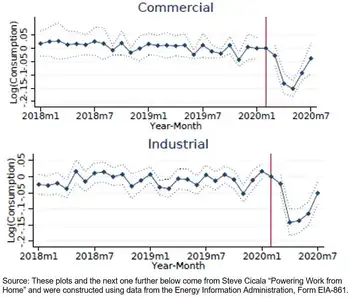
But it’s not homes that are turning off the lights. SaskPower spokesman Joel Cherry said commercial and industrial usage is down, while residential demand is up, with household electricity bills rising as more people stay home.

The timing of power demand has also shifted, a pattern seen as residential electricity use rises during work-from-home routines. Peak load would usually come around 8 or 9 p.m. in April. Now it’s coming earlier, typically between 5 and 6 p.m.

Oil well applications fall 15-fold
Oil prices have cratered since late February, and producers in Saskatchewan have reacted by pulling back on drilling plans, while neighbouring Alberta provides transition support for coal workers amid broader energy shifts.

Applications for well licences fell from 242 in January to 203 in February (including nine potash and one helium operations), before dropping to 84 in March. April, the month benchmark oil prices went negative for one day, producers submitted just 15 applications.

That’s 15 times fewer than the 231 applications the Ministry of Energy and Resources received in April 2019.

Well licences are needed for drilling, operating, injecting, producing or exploring an oil and gas or potash well in the province.

There has been no clear trend in well abandonment, however. There were 176 applications for abandonment in March and 155 in April, roughly in line with figures from the year before.

SGI spokesman Tyler McMurchy believes the lower numbers might stem from a combination of lower traffic volumes during part of the month, possibly combined with a shift in police priorities. The March 2020 numbers are also well below January and February figures.

Indeed, the Ministry of Highways and infrastructure reported a 16 per cent decrease in average daily traffic last month compared to March 2019, through its traffic counts at 11 different spots on highways across the province.

In Regina, traffic counts at 16 locations dropped from a high of 2.1 million in the first week of March to a low of 1.3 million during the week of March 22. That’s a 44 per cent decrease.

Counts have gradually recovered to 1.6 million in the weeks since. The data was fairly consistent at all 16 spots, which are largely major intersections, though the city cautioned they may not be representative of Regina as a whole.

Tickets for cellphone use while driving also fell, dropping from 562 in February to 314 in March. McMurchy noted that distracted driving numbers in general have been falling since November as stiffer penalties were announced. Impaired driving tickets were up, by contrast, but still within a typical range.

Internet traffic shoots up 16 per cent, far more for rural high speed
You may be spending a lot more time on Netflix and Facebook in the age of social distancing, and SaskTel has noticed.

From late February to late April, SaskTel has seen “very significant increases in provincial data traffic.” DSL and fibre optic networks have handled a 16 per cent increase in traffic, while demand on the wireless LTE network is up 34 per cent.

Usage on the Fusion network up 46 per cent. That network serves rural areas that don’t have access to other high-speed options.

The specific reference dates for comparison were February 24 and April 27.

“We attribute these changes in data usage to the pandemic and not expected seasonal or yearly shifts in usage patterns,” said spokesman Greg Jacobs.

Saskatchewan.ca was attracting just 70 page views per minute on average in February. But page views jumped over 10,000 per minute at 2:38 p.m. on March 18, as Moe was still announcing the new measures.

That’s a 14,000 per cent increase.

For all of March, visitor sessions on the site clocked in at 3,905,061, almost four times the 944,904 recorded for February.

Bureaucracy has increasingly migrated to cyberspace, with 62 per cent of civil servants now working from home. Government Skype calls, both audio and video, have tripled from 12,000 sessions per day to 35,000.Telephone conference calls increased by a factor of 14 from the first week of February to the second full week of April, with 25 times more weekly call participants. 

The Ministry of Central Services reported a 17 per cent jump in emails received by government over the past two months, excluding the Ministry of Health.

But as civil servants spend more time on their computers, the government’s fleet is spending a lot less time on the road. The ministry has purchased 40 per cent fewer litres of fuel for its vehicles over the past four weeks, compared to the same time last year.

Alcohol wholesale volumes up 22 per cent, then fall back to normal
Retailers bought more alcohol from the Saskatchewan Liquor and Gaming Authority (SLGA) last month, just as the government began tightening pandemic restrictions.

Wholesale sales volumes were up 22 per cent over March 15 to 28, compared to the same period in 2019. SLGA spokesman David Morris said the additional demand “was likely the result of retailers stocking-up as restrictions related to COVID-19 took effect.”

But the jump didn’t last. Wholesale volumes were back to normal for the first two weeks of April. SLGA did notice a very slight uptick last week, however, with volumes out of its distribution centre up three per cent. The numbers do not include Brewer’s Distributors Ltd.

It’s unclear how much more alcohol consumers actually purchased, since province-wide retail numbers were not available.

There was no discernible trend in March for anti-anxiety medication, however. The number of prescriptions filled for benzodiazepines like Valium, Xanax and Ativan see-sawed over March, according to data provided by the College of Physicians and Surgeons, but its associate registrar does not believe the trends are statistically relevant.

One-fifth of tenants miss April rent
About 20 per cent of residential rent went totally unpaid in the first six days of April, according to the Saskatchewan Landlord Association (SLA).

The precise number is 19.7 per cent, but there’s some uncertainty due to the survey method, which is based on responses from 300 residential landlords with 14,000 units. An additional 12 per cent of tenants paid a portion of their rent, but not the full amount. The figures do not include social housing.

Cameron Choquette, the association’s executive officer, partly blames the province’s decision to suspend most landlord tenant board hearings for evictions, saying it “allows more people to take advantage of landlords by not paying their rent and not facing any consequences.”

The government has defended the suspension by saying it’s needed to ensure everyone has a safe place to self-isolate if needed during the pandemic.

March’s jobs numbers were bad, with almost 21,000 fewer Saskatchewan people employed compared to February.

April’s labour force survey is expected on Friday. But new April numbers released Wednesday show that two-thirds of the province’s businesses managed to avoid laying off staff almost entirely.

According to Statistics Canada, 66.2 per cent of businesses reported laying off between zero and one per cent of their employees due to COVID-19. That was better than any other province. Just 7.6 per cent laid off all of their employees, again the best number outside the territories. The survey period was April 3 to 24.

Some businesses are even hiring. Walmart, for instance, has hired 300 people in Saskatchewan since mid-March.

Trade and Export Development Minister Jeremy Harrison chalked the data up to a relatively more optimistic business outlook in Saskatchewan, combined with “very targeted” restrictions and a support program for small and medium businesses.

That support program, which provides $5,000 grants to qualifying businesses affected by government restrictions, has only been around for three weeks. But it’s already been bombarded with 6,317 applications.

The total value of those applications would be $24,178,000, according to Harrison. Of them, 3,586 have been approved with a value of $11,755,000.

Businesses are coming to Harrison’s ministry with thousands of questions. Since it opened in March, the Business Response Team has received 4,125 calls and 1,758 emails.

The kinds of questions have changed over the course of the pandemic. Many are now asking when they can open their doors, according to Harrison, as they wonder about “grey areas” in the Re-Open Saskatchewan plan.


Related News

View more

Texas lawmakers propose electricity market bailout after winter storm

Texas Electricity Market Bailout proposes securitization bonds and ERCOT-backed fees after Winter Storm Uri, spreading costs via ratepayer charges on power bills to stabilize generators, co-ops, and retailers and avert bankruptcies and investor flight.


Key Points

State plan to securitize storm debts via ERCOT fees, adding bill charges to stabilize Texas power firms.

✅ Securitization bonds finance unpaid ancillary services and energy costs

✅ ERCOT fee spreads Winter Storm Uri debts across ratepayers statewide

✅ Aims to prevent bankruptcies, preserve grid reliability, reassure investors


An approximately $2.5 billion plan to bail out Texas’ distressed electricity market from the financial crisis caused by Winter Storm Uri in February has been approved by the Texas House.

The legislation would impose a fee — likely for the next decade or longer — on electricity companies, which would then get passed on to residential and business customers in their power bills, even as some utilities waived certain fees earlier in the crisis.

House lawmakers sent House Bill 4492 to the Senate on Thursday after a 129-15 vote. A similar bill is advancing in the Senate.

Some of the state’s electricity providers and generators are financially underwater in the aftermath of the February power outages, which left millions without power and killed more than 100 people. Electricity companies had to buy whatever power was available at the maximum rate allowed by Texas regulations — $9,000 per megawatt hour — during the week of the storm (the average price for power in 2020 was $22 per megawatt hour). Natural gas fuel prices also spiked more than 700% during the storm.

Several companies are nearing default on their bills to the Electric Reliability Council of Texas, which manages the Texas power grid that covers most of the state and facilitates financial transactions in it.

Rural electric cooperatives were especially hard hit; Brazos Electric Power Cooperative, which supplies electricity to 1.5 million customers, filed for bankruptcy citing a $1.8 billion debt to ERCOT.

State Rep. Chris Paddie, R-Marshall, the bill’s author, said a second bailout bill will be necessary during the current legislative session for severely distressed electric cooperatives.

“This is a financial crisis, and it’s a big one,” James Schaefer, a senior managing director at Guggenheim Partners, an investment bank, told lawmakers at a House State Affairs Committee hearing in early April. He warned that more bankruptcies would cause higher costs to customers and hurt the state’s image in the eyes of investors.

“You’ve got to free the system,” Schaefer said. “It’s horrible that a bunch of folks have to pay, but it’s a system-wide failure. If you let a bunch of folks crash, it’s not a good look for your state.”

If approved by the Senate and Gov. Greg Abbott, a newly-created Texas Electric Securitization Corp. would use the money raised from the fees for bonds to help pay the companies’ debts, including costs for ancillary services, a financial product that helps ensure power is continuously generated and improve electricity reliability across the grid.

Paddie told his colleagues Wednesday that he could not yet estimate how long the new fee would be imposed, but during committee hearings lawmakers estimated it’s likely to be at least a decade. Several other bills to spread out the costs of the winter storm and consider market reforms are also moving through the Legislature.

ERCOT’s independent market monitor recommended in March that energy sold during that period be repriced at a lower rate, which would have allowed ERCOT to claw back about $4.2 billion in payments to power generators, but the Public Utility Commission declined to do so, even as a court ruling on plant obligations in emergencies drew scrutiny among market participants.

Instead, lawmakers are pushing for bailouts that several energy experts have said is needed, both to ensure distressed companies don’t pass enormous costs on to their customers and to prevent electricity investors and companies from leaving the state if it’s viewed as too risky to continue doing business.

Becky Klein, an energy consultant in Austin and former chair of the Public Utility Commission who played a key role in de-regulating Texas’ electricity market two decades ago, said during a retail electricity panel hosted by Integrate that legislation is necessary to provide “some kind of backstop during a crazy market crisis like this to show the financial market that we’re willing to provide some relief.”

Still, some lawmakers are concerned with how they will win public support, including potential voter-approved funding measures, for bills to bail out the state’s electricity market.

“I have to go back to Laredo and say, ‘I know you didn’t have electricity for several days, but now I’m going to make you pay a little more for the next 20 years,’” state Rep. Richard Peña Raymond, D-Laredo, said during an early April discussion on the plan in the House State Affairs Committee. He said he voted for the bill because it’s in the best interest of the state.

Paddie, during the same committee hearing, acknowledged that “none of us want to increase fees or taxes.” However, he said, “We have to deal with the reality set before us.”


Related News

View more

Prevent Summer Power Outages

Summer Heatwave Electricity Shutoffs strain utilities and vulnerable communities, highlighting energy assistance, utility moratoriums, cooling centers, demand response, and grid resilience amid extreme heat, climate change, and rising air conditioning loads.


Key Points

Service disconnections for unpaid bills during extreme heat, risking vulnerable households and straining power grids.

✅ Moratoriums and flexible payment plans reduce shutoff risk.

✅ Cooling centers and assistance programs protect at-risk residents.

✅ Demand response, smart grids, and efficiency ease peak loads.


As summer temperatures soar, millions of people across the United States face the grim prospect of electricity shutoffs due to unpaid bills, as heat exacerbates electricity struggles for many families nationwide. This predicament highlights a critical issue exacerbated by extreme weather conditions and economic disparities.

The Challenge of Summer Heatwaves

Summer heatwaves not only strain power grids, as unprecedented electricity demand has shown, but also intensify energy consumption as households and businesses crank up their air conditioning units. This surge in demand places considerable stress on utilities, particularly in regions unaccustomed to prolonged heatwaves or lacking adequate infrastructure to cope with increased loads.

Vulnerable Populations

The threat of electricity shutoffs disproportionately affects vulnerable populations, including low-income households who face sky-high energy bills during extreme heat, elderly individuals, and those with underlying health conditions. Lack of access to air conditioning during extreme heat can lead to heat-related illnesses such as heat exhaustion and heatstroke, posing serious health risks.

Economic and Social Implications

The economic impact of electricity shutoffs extends beyond immediate discomfort, affecting productivity, food storage, and the ability to work remotely for those reliant on electronic devices, while rising electricity prices further strain household budgets. Socially, the inability to cool homes and maintain basic comforts strains community resilience and exacerbates inequalities.

Policy and Community Responses

In response to these challenges, policymakers and community organizations advocate for measures to prevent electricity shutoffs during heatwaves. Proposed solutions include extending moratoriums on shutoffs, informed by lessons from COVID-19 energy insecurity measures, implementing flexible payment plans, providing financial assistance to at-risk households, and enhancing communication about available resources.

Public Awareness and Preparedness

Raising public awareness about energy conservation during peak hours and promoting strategies to stay cool without overreliance on air conditioning are crucial steps towards mitigating electricity demand. Encouraging energy-efficient practices and investing in renewable energy sources also contribute to long-term resilience against climate-driven energy challenges.

Collaborative Efforts

Collaboration between government agencies, utilities, nonprofits, and community groups is essential in developing comprehensive strategies to safeguard vulnerable populations during heatwaves, especially when systems like the Texas power grid face renewed stress during prolonged heatwaves. By pooling resources and expertise, stakeholders can better coordinate emergency response efforts, distribute cooling centers, and ensure timely assistance to those in need.

Technology and Innovation

Advancements in smart grid technology and decentralized energy solutions offer promising avenues for enhancing grid resilience and minimizing disruptions during extreme weather events. These innovations enable more efficient energy management, demand response programs, and proactive monitoring of grid stability, though some utilities face summer supply-chain constraints that delay deployments.

Conclusion

As summer heatwaves become more frequent and severe, the risk of electricity shutoffs underscores the urgent need for proactive measures to protect vulnerable communities. By prioritizing equity, sustainability, and resilience in energy policy and practice, stakeholders can work towards ensuring reliable access to electricity, particularly during times of heightened climate vulnerability. Addressing these challenges requires collective action and a commitment to fostering inclusive and sustainable solutions that prioritize human well-being amid changing climate realities.


Related News

View more

B.C. Hydro adds more vehicle charging stations across southern B.C.

BC Hydro EV Charging Stations expand provincewide with DC fast chargers, 80% in 30 minutes at 35 c/kWh, easing range anxiety across Vancouver, Vancouver Island, Coquihalla Highway, East Kootenay, between Kamloops and Prince George.


Key Points

Public DC fast-charging network across B.C. enabling 80% charge in 30 minutes to cut EV range anxiety.

✅ 28 new stations added; 30 launched in 2016

✅ 35 c/kWh; about $3.50 per tank equivalent

✅ Coverage: Vancouver, Island, Coquihalla, East Kootenay


B.C. Hydro is expanding its network of electric vehicle charging stations.

The Crown utility says 28 new stations complete the second phase of its fast-charging network and are in addition to the 30 stations opened in 2016.

Thirteen of the stations are in Metro Vancouver, seven are on Vancouver Island, including one at the Pacific Rim Visitor Centre near Tofino, another is in Campbell River, and two have opened on the Coquihalla segment of B.C.'s Electric Highway at the Britton Creek rest area.

A further six stations are located throughout the East Kootenay and B.C. Hydro says the next phase of its program will connect drivers travelling between Kamloops and Prince George, while stations in Prince Rupert are also being planned.

BC Hydro has also opened a fast charging site in Lillooet, illustrating expansion into smaller communities.

Hydro spokeswoman Mora Scott says the stations can charge an electric vehicle to 80 per cent in just 30 minutes, at a cost of 35 cents per kilowatt hour.

Mora Scott says that translates to roughly $3.50 for the equivalent of a full tank of gas in the average four-cylinder car.

“The number of electric vehicles on B.C. roads is increasing, there’s currently around 9,000 across the province, and we actually expect that number to rise to 300,000 by 2030,” Scott says in a news release.

In partnership with municipalities, regional districts and several businesses, B.C. Hydro has been installing charging stations throughout the province since 2012 with support from the provincial and federal governments and programs such as EV charger rebates available to residents.

Scott says the utility wants to ensure the stations are placed where drivers need them so charging options are available provincewide.

“One big thing that we know drivers of electric vehicles worry about is the concept called range anxiety, that the stations aren’t going to be where they need them,” she says.

Several models of electric vehicle are now capable of travelling up to 500 kilometres on a single charge, says Scott.

BC Hydro president Chris O’Riley says the new charging sites will encourage electric vehicle drivers to explore B.C. this summer.


Related News

View more

U.S. power companies face supply-chain crisis this summer

U.S. Power Grid Supply Shortages strain reliability as heat waves, hurricanes, and drought drive peak demand; transformer scarcity, gas constraints, and renewable delays raise outage risks across ERCOT and MISO, prompting FERC warnings.


Key Points

They are equipment and fuel constraints that, amid extreme weather and peak demand, elevate outage risks.

✅ Transformer shortages delay storm recovery and repairs.

✅ Record gas burn, low hydro tighten generation capacity.

✅ ERCOT and MISO warn of rolling outages in heat waves.


U.S. power companies are facing supply crunches amid the U.S. energy crisis that may hamper their ability to keep the lights on as the nation heads into the heat of summer and the peak hurricane season.

Extreme weather events such as storms, wildfires and drought are becoming more common in the United States. Consumer power use is expected to hit all-time highs this summer, reflecting unprecedented electricity demand across the Eastern U.S., which could strain electric grids at a time when federal agencies are warning the weather could pose reliability issues.

Utilities are warning of supply constraints for equipment, which could hamper efforts to restore power during outages. They are also having a tougher time rebuilding natural gas stockpiles for next winter, after the Texas power system failure highlighted cold-weather vulnerabilities, as power generators burn record amounts of gas following the shutdown of dozens of coal plants in recent years and extreme drought cuts hydropower supplies in many Western states.

"Increasingly frequent cold snaps, heat waves, drought and major storms continue to challenge the ability of our nation’s electric infrastructure to deliver reliable affordable energy to consumers," Richard Glick, chairman of the U.S. Federal Energy Regulatory Commission (FERC), said earlier this month.

Federal agencies responsible for power reliability like FERC have warned that grids in the western half of the country could face reliability issues this summer as consumers crank up air conditioners to escape the heat, with nationwide blackout risks not limited to Texas. read more

Some utilities have already experienced problems due to the heat. Texas' grid operator, the Electric Reliability Council of Texas (ERCOT), was forced to urge customers to conserve energy as the Texas power grid faced another crisis after several plants shut unexpectedly during an early heat wave in mid-May. read more

In mid-June, Ohio-based American Electric Power Co (AEP.O) imposed rolling outages during a heat wave after a storm damaged transmission lines and knocked out power to over 200,000 homes and businesses.

The U.S. Midwest faces the most severe risk because demand is rising while nuclear and coal power supplies have declined. read more

The Midcontinent Independent System Operator (MISO), which operates the grid from Minnesota to Louisiana, warned that parts of its coverage area are at increased risk of temporary outages to preserve the integrity of the grid.

Supply-chain issues have already delayed the construction of renewable energy projects across the country, and the aging U.S. grid is threatening progress on renewables and EVs. Those renewable delays coupled with tight power in the Midwest prompted Wisconsin's WEC Energy Group Inc (WEC.N) and Indiana's NiSource Inc (NI.N) to delay planned coal plant shutdowns in recent months.

BRACING FOR SUPPLY SHORTAGES
Utility operators are conserving their inventory of parts and equipment as they plan to prevent summer power outages during severe storms. Over the last several months, that means operators have been getting creative.

"We’re doing a lot more splicing, putting cables together, instead of laying new cable because we're trying to maintain our new cable for inventory when we need it," Nick Akins, chief executive of AEP, said at the CERAWeek energy conference in March.

Transformers, which often sit on top of electrical poles and convert high-voltage energy to the power used in homes, are in short supply.

New Jersey-based Public Service Enterprise Group Inc (PSEG) (PEG.N) Chief Executive Ralph Izzo told Reuters the company has had to look at alternate supply options for low voltage transformers.

"You don’t want to deplete your inventory because you don't know when that storm is coming, but you know it's coming," Izzo said.

Some utilities are facing waiting times of more than a year for transformer parts, the National Rural Electric Cooperative Association and the American Public Power Association told U.S. Energy Secretary Jennifer Granholm in a May letter.

Summer is just starting, but U.S. weather so far this year has already been about 21% warmer than the 30-year norm, according to data provider Refinitiv.

"If we have successive days of 100-degree-heat, those pole top transformers, they start popping like Rice Krispies, and we would not have the supply stack to replace them," Izzo said.


Related News

View more

Sign Up for Electricity Forum’s Newsletter

Stay informed with our FREE Newsletter — get the latest news, breakthrough technologies, and expert insights, delivered straight to your inbox.

Electricity Today T&D Magazine Subscribe for FREE

Stay informed with the latest T&D policies and technologies.
  • Timely insights from industry experts
  • Practical solutions T&D engineers
  • Free access to every issue

Live Online & In-person Group Training

Advantages To Instructor-Led Training – Instructor-Led Course, Customized Training, Multiple Locations, Economical, CEU Credits, Course Discounts.

Request For Quotation

Whether you would prefer Live Online or In-Person instruction, our electrical training courses can be tailored to meet your company's specific requirements and delivered to your employees in one location or at various locations.