Digital Grid Solutions in Utility Control Architecture
By William Conklin, Associate Editor
By William Conklin, Associate Editor
Request for Quotation Service

Buyers Submit Free RFQs to top suppliers, no obligation.
Suppliers Browse real project RFQs directly from buyers.
Trust Electricity Forum 40 years connection buyers and suppliers.
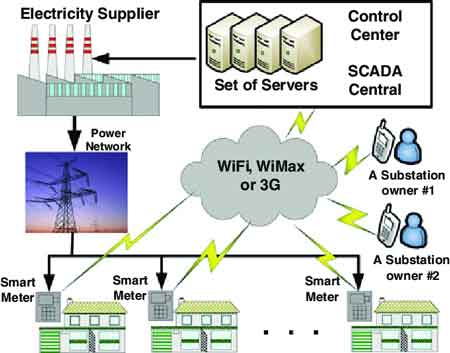
Digital grid solutions determine whether a control room action stabilizes or destabilizes a feeder, integrating SCADA, data analytics, grid cybersecurity strategy, and smart grid communication to govern real-time DER coordination and operational resilience.
Digital grid solutions determine whether a control room action stabilizes or destabilizes a feeder. In modern distribution networks saturated with DER, inverter backfeed, and high endpoint density, a misclassified system state can trigger automated switching that amplifies rather than contains disturbance.
This is not a modernization discussion. It is a governance discussion. When topology confidence drops below operational tolerance, every automated action becomes a risk multiplier.
Transmission and distribution systems now operate under sub-second validation constraints. If breaker state confirmation, current magnitude verification, and topology alignment cannot be validated within a 2-second control window, fallback logic must inhibit automation. If that window extends to 8 seconds under congestion or telemetry drift, switching certainty degrades, and operator hesitation increases.
Digital grid solutions, therefore, govern permission to act, not simply visibility.
Utilities often deploy analytics layers without restructuring operational accountability. Visibility alone does not reduce outage duration. Decision authority does. Effective digital grid solutions bind telemetry, validation logic, and switching workflows into a controlled execution stack.
When SCADA integration is aligned with topology validation and breaker state confirmation, operators reduce switching hesitation. In large deployments exceeding 500,000 endpoints, topology validation accuracy above 99 percent has reduced fault isolation time by more than 20 percent. That metric is not cosmetic. It compresses customer minutes of interruption and reduces patrol exposure.
However, model integrity depends on disciplined data ingestion. Integrating distributed telemetry through smart grid communication requires deterministic latency and secure authentication. If packet loss or time stamp drift corrupts the sequence of events, automated switching sequences can misalign with field conditions.
Download our FREE Electrical Training Catalog and explore a full range of expert-led electrical training courses.

Control engineers confront a threshold discipline problem that cannot be abstracted. For example, if the voltage deviation exceeds 4 percent beyond the expected feeder model tolerance and the DER reverse flow contribution remains unverified, automated sectionalizing must be suspended. If the tolerance is widened to 6 percent to avoid nuisance inhibition, the misoperation probability increases under transient harmonic distortion.
That is the control boundary.
When digital governance fails at that boundary, regulatory exposure follows. A misclassified sustained fault that results in improper reclosing can escalate into reportable reliability violations and NERC compliance review. The failure point is digital interpretation, not hardware performance.
This increases compression resistance significantly.
Consider a mid-feeder fault on a circuit serving 30 laterals with embedded solar generation. If the digital model underestimates the contribution of reverse flow, protection settings may misclassify the disturbance as a transient rather than a sustained fault. The breaker recloses, fault current persists, and upstream devices experience mechanical stress.
What begins as a local topology miscalculation becomes cascading equipment fatigue, extended outage duration, and regulatory scrutiny. The failure point is not hardware. It is digital governance.
This is why grid modernization cannot be reduced to an infrastructure refresh. It requires threshold discipline, model validation cycles, and cross-domain telemetry reconciliation.
Digital grid solutions depend on data analytics, not as reporting dashboards but as verification engines. Anomaly detection must confirm feeder load symmetry, DER ramp behavior, and substation voltage alignment before dispatching automated commands.
Edge cases expose weaknesses. High-harmonic distortion from inverter clusters can corrupt phasor measurements, leading to false overload alerts. If analytics layers are not tuned for DER distortion patterns, operators face false positives that erode trust in automation.
Advanced deployments incorporate feedback from smart grid monitoring devices to validate breaker operations against expected current decay curves. When waveform confirmation aligns with SCADA state change within milliseconds, switching certainty increases.
Grid modernization is an infrastructure change. It addresses physical upgrades, communication expansion, and asset deployment across substations and feeders.
Digital grid solutions are operational governance frameworks controlling the infrastructure. They do not describe the deployment of sensors, analytics engines, or cybersecurity layers in isolation. They define how switching authority is granted, how model uncertainty is bounded, and how automated control actions are permitted or denied under real-time constraints.
This page governs operational decision authority. Other smart grid pages govern infrastructure, monitoring, analytics, or cybersecurity in isolation.
As distributed energy resources penetration increases, alongside clustering of electric vehicles and inverter-driven load, solutions must process advanced analytics outputs within strict control thresholds to prevent misclassification of feeder state.
These conditions are no longer peripheral to the grid, including transmission and distribution coordination. They directly influence switching authority, model validation discipline, and real-time operational stability inside the control room.
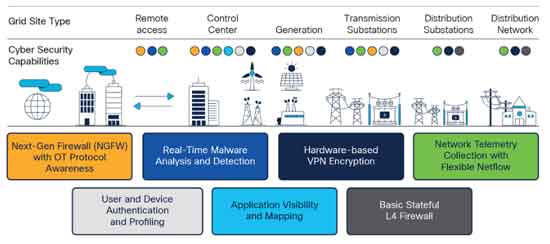
Any digital control architecture inherits exposure surfaces. A misconfigured firewall or a compromised credential can turn digital grid solutions into adversarial attack vectors. Operational continuity now depends on disciplined grid cybersecurity strategy enforcement.
Utilities have learned that segmentation between corporate IT and OT domains is necessary but insufficient. Lateral movement within OT environments remains a threat if device authentication is inconsistent. A single compromised endpoint can inject falsified telemetry, distorting topology interpretation.
The constraint is practical. Increasing encryption overhead can introduce latency. Excessive latency degrades control precision. Engineers must therefore balance cybersecurity hardening with deterministic performance.
Stay informed with our FREE Smart Grid Newsletter — get the latest news, breakthrough technologies, and expert insights, delivered straight to your inbox.
As DER penetration rises, central polling models become insufficient. smart grid edge computing distributes validation logic closer to feeders, reducing decision lag and enabling local anomaly filtering before control room escalation.
This distribution introduces tradeoffs. Edge intelligence improves response time but complicates governance. Firmware updates, configuration drift, and patch management scale across thousands of devices. Without strict version control, inconsistent execution of logic may fragment system behavior.
In high-solar-saturation feeders, reverse-flow events can change voltage profiles within seconds. Digital solutions must reconcile substation regulation logic with feeder-level inverter behavior. If not, tap changers cycle excessively, accelerating mechanical wear.
Operational flexibility depends on coordinated storage dispatch. Understanding the cost of different storage systems for smart grids informs whether battery assets are used for reliability buffering, peak shaving, or contingency reserve.
If storage dispatch logic is misaligned with load forecasting, digital control may overcommit assets during minor disturbances, leaving insufficient reserve for major events. That misallocation compounds during extreme weather conditions when system margins are already compressed.
The sentence that increases decision gravity is this: if digital solutions misclassify system state, every automated action that follows amplifies the original error.
Digital grid solutions succeed only when they function as operational governance frameworks. They must bind telemetry validation, cybersecurity discipline, edge logic coordination, and switching authority into a coherent decision stack.
If they remain visualization layers, outage duration, equipment stress, and regulatory exposure will continue to be managed reactively rather than governed proactively.
Advantages To Instructor-Led Training – Instructor-Led Course, Customized Training, Multiple Locations, Economical, CEU Credits, Course Discounts.
Request For QuotationWhether you would prefer Live Online or In-Person instruction, our electrical training courses can be tailored to meet your company's specific requirements and delivered to your employees in one location or at various locations.