Smart Grid Edge Computing in Distribution Automation
By William Conklin, Associate Editor
By William Conklin, Associate Editor
Request for Quotation Service

Buyers Submit Free RFQs to top suppliers, no obligation.
Suppliers Browse real project RFQs directly from buyers.
Trust Electricity Forum 40 years connection buyers and suppliers.
Smart grid edge computing shifts real-time grid analytics, SCADA integration, and distributed energy coordination to substations and field devices, reducing latency, strengthening cybersecurity boundaries, and protecting operational control when central systems degrade.
Smart grid edge computing determines whether feeder conditions are interpreted at the moment of instability or minutes after damage has already propagated. In distribution systems with high DER penetration, voltage variability, and high endpoint density, processing delays are no longer a data problem. It is a control risk.
Traditional centralized analytics models assume reliable backhaul communications and uninterrupted cloud processing. When telemetry traverses multiple network layers before evaluation, switching authority depends on the remote system's availability. During storm events or cyber containment procedures, that assumption fails.
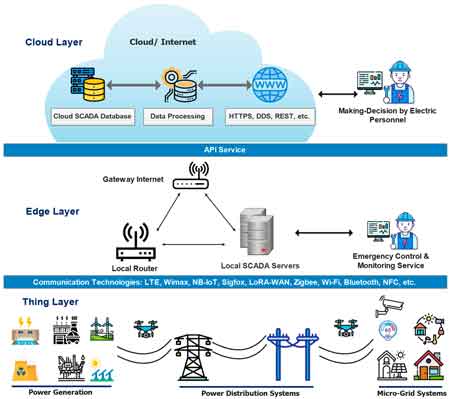
Edge architectures relocate processing logic into substations, recloser controllers, and intelligent field devices. Instead of forwarding raw telemetry upstream for interpretation, devices execute state validation, anomaly detection, and voltage regulation logic locally. The decision boundary moves physically closer to the asset.
In modern feeders with thousands of smart endpoints, milliseconds matter. A 300 millisecond delay in voltage excursion recognition can alter inverter tripping behavior. Edge computing reduces decision latency by eliminating round trip processing through centralized SCADA environments.
Utilities integrating edge logic must reassess how SCADA layers operate. The relationship between local intelligence and centralized visibility is explored in How Does SCADA Work. When the edge executes autonomous logic, SCADA becomes supervisory rather than primary.
The deployment constraint is architectural fragmentation. Distributed intelligence improves resilience but increases the burden of configuration management. Firmware divergence, inconsistent model thresholds, and patch governance introduce cybersecurity exposure if not governed within a coherent Grid Cybersecurity Strategy.

Consider a feeder operating at 65 percent rooftop solar penetration during peak irradiance. Cloud cover introduces rapid voltage oscillations across multiple lateral branches. If anomaly detection logic resides only in centralized analytics, voltage excursions may propagate long enough to trigger inverter trips at scale.
The cascade begins with localized voltage misclassification. Inverters disconnect. Reactive support collapses. Feeder voltage drops further. Restoration sequencing becomes reactive rather than preventive. What began as a transient oscillation becomes a multi-segment outage.
Edge-based voltage state validation intercepts oscillations before trip thresholds are exceeded. In field deployments with more than 250,000 endpoints, utilities have reported 30% faster oscillation detection when threshold filtering is executed at the device layer rather than at the control center. That time compression alters reliability exposure.
Edge computing does not eliminate model uncertainty. It redistributes it. Localized machine learning models require disciplined confidence thresholds. If anomaly detection confidence drops below 92 percent during high load variability, autonomous switching logic should revert to supervisory confirmation.
Without explicit threshold discipline, false positives can initiate unnecessary reconfiguration. Excessive micro-switching increases equipment wear and erodes operator trust. The discipline is not computational capacity. It is governance of decision confidence.
Integration of distributed logic must align with broader Digital Grid Solutions architectures. Edge models cannot drift independently from enterprise topology validation or state estimation frameworks.
Edge computing also introduces synchronization and lifecycle risk. During partial network segmentation, substation and lateral controllers can lose upstream topology alignment while continuing autonomous logic.
If the configuration state diverges, a device may sectionalize based on stale feeder assumptions, shifting misoperation risk from latency to authority misalignment.
At the same time, firmware governance must balance patch velocity against operational validation. Quarterly maintenance cycles rarely align with real time threat exposure. Finally, edge devices must sustain worst-case concurrency, not nominal load.
During feeder fault storms, event density can spike to five times normal telemetry rates. If processors cannot maintain a deterministic response under 5x ingestion pressure, latency returns at the moment containment is most critical.
Edge computing can misinterpret harmonics generated by EV clusters or inverter fleets as incipient faults. In feeders with significant nonlinear loads, waveform distortion complicates the detection of localized anomalies.
Improved filtering and classification methods described in Improved Sensor Technology reduce the risk of misclassification. However, sensor resolution and sampling rate become tradeoffs. Higher resolution improves diagnostic clarity but increases processing load at the edge.
If the computational load exceeds the device's capacity, packet loss or delayed execution can occur during high event density. Edge systems must therefore be provisioned for worst-case event concurrency, not average load.
Moving intelligence outward increases resilience against central failure but complicates orchestration. Utilities must determine whether autonomy remains at the device, substation, or regional controller layer.
In coordinated architectures such as Smart Substation environments, edge processing complements substation automation rather than replacing it. The question is not whether edge computing is superior. The question is: where does authority reside during degradation?
Storage coordination further complicates deployment. Latency benefits may be neutralized if distributed storage dispatch relies on centralized optimization logic tied to the Cost of Different Storage Systems for Smart Grids. Hybrid decision hierarchies are required.
Edge computing must also remain interoperable with broader Smart Grid Technologies. If each device layer becomes vendor-specific, long-term upgradeability declines.
Download our FREE Electrical Training Catalog and explore a full range of expert-led electrical training courses.

Smart grid edge computing is not an IT enhancement. It determines whether disturbance containment occurs at inception or after cascade. The governance decision is architectural: define the control boundary correctly or accept systemic fragility.
Advantages To Instructor-Led Training – Instructor-Led Course, Customized Training, Multiple Locations, Economical, CEU Credits, Course Discounts.
Request For QuotationWhether you would prefer Live Online or In-Person instruction, our electrical training courses can be tailored to meet your company's specific requirements and delivered to your employees in one location or at various locations.