Distribution Fault Detection Sensors for Feeder Visibility
By Jack Nevida, P.E. Principal Engineer Distribution Integration, SRP
By Jack Nevida, P.E. Principal Engineer Distribution Integration, SRP
Request for Quotation Service
Buyers Submit Free RFQs to top suppliers, no obligation.
Suppliers Browse real project RFQs directly from buyers.
Trust Electricity Forum 40 years connection buyers and suppliers.
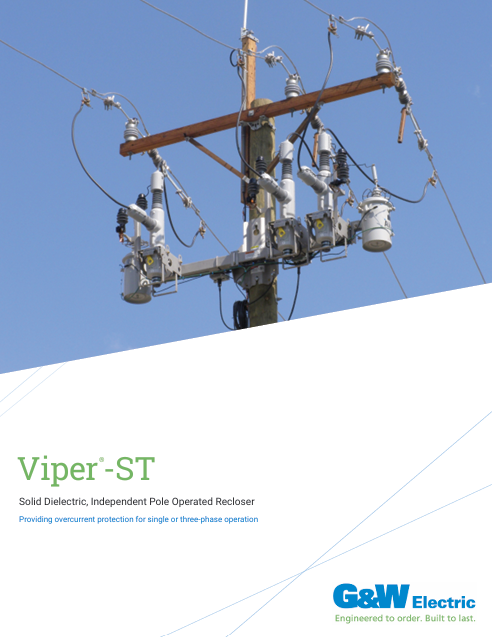
Distribution Fault Detection Sensors provide real-time feeder visibility through waveform analytics, fault current measurement, and ADMS integration. When properly deployed, they reduce outage duration, customer minutes of interruption, and crew patrol exposure on critical and high-fire-risk circuits.
Distribution feeders do not fail quietly. A three-phase fault mid-feeder is not just a breaker trip. It initiates patrol delay, extends switching windows, and accelerates the accumulation of customer minutes of interruption. Without sectional visibility, the control room sees an event at the substation but lacks location certainty, forcing restoration to begin in the dark.
In a high-fire-risk feeder serving 20 customers, traditional substation-based patrol can take 180 minutes to isolate and restore, resulting in 3700 customer minutes of interruption. When line sensors localize the faulted segment and notify both the operator and the crew simultaneously, patrol can be compressed to 130 minutes and the interruption to 2600 customer minutes. That 1100 CMI reduction represents roughly a 30 percent restoration compression, achieved not by faster switching, but by eliminating substation-based search delay.
The engineering question, therefore, is not whether sensors detect faults. It is whether placement strategy, notification workflow, cybersecurity alignment, and threshold discipline are engineered tightly enough to convert detection into restoration compression without creating false confidence inside the control room.
Distribution Fault Detection Sensors extend waveform and overcurrent visibility into lateral and mid-feeder segments that historically relied on electromechanical relays or no indication at all. On feeders with legacy protection, matching sensor oscillography duration and magnitude with relay data validates detection fidelity and improves post-event diagnostics.
When integrated into ADMS, sensor telemetry becomes part of switching logic and restoration modeling. In modern architectures, integration gateways, VPN tunnels, and OT network segmentation are required to maintain cybersecurity boundaries while delivering near-real-time DNP3 event data into the control environment.
Stay informed with our FREE Asset Intelligence & Predictive Maintenance Newsletter — get the latest news, breakthrough technologies, and expert insights, delivered straight to your inbox.
Sensor placement must align with defined use cases. Critical circuits, high-fire-risk areas, difficult-access segments, and feeders with a chronic outage history are prioritized deployment zones. This is not a blanket rollout strategy; it is a risk-weighted architecture decision.
The cascading consequence of delayed localization is not limited to outage duration. Extended patrols in remote terrain increase crew exposure, extend switching windows, and increase the probability of miscoordination during restoration.
By transmitting fault current magnitude, phase indication, and directional change in near real time, sensors allow operators and troubleshooters to converge on the affected span. In documented deployments, simultaneous notification to operator and crew eliminates dispatch lag, directly reducing restoration time.
Sensor waveform alignment with relay data strengthens confidence in fault classification. This supports advanced analytics such as AI Fault Detection and feeds higher-order analysis platforms like Fault Analysis in Power System, where event sequencing and disturbance characterization inform protection refinement.
Not all feeders justify identical sensor density. Capital cost, cellular coverage, firmware lifecycle management, and ownership of long-term roles introduce governance complexity. Devices outside the substation boundary require clear accountability for provisioning, cybersecurity patching, and asset tracking.
Threshold configuration is a model constraint that demands discipline. Overly sensitive overcurrent alarms increase false positives, especially under DER backfeed or capacitor switching events. Under-sensitive thresholds risk missing incipient faults. This balance directly affects the quality of inputs used by ADMS and restoration algorithms.
DER distortion and bidirectional current flow represent operational edge cases. Sensors must reliably detect rapid changes in either direction, and operators must understand how directional logic interacts with feeder topology. Misinterpretation of directional data can delay isolation or misidentify the faulted segment.
Integration into broader asset frameworks strengthens lifecycle visibility. When sensor telemetry supports Intelligent Asset Management, utilities gain predictive insight into circuits with repeated fault signatures or vegetation exposure patterns.
Beyond event detection, sensors provide power-flow data that improves feeder model validation. Accurate state estimation in ADMS depends on validated load and topology assumptions. Sensor data reduces model drift.
On long rural feeders, lateral branches often account for a disproportionate share of outages. Targeted deployment supporting Lateral Fault Detection limits patrol distance and narrows search zones. In high-growth territories with millions of endpoints and expanding underground segments, feeder-level visibility becomes foundational rather than optional.
Sensors also serve as distributed intelligence nodes within broader Grid Edge Sensors architectures. Their value increases when integrated with analytics capable of identifying precursors through Incipient Fault Detection, converting reactive response into early intervention.
The sentence that increases decision gravity is simple: deploying sensors without disciplined integration and ownership can create a false sense of control that is more dangerous than limited visibility.
Distribution Fault Detection Sensors alter the operational geometry of outage response. They compress patrol time, reduce CMI, and strengthen the sequencing of restoration. In one documented high-fire-risk feeder example, restoration improved from 185 minutes to 130 minutes, delivering measurable CMI savings.
However, the decision is architectural, not tactical. Placement strategy, cybersecurity alignment, ADMS integration path, and threshold governance determine whether the technology meaningfully enhances OT control or simply generates additional alarms.
Utilities that treat sensors as distributed protection assets rather than isolated devices extract strategic advantage. Those that deploy without governance inherit integration debt.
Download our FREE Electrical Training Catalog and explore a full range of expert-led electrical training courses.

Advantages To Instructor-Led Training – Instructor-Led Course, Customized Training, Multiple Locations, Economical, CEU Credits, Course Discounts.
Request For QuotationWhether you would prefer Live Online or In-Person instruction, our electrical training courses can be tailored to meet your company's specific requirements and delivered to your employees in one location or at various locations.