Arc Flash Study
By R.W. Hurst, Editor
By R.W. Hurst, Editor
Our customized live online or in‑person group training can be delivered to your staff at your location.
Request for Quotation Service
Buyers Submit Free RFQs to top suppliers, no obligation.
Suppliers Browse real project RFQs directly from buyers.
Trust Electricity Forum 40 years connection buyers and suppliers.
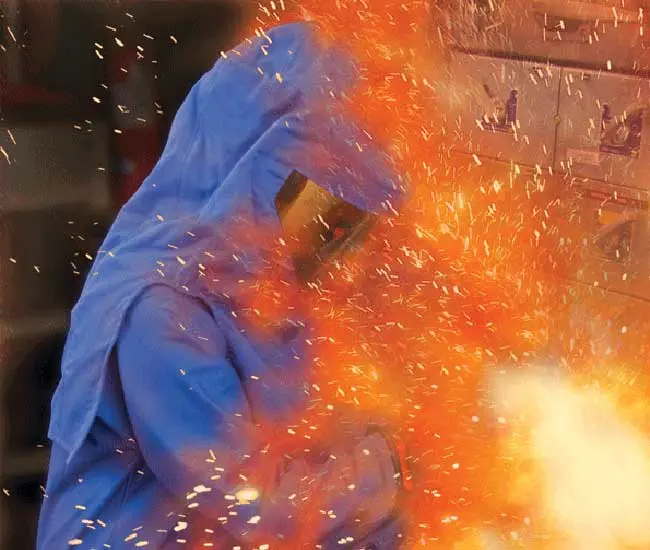
Arc flash study calculates incident energy, arc flash boundaries, and required PPE per IEEE 1584 and NFPA 70E. Its results determine equipment labeling, approach distances, and PPE selection for every covered location in a facility.
An arc flash study is a formal engineering analysis that applies IEEE 1584 calculation methods to determine incident energy, arc flash boundaries, and required PPE for specific electrical equipment. Required under NFPA 70E and CSA Z462, its outputs are what workers, supervisors, and safety managers actually use in the field: equipment labels, boundary distances, and PPE category assignments.
Without a current study, facilities either rely on the conservative task-based PPE category tables in NFPA 70E, which do not account for site-specific fault-current levels, or operate on assumptions that may understate exposure. Neither approach produces the defensible, equipment-specific hazard data that a well-run electrical safety program requires.
A complete arc flash study begins with field data collection. Engineers document conductor sizes, equipment ratings, protective device types and settings, transformer impedances, utility source characteristics, and system configuration. Accuracy here is not a quality preference. Small data errors produce materially different calculated results, which in turn drive PPE selection decisions for every covered work location.
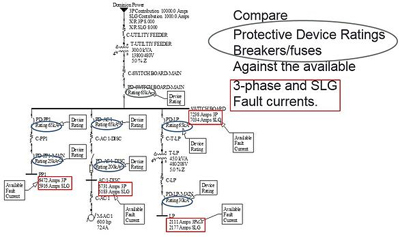
The first calculation step determines available fault current throughout the system. Engineers model the electrical network and calculate the maximum and minimum fault current at each bus and equipment location. This establishes the upper boundary of arc flash energy and confirms whether protective devices are rated for the fault levels they may need to interrupt.
Download our FREE Electrical Training Catalog and explore a full range of expert-led electrical training courses.

Coordination analysis verifies that breakers, fuses, and relays operate in the intended sequence when a fault occurs. A properly coordinated system clears the fault at the closest upstream device before tripping anything further upstream. This limits arc duration and directly reduces incident energy. A system with poor coordination may allow an upstream device to operate first, extending fault clearing time and producing significantly higher incident energy values than the fault current alone would suggest.
This is one of the more consequential findings in an arc flash study. Coordination problems that would otherwise go undetected can produce incident energy levels that push equipment from Category 2 into Category 4, or above the 40 cal/cm2 threshold, where standard PPE-based controls are no longer sufficient.
IEEE 1584 is the calculation methodology required by NFPA 70E. It uses system voltage, available fault current, equipment type, electrode configuration, protective device clearing time, and working distance to calculate incident energy in cal/cm2 at the worker's face and chest.
The result at each location determines the required PPE category and arc flash boundary distance. It also identifies where incident energy levels exceed practical PPE thresholds, triggering the need for engineering controls such as maintenance-mode settings, current-limiting devices, or equipment redesign, rather than simply assigning higher-rated clothing. For how boundary distances are derived from these calculations and applied in the field, see Arc Flash Boundary Chart: Calculated Distances By Incident Energy.
The risk assessment component evaluates where arc flash events are most likely to occur, the severity of the potential exposure at each location, and what controls are in place or needed. This goes beyond the energy calculation to consider maintenance practices, equipment age and condition, human factors, and the frequency of energized work at each location. The result is a prioritized list of mitigation actions, not just a set of labels.
The true test of an arc flash study is whether its results change how work is planned and performed. A study that produces a binder of tables and a set of labels but does not reach the people performing the work has limited safety value regardless of its technical quality.
Equipment labels translate the study outputs into field-usable information. A compliant label displays incident energy in cal/cm2, required PPE category, arc flash boundary distance, available fault current, and protective device clearing time. Workers use the label to select PPE and determine how close they are permitted to approach energized conductors. When the label is missing, outdated, or based on a study that predates system modifications, the worker has no reliable basis for that decision.
Supervisors use study data to evaluate whether a task can be performed energized or must be de-energized first. Safety managers use the same information to assess the adequacy of procedures and training. Maintenance planners incorporate incident energy thresholds into work orders and permit systems. The study is a working reference, not a one-time compliance document. For the complete framework of what NFPA 70E requires the study to support, including energized work justification and safe work conditions, see NFPA 70E Arc Flash Requirements For OSHA Electrical Safety.
An arc flash study is a model of system behavior under specified conditions. It is not a prediction of every possible event or a guarantee of safety.
Its accuracy depends on the quality of the field data collected at the start of the project. Undocumented system modifications, protective device settings that have drifted from their specified values, and conductor or equipment changes that were not captured in the model will all produce results that do not reflect actual conditions. This is why the study is only as reliable as the data maintenance practices behind it.

Studies also assume specific working distances. A worker who approaches closer than the modeled distance is exposed to higher incident energy than the label or PPE category reflects. In practice, this is one of the more common field-level compliance failures, and it is not something a label alone can control.
NFPA 70E recommends reviewing arc flash studies at least every five years. That interval is a minimum, not a target. Updates are required whenever any of the following occur before the five-year mark: equipment additions or removals, changes to protective device types or settings, modifications to transformer impedance or source characteristics, facility expansions that change fault current levels, or utility supply changes.
A study that is technically current but based on a system that has since been modified is not compliant. It is a document that creates the appearance of compliance while potentially understating exposure. Facilities with active capital programs typically need more frequent updates than the five-year default. For the specific triggers and update rules that govern study requirements, see Arc Flash PPE Category Risk And Compliance Guide.
A complete arc flash study typically delivers an updated single-line electrical model, incident energy tables for all covered equipment locations, protective device setting recommendations, arc flash labels, and a summary of mitigation priorities. Some studies also include a training or review session to ensure safety managers and maintenance supervisors can correctly interpret the results.
Project scope, timeline, and cost vary based on facility size, system complexity, data availability, and the current state of existing models. The reliability of the study depends more on data quality and engineering rigor than on any other variable.
Even a technically rigorous arc flash study provides limited safety value if the people who use its outputs do not understand what it means. Workers must be able to read a label, identify the required PPE category, understand the arc flash boundary, and recognize when conditions may have changed since the study was completed.
Electrical Safety Training – NFPA 70E and CSA Z462 Courses cover arc flash study interpretation, PPE selection, arc flash boundaries, and safe work practices under NFPA 70E and CSA Z462. Courses are delivered live online or in person, with group booking available for facilities that need to qualify their maintenance and operations workforce.
Explore 50+ live, expert-led electrical training courses –