Predictive Grid Intelligence Gives Utilities Advance Warning
By Dr. Fivos Maniatakos, CEO & Co-Founder, Sensewaves
By Dr. Fivos Maniatakos, CEO & Co-Founder, Sensewaves
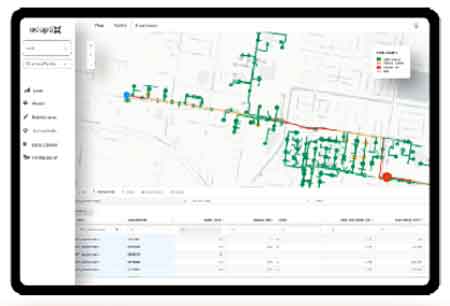
Predictive grid intelligence transforms AMI, GIS, and SCADA telemetry into a continuously validated digital grid model that forecasts asset overloads, topology errors, outage risk, and voltage instability. This operational intelligence enables utilities to anticipate failures, optimize restoration sequencing, and improve reliability before physical infrastructure reaches failure thresholds.
Distribution utilities operate vast electrical networks in which most assets function without direct telemetry. Transformers, switches, and feeder segments often operate for years without revealing their internal stress or connectivity condition. Predictive grid intelligence changes this reality by converting meter data, topology models, and operational telemetry into a continuously evolving electrical model that reflects actual system behavior. Instead of waiting for alarms or protection events, operators gain advanced insight into load imbalances, topology errors, and failure risk. This allows utilities to intervene before instability propagates, shifting grid operation from reactive fault response to anticipatory operational control.
Operational visibility does not guarantee operational control. Utilities often assume that knowing circuit status, breaker position, and customer outages is sufficient to maintain reliability. In reality, visibility without predictive interpretation leaves operators reacting to events that have already destabilized the system.
Most distribution networks contain thousands of unmonitored nodes, transformers, switches, and line segments that operate without direct telemetry. Even in modern AMI deployments, meter readings provide endpoint consumption data but do not directly reveal intermediate asset stress or connectivity errors. As a result, overload conditions, misconfigured topology, and phase imbalance can develop unnoticed until protection systems trip or equipment fails.
Predictive grid intelligence closes this operational blind spot. It converts passive measurement into an active, continuously verified operational model capable of forecasting system behavior before instability occurs.
Stay informed with our FREE Asset Intelligence & Predictive Maintenance Newsletter — get the latest news, breakthrough technologies, and expert insights, delivered straight to your inbox.
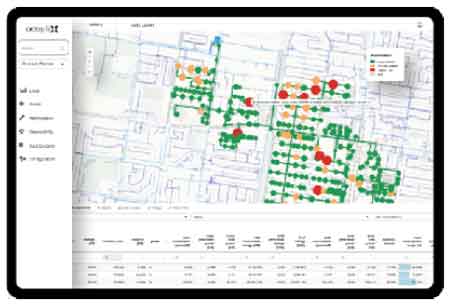
Smart meters generate enormous volumes of time-series consumption and voltage data, but raw data alone does not provide actionable insight. Predictive grid intelligence integrates AMI streams with GIS topology and operational telemetry to construct a continuously updated, computational representation of the network.
This process forms the operational foundation of AMI Data, enabling utilities to infer electrical behavior at every node, even where no sensors exist.
Using advanced load flow modeling, utilities can estimate asset loading, detect imbalance, and forecast stress conditions at circuit and device levels. Unlike static engineering studies, this model evolves continuously as conditions change, reflecting real system behavior rather than theoretical assumptions.
This predictive modeling capability aligns with modern Grid Modeling practices, where utilities rely on dynamic system representations to evaluate operational risk and validate planning decisions.
The transition from reactive monitoring to predictive intelligence depends on a digital twin, a continuously validated computational model of grid connectivity, asset relationships, and electrical behavior.
Predictive intelligence platforms automatically validate and correct topology using AMI voltage patterns, connectivity inference, and load correlation analysis. In large deployments, this process reveals previously undetected topology errors, incorrect asset relationships, and missing electrical connections.
These corrections significantly enhance situational awareness, forming the operational basis of Grid Observability, where utilities maintain an accurate, real-time understanding of network state.
This digital twin does more than represent the system. It enables operators to forecast how the grid will respond to load changes, switching operations, or contingency events.
One of the most significant operational limitations in distribution systems is the lack of direct telemetry from intermediate assets. Transformers, reclosers, and feeder segments often operate without continuous monitoring, forcing utilities to rely on assumptions rather than measurements.
Predictive intelligence solves this problem by creating virtual telemetry—calculated electrical measurements at any point in the network derived from AMI and topology data.
This virtual monitoring capability supports proactive asset management strategies, similar to those described in Intelligent Asset Management, in which maintenance decisions are driven by actual operating conditions rather than fixed schedules.
By predicting overloads, imbalance, and thermal stress, utilities can intervene before equipment deteriorates to failure.
Traditional outage management relies on fault detection followed by restoration response. Predictive intelligence fundamentally reverses this model by identifying failure risk before faults occur.
For example, predictive load analysis can identify transformers approaching critical thermal limits during cold weather, allowing operators to redistribute load or schedule replacements before failure.
This predictive operational capability complements systems such as Advanced Distribution Management System (ADMS), which coordinate switching operations and restoration sequencing based on real-time system state.
Predictive intelligence enhances restoration efficiency by providing operators with accurate topology, load conditions, and failure probability—allowing faster isolation and more effective restoration sequencing.
Predictive grid intelligence shifts utilities from reactive replacement to proactive asset lifecycle management. Instead of waiting for failures or relying on age-based replacement cycles, utilities can forecast asset failure probability using operational data, load history, and environmental conditions.
This predictive maintenance approach supports the reliability goals addressed in Power System Reliability, where failure prevention is more effective than restoration alone.
Predictive intelligence allows utilities to prioritize replacement based on actual risk, improving reliability while optimizing capital investment.
Predictive intelligence is not a planning tool. It is an operational infrastructure that continuously informs control room decisions, restoration actions, and asset management strategies.
Think you know Asset Intelligence & Predictive Maintenance? Take our quick, interactive quiz and test your knowledge in minutes.
Operators gain confidence in switching decisions because topology and load conditions are continuously verified. Field crews receive accurate system state information, improving restoration efficiency. Engineers gain insight into asset stress, enabling proactive intervention.
This capability transforms grid operation from reactive management into predictive control.
Utilities that deploy predictive grid intelligence do not merely observe grid behavior. They anticipate it, manage it, and prevent failure before it disrupts service.
Advantages To Instructor-Led Training – Instructor-Led Course, Customized Training, Multiple Locations, Economical, CEU Credits, Course Discounts.
Request For QuotationWhether you would prefer Live Online or In-Person instruction, our electrical training courses can be tailored to meet your company's specific requirements and delivered to your employees in one location or at various locations.