Deciding When a Motor Protection Relay Is the Right Tool
By William Conklin, Associate Editor
By William Conklin, Associate Editor
Our customized live online or in‑person group training can be delivered to your staff at your location.
Request for Quotation Service

Buyers Submit Free RFQs to top suppliers, no obligation.
Suppliers Browse real project RFQs directly from buyers.
Trust Electricity Forum 40 years connection buyers and suppliers.
A motor protection relay safeguards electric motors by detecting thermal stress, phase imbalance, stall, and abnormal operating conditions that overload devices and breakers cannot see, guiding engineers on when advanced motor control adds value.
Motor protection relays rarely get specified because something “failed catastrophically.” They get added after a series of quieter problems: motors that run hot without ever tripping, nuisance shutdowns that don’t show up in fault logs, or equipment that passes acceptance testing but degrades months later under real load. This type of relay exists to govern those gray zones. It does not replace short-circuit control, nor does it simply repeat overload behavior. It controls how a motor is allowed to live under stress, imbalance, abnormal starts, and imperfect power, conditions that breakers and basic overload devices were never designed to interpret on their own.
In most installations, the first layer of motor protection is familiar and blunt. Circuit breakers and fuses respond to high fault current. Thermal overload devices react to sustained overcurrent. Both are necessary, and neither is subtle. A motor protection relay sits between those layers, watching patterns rather than single events. That distinction matters. Many premature motor failures occur without ever exceeding instantaneous trip thresholds, which is why relying only on upstream devices can give a false sense of security.
This is also where confusion often starts. Motor protection relays are frequently described as “advanced overloads,” but that framing misses the point. They are better understood as decision devices that evaluate operating conditions over time. When paired correctly with upstream fault control, such as overcurrent devices, they allow faults to be cleared decisively while still protecting the motor from cumulative damage that may not look dramatic in the moment. The difference between those roles becomes clearer when you view them alongside traditional motor overload protection, which reacts to heat but not to many of the causes that create it.
Think you know Electrical Protection? Take our quick, interactive quiz and test your knowledge in minutes.
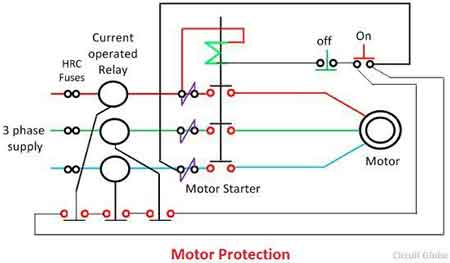
Most modern motor protection relays model motor behavior rather than reacting to a single measured value. They infer thermal stress from current, detect phase imbalance before insulation suffers, recognize stall conditions during abnormal starts, and respond to voltage anomalies that shorten motor life without ever triggering a breaker. None of these conditions appears to be a classic fault. That is precisely why they are often missed.
This does not mean every motor benefits from this level of supervision. Applying a relay where a simple overload would suffice can introduce its own problems—false trips, coordination conflicts, and unnecessary commissioning complexity. That tradeoff is rarely discussed on vendor pages, but it is central to real-world reliability. Understanding where this device fits requires stepping back into the broader context of electric motor protection rather than treating the relay as an isolated upgrade.
A common mistake is expecting a motor protection relay to solve problems it was never meant to address. It does not interrupt high fault current. It does not replace upstream coordination. That responsibility remains with devices designed for fault clearing and current interruption, governed by the same principles outlined under overcurrent protection. When those boundaries are blurred, fault control schemes become unpredictable.
This is also why motor fault control relays must be coordinated thoughtfully with upstream equipment. If relay trip logic conflicts with breaker timing or upstream relays, the result is often nuisance shutdowns that appear random to operators. Proper alignment with the broader abnormal-condition detection system, especially in facilities with layered relay schemes, is part of the same coordination challenge addressed in relay and circuit breaker coordination. Ignoring that context is one of the fastest ways to turn a protective device into a reliability problem.
These relays earn their place on motors that are expensive, critical to process continuity, or exposed to variable operating conditions. Large horsepower drives, motors subject to frequent starts, and equipment feeding process bottlenecks are typical candidates. In those environments, early detection of abnormal behavior prevents downtime that far exceeds the cost of the device.
By contrast, applying motor protection relays indiscriminately to small or non-critical motors often produces more alarms than insight. The relay does exactly what it is designed to do: interpret deviations, but the system gains little from that information. This distinction is often clearer once you understand how these devices differ from general protective relays, which may protect feeders, transformers, or entire sections of a system using very different logic.
One of the less obvious benefits of motor protection relays is diagnostic clarity. When a motor trips repeatedly without a visible cause, these devices provide context that simple overloads cannot. That insight becomes especially valuable in systems where available fault levels, voltage stability, or upstream events influence motor behavior without creating a classic electrical fault. Understanding those upstream conditions—such as changes in available fault current, often explains why a protection relay intervened when nothing else appeared wrong.
This diagnostic role also changes how maintenance teams respond. Instead of replacing components reactively, they can correct underlying conditions before damage accumulates. That shift in approach is subtle but significant, and it is one reason these relays are often introduced after repeated unexplained failures rather than during initial design.
Stay informed with our FREE Electrical Protection Newsletter — get the latest news, breakthrough technologies, and expert insights, delivered straight to your inbox.
Motor protection relays should be viewed as a focused leaf within the fault control landscape, not a replacement for upstream strategy. They sit between system-level concepts covered under power system protection and device-level components such as overloads and starters. Keeping that hierarchy intact prevents overlap, confusion, and misapplication.
Motor protection relay selection rarely resolves uncertainty; it usually exposes it. A relay may trip exactly as programmed, yet still leave unanswered questions about whether the motor was genuinely at risk, whether coordination with upstream devices remains intact, or whether repeated interventions are masking a deeper power or mechanical issue. In real facilities—especially those with variable loads, aging motors, or evolving control schemes—the danger lies in treating a relay trip as confirmation rather than as evidence that demands interpretation.
That interpretive judgment does not come from knowing relay features alone. It develops through understanding how motor behavior, overload characteristics, upstream fault control, and system conditions interact over time. Training such as Basic Protective Relay Training helps practitioners recognize how failure mitigation elements respond to thermal models, imbalance detection, and time-based stress, and when relay action reflects true motor risk versus a coordination or application issue elsewhere in the system.
Advantages To Instructor-Led Training – Instructor-Led Course, Customized Training, Multiple Locations, Economical, CEU Credits, Course Discounts.
Request For QuotationWhether you would prefer Live Online or In-Person instruction, our electrical training courses can be tailored to meet your company's specific requirements and delivered to your employees in one location or at various locations.