A Transformer Protection Relay Demands More Than Overcurrent Logic
By William Conklin, Associate Editor
By William Conklin, Associate Editor
Our customized live online or in‑person group training can be delivered to your staff at your location.
Request for Quotation Service
Buyers Submit Free RFQs to top suppliers, no obligation.
Suppliers Browse real project RFQs directly from buyers.
Trust Electricity Forum 40 years connection buyers and suppliers.
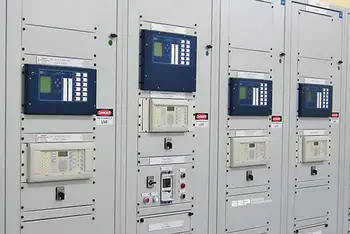
Transformer protection relay strategy explains when overcurrent alone is insufficient, how internal faults, inrush, and ground conditions alter risk, and why transformer-specific detection improves reliability, selectivity, and asset protection.
Transformer protection relay decisions are rarely about the relay itself. They are about recognizing when a transformer’s electrical behavior introduces risks that upstream devices cannot clearly see or respond to in time, and deciding how to isolate those risks before damage propagates through the system.
Transformers occupy a unique position in electrical networks. They are neither simple conductors nor passive components. Their windings store energy magnetically, their cores respond non-linearly during energization, and their internal faults can develop without producing the sustained current signatures that upstream devices expect. These characteristics make transformer failures harder to interpret and more likely to be misjudged if the protection strategy relies solely on remote devices.
In smaller installations, it is common to assume that a transformer is adequately protected by upstream breakers or fuses. As system size, fault consequences, or operational criticality increase, this assumption becomes increasingly fragile. Many transformer faults evolve internally, producing conditions that never rise cleanly to the pickup thresholds of upstream devices. By the time those devices respond, winding damage or insulation breakdown may already be irreversible.
This limitation becomes apparent when transformer behavior is evaluated within broader power system protection boundaries, where upstream devices are designed to manage line faults and system disturbances rather than internal transformer conditions. Overcurrent methods that work well on feeders often fail to discriminate between normal transformer behavior and developing internal damage.
Think you know Electrical Protection? Take our quick, interactive quiz and test your knowledge in minutes.
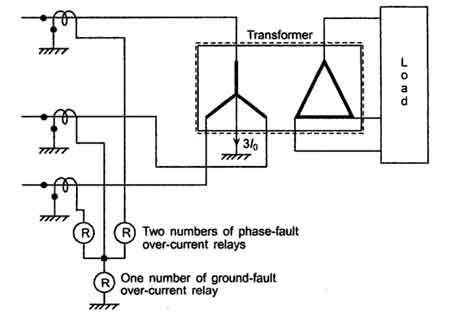
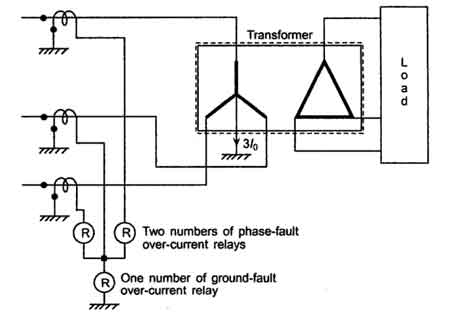
The shortcomings of relying solely on upstream detection are well illustrated in discussions of transformer overcurrent protection, where overcurrent is shown to be an imprecise indicator of internal transformer distress rather than a definitive safeguard.
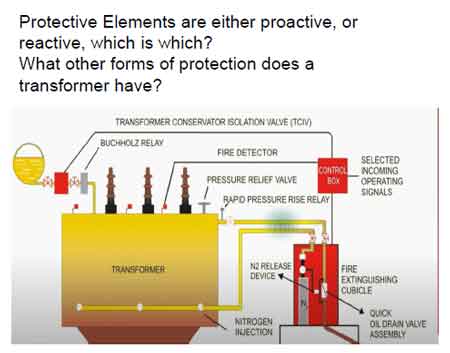
Several transformer characteristics complicate traditional protection logic. Magnetizing inrush during energization can resemble a fault even when no damage exists. Through-faults on the secondary side can impose severe mechanical and thermal stress while appearing electrically external. Internal ground faults may remain low in magnitude yet destructive over time, particularly when grounding methods limit current in ways that upstream devices misinterpret.
These challenges are compounded when fault magnitude itself becomes misleading. The available fault current at transformer terminals may appear modest while internal conditions deteriorate rapidly, creating a false sense of security if protection decisions rely solely on current levels rather than fault character.
Not every transformer requires a dedicated protection relay. The decision is rarely driven solely by nameplate rating. It is driven by consequence. Transformers supplying critical processes, feeding wide downstream distribution, or operating where internal failure would escalate into prolonged outages or safety exposure justify transformer-specific detection logic.
Analytical uncertainty is another trigger. While short-circuit analysis can describe worst-case external faults, it offers limited insight into how internal transformer failures develop, particularly when faults do not conform to idealized assumptions.
A transformer protection relay does not replace upstream devices. It defines responsibility. By clearly assigning fault detection to the transformer zone, it allows feeders, breakers, and system protection to operate as intended without compensating for blind spots they were never designed to cover.
This distinction becomes especially important in systems where the current magnitude is intentionally constrained. Devices such as fault current limiters reduce mechanical and thermal stress but can also mask developing transformer faults from upstream protection, increasing reliance on transformer-specific detection rather than diminishing it.
One of the most persistent mistakes in transformer protection is treating the problem as a relay-setting exercise rather than a protection-zone decision. Adjusting pickup values or delays on existing devices does not resolve the fundamental issue of visibility. Another error is collapsing transformer protection into generic relay explanations that describe how relays function, rather than explaining why transformers require different protection judgments.
This confusion is avoided when the transformer protection relay strategy is understood as part of relay protection design rather than as a subset of device operation. The question is not how the relay works, but what electrical behavior it must recognize and isolate.
When transformer protection is correctly scoped, failures remain localized. Internal faults are isolated before upstream coordination collapses. Maintenance decisions improve because abnormal behavior is detected earlier. Most importantly, system response becomes predictable rather than reactive.
These outcomes are not achieved by adding devices indiscriminately. They result from recognizing that transformers behave differently, fail differently, and therefore must be protected differently. A transformer protection relay, applied with clear intent, reflects mature protection engineering in which consequences drive design and strategy precedes settings.
Download our FREE Electrical Training Catalog and explore a full range of expert-led electrical training courses.

Advantages To Instructor-Led Training – Instructor-Led Course, Customized Training, Multiple Locations, Economical, CEU Credits, Course Discounts.
Request For QuotationWhether you would prefer Live Online or In-Person instruction, our electrical training courses can be tailored to meet your company's specific requirements and delivered to your employees in one location or at various locations.