AIOps for Electric Utilities in Deterministic Grid Remediation
By Matt Deibel, Manager Grid Automation Services, Southern California Edison
By Matt Deibel, Manager Grid Automation Services, Southern California Edison

AIOps for Electric Utilities applies alarm correlation, deterministic orchestration, and governed automated remediation to reduce false positives, preserve OT control authority, and prevent cascading instability across substations and grid networks.
Control room instability rarely begins with equipment failure. It begins when alarm density exceeds human discrimination capacity and automated responses trigger without sufficient context. At scale, false positives are not nuisance events. They are latent instability vectors.
AIOps for Electric Utilities exists to compress noise before execution authority is exercised. It binds telemetry ingestion, alarm correlation, deterministic workflow sequencing, and governed remediation into a constrained control loop. The objective is not automation efficiency. The objective is to maintain operational state confidence amid exponential asset growth.
The engineering question is precise: how can automated remediation accelerate response time without eroding regulatory accountability or degrading system state?
AIOps begins with event reduction. Raw telemetry from WAN domains, substations, SCADA endpoints, and edge devices must be correlated before workflow execution. In large deployments with more than 100,000 infrastructure assets, daily alarm volumes can exceed 1,000 signals, while fewer than 30 percent are actionable operational risks. Correlation reduces cognitive overload before orchestration is allowed to act.
Deterministic orchestration enforces sequencing, validation, and rollback capability before any automated remediation is committed. This structure aligns with Utility Network Automation Architecture, where workflow governance, ticket integration, and approval gates are structural safeguards rather than optional features.
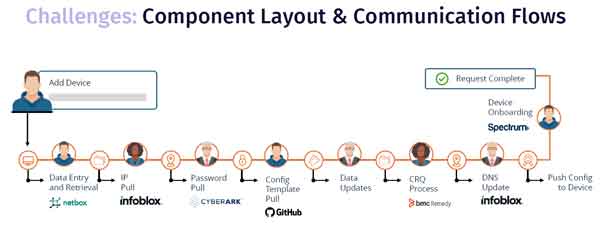
Manual onboarding processes that once required 17 discrete steps have been reduced to 6 orchestrated stages, with integrated validation and logging. Ticket latency reductions exceeding 40 percent demonstrate a measurable operational benefit. The quantified signal is important. Efficiency gains are only defensible when traceability is preserved.
Think you know Grid Data Foundations & AI Infrastructure? Take our quick, interactive quiz and test your knowledge in minutes.
The greatest risk in AIOps is not automation failure. It is a misclassification under load. Consider packet degradation during peak DER export conditions. If anomaly detection interprets transient congestion as malicious activity and modifies ACL policies across substations, telemetry streams feeding voltage control logic may become partially obstructed. Voltage regulation algorithms then operate on distorted state awareness. Switching sequences triggered under those conditions can amplify feeder instability rather than contain it.
The cascading consequence begins with a confidence error. It propagates through tightly coupled control systems. That exposure intersects directly with DER Cybersecurity and SCADA Cybersecurity, where synchronized supervisory visibility is mandatory during remediation.
An automated remediation executed at an inappropriate confidence threshold can destabilize grid conditions faster than delayed human review.
AIOps compresses the mean time to repair. Regulated utilities compress tolerance for undocumented execution. The tradeoff is structural. Faster remediation reduces outage duration but narrows the window for human validation, rollback inspection, and regulatory traceability.
Effective AIOps implementations embed RBAC enforcement, audit logging, and policy validation before granting execution authority. The governance discipline described in Cybersecurity for Utilities ensures that remediation actions are both reversible and defensible.
Granting unrestricted autonomy increases compliance risk. Over-constraining automation negates its operational value. The optimal balance is achieved through architectural sequencing, not policy statements.
AIOps systems operate on probabilistic inference. Confidence thresholds define execution authority. If thresholds are set too low, false positives escalate unnecessary workflows. If set too high, legitimate degradations propagate across network segments.
Threshold calibration is dynamic. Seasonal load shifts, firmware upgrades, topology modifications, and DER penetration alter baseline telemetry patterns. Integration with Enterprise AI Governance for Utilities ensures model updates, registry approvals, and drift monitoring precede operational deployment.
The operational edge case emerges during overlapping maintenance windows. An AIOps engine referencing stale configuration repositories may initiate remediation on assets that are already scheduled for change. State conflict between field crews and automation introduces a risk that deterministic orchestration must resolve before execution.
AIOps is not independent of transport and data integrity. Telemetry reliability across segmented WAN domains is foundational, as defined in Utility WAN Architecture. Converged telemetry pipelines and configuration validation workflows described in Integrated AI Driven Solutions strengthen state consistency across SCADA, AMI, and grid applications.
Progression toward Autonomous Utility Networks does not eliminate human oversight. It relocates oversight into governance design and threshold calibration rather than manual task execution.
AIOps for Electric Utilities, therefore, functions as a gateway capability within Grid Data Foundations and AI Infrastructure. It marks the maturity point at which alarm correlation, deterministic orchestration, and governance discipline are strong enough to enable automated remediation without surrendering OT control authority. The unresolved boundary remains how much automation can be safely granted before accountability begins to erode under scale.
Download our FREE Electrical Training Catalog and explore a full range of expert-led electrical training courses.

Advantages To Instructor-Led Training – Instructor-Led Course, Customized Training, Multiple Locations, Economical, CEU Credits, Course Discounts.
Request For QuotationWhether you would prefer Live Online or In-Person instruction, our electrical training courses can be tailored to meet your company's specific requirements and delivered to your employees in one location or at various locations.