NFPA 70b Training - Electrical Maintenance
Our customized live online or in‑person group training can be delivered to your staff at your location.

- Live Online
- 12 hours Instructor-led
- Group Training Available
Regular Price:
$699
Coupon Price:
$599
Thermoelectric Charging Boots convert foot heat via the Seebeck effect into portable power, using thermocouples and a power-generating sole, storing energy in-heel to charge mobile phones after long walks and festival wear.
The Big Picture
Wellington boots that harvest foot heat via the Seebeck effect, storing power in-heel to charge mobile phones off-grid.
- Uses Seebeck effect with thermocouple thermopile array
- Heat from foot and ground-cold create voltage differential
- Power stored in heel battery for later phone charging
Modern festival-goers who dread ending up with a dead mobile phone battery after days stuck in a muddy field with no electric plug power points may now have a solution — power boots.
Mobile phone company European Telco Orange has introduced a phone charging prototype — a set of thermoelectric gumboots or Wellington boots with a 'power generating sole' that converts heat from the wearer's feet into electrical power to charge battery-powered hand-helds.
The boot was designed by Dave Pain, managing director at GotWind, a renewable energy company.
Pain said the boot uses the Seebeck effect, named after physicist Thomas Johann Seebeck, in which a circuit made of two dissimilar metals conducts electricity if the two places where they connect are held at different temperatures, similar to approaches that generate electricity at night using thermal gradients.
"That electrical charge we then pass through to a battery, echoing research into portable power systems in development, which you'll find in the heel of the boot for storage of the electrical power for later use to charge your mobile phone."
These thermocouples are connected electrically, forming an array of multiple thermocouples thermopile. They are then sandwiched between two thin ceramic wafers.
When the heat from the foot is applied on the top side of the ceramic wafer and cold is applied on the opposite side, from the cold of the ground, as in nighttime renewable energy approach demonstrations in research, electricity is generated.
After a full day's festival frolics music lovers can plug their phone into the power output at the top of the welly and use the energy generated throughout the day to charge their phone.
But the prototype boot does have one drawback. You need to walk for 12 hours in the boots to generate one hour's worth of charge, illustrating the limits of harvesting human power with wearables today.
Pain said GotWind was working on improving the technology, which could then also be used in other forms of clothing.
"The technology's not just limited to footwear, or indeed boots, but you could for example make clothing out of it, you know, a headband, for example, and other forms of people power show similar promise. So really anywhere where you're limited to using grid power, you could use this sort of technology," he said.
Related News
Related News
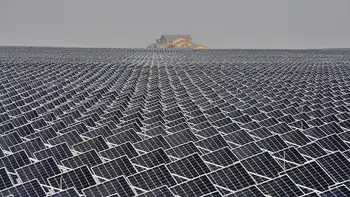
China boosts wind energy, photovoltaic and concentrated solar power
China Renewable Energy Law drives growth in wind power, solar thermal, and photovoltaic capacity, supporting…
View more
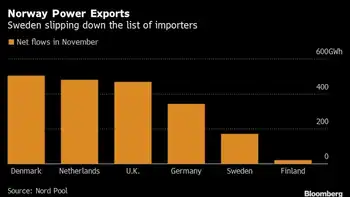
Europe's Thirst for Electricity Spurs Nordic Grid Blockade
Nordic Power Grid Dispute highlights cross-border interconnector congestion, curtailed exports and imports, hydropower priorities, winter…
View more

UK's Energy Transition Stalled by Supply Delays
UK Clean Energy Supply Chain Delays are slowing decarbonization as transformer lead times, grid infrastructure…
View more

Worker injured after GE turbine collapse
GE Wind Turbine Collapse Brazil raises safety concerns at Omega Energia's Delta VI wind farm…
View more
Kenya Power on the spot over inflated electricity bills
Kenya Power token glitches, inflated bills disrupt prepaid meters via M-Pesa paybill 888880 and third-party…
View more
Hydro-Québec will refund a total of $535 million to customers who were account holders in 2018 or 2019
Hydro-Québec Bill 34 Refund issues $535M customer credits tied to electricity rates, consumption-based rebates, and…
View more
Sign Up for Electricity Forum’s Newsletter
Stay informed with our FREE Newsletter — get the latest news, breakthrough technologies, and expert insights, delivered straight to your inbox.
Electricity Today T&D Magazine Subscribe for FREE

Stay informed with the latest T&D policies and technologies.
- Timely insights from industry experts
- Practical solutions T&D engineers
- Free access to every issue

