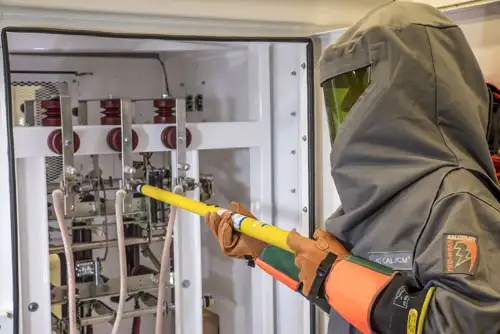
High Voltage Maintenance Training Online
Our customized live online or in‑person group training can be delivered to your staff at your location.
- Live Online
- 12 hours Instructor-led
- Group Training Available
Regular Price:
$599
Coupon Price:
$499
Plans to extend the lifespan of Scotland's nuclear stations were thrown into doubt recenty, after it emerged that cracks had appeared in at least one reactor north of the Border.
The government's nuclear safety watchdog has warned that a radioactive leak could be "inevitable" if action was not taken after cracks emerged in up to six UK reactors, including the one at Hunterston B in Ayrshire.
Opposition politicians said the cracks could scupper plans to extend the life of Hunterston B and other plants across the UK - a claim rejected by British Energy, the plant's owner.
The safety assessments, obtained under the Freedom of Information Act, show the Nuclear Safety Directorate (NSD) has issued warnings over the cracks in graphite bricks at the core of the reactors.
Inspectors warned that there was no technology that could detect sub-surface cracks, branding it a "significant shortfall in the safety case".
"If this is not achieved, there is a reasonable likelihood that extensive sub-surface cracking may be present and subsequent propagation to the surface may occur over a relatively short time period."
The report said that while it did not expect a major radioactive leak, there was a possibility that some "lesser event" could be inevitable if precautions were not taken.
The cracks cannot be repaired, although British Energy, which runs 13 atomic plants around the UK, said this did not have safety implications.
But the watchdog's findings could fatally undermine the compromise offered to Westminster by Jack McConnell, the First Minister, to extend the life-cycle of the reactors only until renewable energy sources can take their place.
David Howarth, the Liberal Democrats' energy spokesman, warned that it would become impossible to extend the life of a reactor, let alone welcome a new age of atomic energy.
"This could spell an earlier end to nuclear plants, rather than an extension of their life-cycle that the government had hoped for," he said.
"The evidence is mounting that the government is taking a huge gamble by pushing for a new generation of nuclear power plants.
"Over-reliance on large, centralised and risky nuclear plants could seriously threaten our electricity supplies if one or more reactor is shut down due to these sort of safety concerns," he added.
John Busby, a former engineer and energy expert, told The Scotsman the problems could render a new generation of reactors unviable on economic grounds, as the industry needed the life extension to justify the massive capital investment.
He added that the position of the cracked graphite blocks was crucial - and potentially catastrophic if it hampered the ability to shut down the plant.
"If these got stuck, the reactor could melt down. The rods are dropped to shut down the reactor for any reason, perhaps in an emergency."
A spokeswoman for British Energy dismissed suggestions the findings would affect the extension of the reactors' lifespan. British Energy had identified the cracks itself, first 18 months ago in Hartlepool, which triggered the inspection of its other facilities. She called for some "perspective", pointing to cracks in 14 out of 6,000 graphite blocks.
"We have no reason to believe that this will affect our desire to [extend] the life of Torness or Hunterston B and, if it ever did, that's something we would have to take into consideration."
She added that reports naming Torness in East Lothian as one of the "problem" sites were wrong, because it had opened in 1988.
However, Hunterston B, at 30 yearsn old, is due to close in just five years.
No decision is expected to be taken on the future of the Ayrshire reactor until 2008, and it is due to be decommissioned three years later if its life-cycle is not extended.
Only "technical" or "economic" factors could hamper this.
However, British Energy confirmed that the cracks would force it to lose revenue as now it has to shut its reactors down for "days longer" than normal when refuelling once every three months, and during the statutory maintenance close-down every three years.
The company described the degradation as the kind of "wear and tear" seen on any kind of brick over time.
Related News

UK must start construction of large-scale storage or fail to meet net zero targets.
UK Hydrogen Storage Caverns enable long-duration, low-carbon electricity balancing, storing surplus wind and solar power…
View more

UN: Renewable Energy Ambition in NDCs must Double by 2030
NDC Renewable Energy Ambition drives COP25 calls to align with the Paris Agreement, as IRENA…
View more
National Grid and SSE to use electrical transformers to heat homes
Grid Transformer Waste Heat Recovery turns substations into neighborhood boilers, supplying district heating via heat…
View more
Demise of nuclear plant plans ‘devastating’ to Welsh economy, MP claims
Wylfa Nuclear Project Cancellation reflects Hitachi's withdrawal, pulling £16bn from North Wales, risking jobs, reshaping…
View more

Hydro One deal to buy Avista receives U.S. antitrust clearance
Hydro One-Avista Acquisition secures U.S. antitrust clearance under Hart-Scott-Rodino, pending approvals from state utility commissions,…
View more
Alberta Introduces New Electricity Rules
Alberta Rate of Last Resort streamlines electricity regulations to stabilize the default rate, curb price…
View more
Sign Up for Electricity Forum’s Newsletter
Stay informed with our FREE Newsletter — get the latest news, breakthrough technologies, and expert insights, delivered straight to your inbox.
Electricity Today T&D Magazine Subscribe for FREE

Stay informed with the latest T&D policies and technologies.
- Timely insights from industry experts
- Practical solutions T&D engineers
- Free access to every issue

