Hydro-Quebec Nuclear Plant Gets 4-year License

By Reuters


Electrical Testing & Commissioning of Power Systems

Our customized live online or in‑person group training can be delivered to your staff at your location.

  • Live Online
  • 12 hours Instructor-led
  • Group Training Available
Regular Price:
$599
Coupon Price:
$499
Reserve Your Seat Today
The license of the Hydro-Quebec Gentilly-2 nuclear power plant in Becancour, Quebec, has been renewed until late 2006, the Canadian Nuclear Safety Commission said.

The approval until Dec. 31, 2006, was given after public hearings held earlier this fall.

"The commission concluded that Hydro-Quebec is qualified to carry out the activities authorized under the license and, in doing so, will make adequate provision for the protection of the environment, the health and safety of persons," the commission said.

Hydro-Quebec is one of North America's largest electricity producers and distributors. The Gentilly-2 plant is located half way between Quebec City and Montreal and has been in operation since 1983. It is a 675 megawatt nuclear reactor fueled with natural uranium.

Related News
New Texas will bill electric vehicle drivers an extra $200 a year

Texas EV Registration Fee adds a $200 annual charge under Senate Bill 505, offsetting lost gasoline tax revenue to the State Highway Fund, impacting electric vehicle owners at registration and renewals across Texas.


Key Points

A $200 yearly charge on electric vehicles to replace lost gasoline tax revenue and support Texas Highway Fund road work.

✅ $200 due at registration or renewal; $400 upfront on new EVs.

✅ Enacted by Senate Bill 505 to offset lost gasoline tax revenue.

✅ Advocates propose mileage-based fees; limited $2,500 rebates exist.


Plano resident Tony Federico bought his Tesla five years ago in part because he hated spending lots of money on gas, and Supercharger billing changes have also influenced charging expenses. But that financial calculus will change slightly on Sept. 1, when Texas will start charging electric vehicle drivers an additional fee of $200 each year.

“It just seems like it’s arbitrary, with no real logic behind it,” said Federico, 51, who works in information technology. “But I’m going to have to pay it.”

Earlier this year, state lawmakers passed Senate Bill 505, which requires electric vehicle owners to pay the fee when they register a vehicle or renew their registration, even as fights for control over charging continue among utilities, automakers and retailers. It’s being imposed because lawmakers said EV drivers weren’t paying their fair share into a fund that helps cover road construction and repairs across Texas.

The cost will be especially high for those who purchase a new electric vehicle and have to pay two years of registration, or $400, up front.

Texas agencies estimated in a 2020 report that the state lost an average of $200 per year in federal and state gasoline tax dollars when an electric vehicle replaced a gas-fueled one. The agencies called the fee “the most straightforward” remedy.

Gasoline taxes go to the State Highway Fund, which the Texas Department of Transportation calls its “primary funding source.” Electric vehicle drivers don’t pay those taxes, though, because they don’t use gasoline.

Still, EV drivers do use the roads. And while electric vehicles make up a tiny portion of cars in Texas for now, that fraction is expected to increase, raising concerns about state power grids in the years ahead.

Many environmental and consumer advocates agreed with lawmakers that EV drivers should pay into the highway fund but argued over how much, and debates over fairer vehicle taxes are surfacing abroad as well.

Some thought the state should set the fee lower to cover only the lost state tax dollars, rather than both the state and federal money, because federal officials may devise their own scheme. Others argued the state should charge nothing because EVs help reduce greenhouse gas emissions that drive climate change and can offer budget benefits for many owners.

“We urgently need to get more electric vehicles on the road,” said Luke Metzger, executive director of Environment Texas. “Any increased fee could create an additional barrier for Texans, and particularly more moderate- to low-income Texans, to make that transition.”

Tom “Smitty” Smith, the executive director of the Texas Electric Transportation Resources Alliance, advocated for a fee based on how many miles a person drove their electric car, which would better mirror how the gas taxes are assessed.

Texas has a limited incentive that could offset the cost: It offers rebates of up to $2,500 for up to 2,000 new hydrogen fuel cell, electric or hybrid vehicles every two years. Adrian Shelley, Public Citizen’s Texas office director, recommended that the state expand the rebates, noting that state-level EV benefits can be significant.

In the Houston area, dealer Steven Wolf isn’t worried about the fee deterring potential customers from buying the electric Ford F-150 Lightning and Mustang Mach-E vehicles he sells. Electric cars are already more expensive than comparable gasoline-fueled cars, and charging networks compete for drivers, he said.


Related News

View more

Let’s make post-COVID Canada a manufacturing hub again

Canada Manufacturing Policy prioritizes affordable energy, trims carbon taxes, aligns with Buy America, and supports the resource sector, PPE and plastics supply, nearshoring, and resilient supply chains amid COVID-19, correcting costly green energy policies.


Key Points

A policy to boost industry with affordable energy, lower carbon taxes, resource ties, and aligned U.S. trade.

✅ Cuts energy costs and carbon tax burdens for competitiveness

✅ Rebuilds resource-sector linkages and domestic supply chains

✅ Seeks Buy America relief and clarity on plastics regulation


By Jocelyn Bamford

Since its inception in 2017, the Coalition of Concerned Manufacturers and Businesses has warned all levels of government that there would be catastrophic effects if policies that drove both the manufacturing and natural resources sectors out of the country were adopted.

The very origins of our coalition was in the fight for a competitive landscape in Ontario, a cornerstone of which is affordable energy and sounding the alarm that the Green Energy Policy in Ontario pushed many manufacturers out of the province.


The Green Energy Policy made electricity in Ontario four times the average North American rate. These unjust prices were largely there to subsidize the construction of expensive and inefficient wind and solar energy infrastructure, even as cleaning up Canada's grid is cited as critical to meeting climate pledges.

My company’s November hydro bill was $55,000 and $36,500 of that was the so-called global adjustment charge, the name given to these green energy costs.

Unaffordable electricity, illustrated by higher Alberta power costs in recent years, coupled with ever-more burdensome carbon taxes, have pushed Canadian manufacturing into the open arms of other countries that see the importance of affordable energy to attract business.

One can’t help but ask the question: If Canada had policies that attracted and maintained a robust manufacturing sector, would we be in the same situation with a lack of personal protective equipment and medical supplies for our front-line medical workers and our patients during this pandemic?  If our manufacturing sector wasn’t crippled by taxes and regulation, would it be more nimble and able to respond to a national emergency?

It seems that the federal government’s policies are designed to push manufacturing out, stifle our resource sector, and kill the very plastics industry that is so essential to keeping our front-line medical staff, patients, and citizens safe, even as the net-zero race accelerates federally.

As the federal government chased its obsession with a new green economy – a strange obsession given our country’s small contribution to global GHGs – including proposals for a fully renewable grid by 2030 advocated by some leaders, it has been blinded from the real threats to our country, threats that became very, very real with COVID-19.

After the pandemic has passed, the federal government must work to make Canada manufacturing and resource friendly again, recognizing that the IEA net-zero electricity report projects the need for more power. COVID-19 proves that Canada relies on a robust resource economy and manufacturing sector to survive. We need to ensure that we are prepared for future crises like the one we are facing now.

Here are five things our government can do now to meet that end:

1. End all carbon taxes immediately.

2. Create a mandate to bring manufacturing back to Canada through competitive offerings and favourable tax regimes.

3. Recognize the interconnections between the resource sector and manufacturing, including how fossil-fuel workers support the transition across supply chains. Many manufacturers supply parts and pieces to the resource sector, and they rely on affordable energy to compete globally.

4. Stop the current federal government initiative to label plastic as toxic. At a time when the government is appealing to manufacturers to re-tool and produce needed plastic products for the health care sector, labelling plastics as toxic is counterproductive.

5. Work to secure a Canadian exemption to Buy America. This crisis has clearly shown us that dependency on China is dangerous. We must forge closer ties with America and work as a trading block in order to be more self-sufficient.

These are troubling times. Many businesses will not survive.

We need to take back our manufacturing sector.  We need to take back our resource sector.

We need to understand the interconnected nature of these two important segments of our gross domestic production, and opportunities like an Alberta–B.C. grid link to strengthen reliability.
If we do not, in the next pandemic we may find ourselves not only without ventilators, masks and gowns but also without energy to operate our hospitals.

Jocelyn Bamford is a Toronto business executive and President of the Coalition of Concerned Manufacturers and Businesses of Canada


Related News

View more

US judge orders PG&E to use dividends to pay for efforts to reduce wildfire risks

PG&E dividend halt for wildfire mitigation directs cash from shareholders to tree clearing, wildfire risk reduction, and probation compliance under Judge William Alsup, amid bankruptcy, Camp Fire liabilities, and power line vegetation management mandates.


Key Points

A court-ordered dividend halt funding vegetation clearance and wildfire mitigation as PG&E meets probation terms.

✅ Judge Alsup bars dividends until mitigation targets met

✅ 375,000 trees cleared near power lines in high-risk zones

✅ Measures tied to probation amid bankruptcy and liabilities


A U.S. judge said on Tuesday that PG&E may not resume paying dividends and must use the money to fund its plan for cutting down trees to reduce the risk of wildfires in California, stopping short of more costly measures he proposed earlier this year.

The new criminal probation terms for PG&E are modest compared with ones the judge had in mind in January and that PG&E said could have cost upwards of $150 billion.

The terms will, however, keep PG&E under the supervision of Judge William Alsup of the U.S. District Court for the Northern District of California and hold the company, which also is in Chapter 11 bankruptcy and whose bankruptcy plan has drawn support from wildfire victims, to its target for clearing areas around its power lines of some 375,000 trees this year.

PG&E's probation stems from its felony conviction after a deadly 2010 natural gas pipeline blast in San Bruno, California, near San Francisco, that killed eight people and injured 58 others.

PG&E filed for bankruptcy protection on Jan. 29 in anticipation of liabilities from wildfires, including a catastrophic 2018 blaze, the Camp Fire, for which PG&E later pleaded guilty to 85 counts in state court. It killed 86 people in the deadliest and most destructive wildfire in California history.

At a January hearing, Alsup, who is overseeing PG&E's probation, said he felt compelled to propose additional probation terms in the aftermath of Camp Fire. San Francisco-based PG&E expects its equipment will be found to have caused the blaze.

The probation process is separate from San Francisco-based PG&E's bankruptcy filing and from operational measures such as its pandemic response and shutoff moratorium implemented to protect customers.

As the company faces $30 billion in wildfire liabilities and bankruptcy proceedings and has opened a wildfire assistance program for affected residents, the energy company is expected to name as its new chief executive Bill Johnson, a source said on Tuesday. Johnson has been the CEO of the Tennessee Valley Authority since 2013 and is retiring on Friday.

Additional probation terms imposed by Alsup on Tuesday will require PG&E to meet goals in a wildfire mitigation plan it unveiled in February.

The goals include removing 375,000 dead, dying or hazardous trees from areas at high risk of wildfires in 2019, compared with 160,000 last year.

The judge said PG&E will not be able to pay shareholders until it complies with his new probation terms.

Shares fell 2% on Tuesday to close at $17.66 on the New York Stock Exchange and are down 63% since November 2018 due to concerns about the company's bankruptcy and wildfire liabilities, though the utility has said rates are set to stabilize in 2025 as part of its long-term plan. The shares traded as low as $5.07 in January.

PG&E in December 2017 suspended its quarterly cash dividend, while continuing to pay significant property taxes to California counties, citing uncertainty about liabilities from wildfires in October of that year that struck Northern California.

PG&E paid $798 million in dividends in 2017 and $925 million in 2016, a period in which the company did a poor job of clearing areas around its power lines of hazardous trees, according to Alsup.

Money meant for shareholders should have been spent on efforts to reduce wildfire risks in recent years, Alsup said at Tuesday's hearing.

"PG&E has started way more than its share of these fires," Alsup said.

"I want to see the people of California safe," the judge added.

Lawyers for PG&E did not contest the new terms, which the company considers more feasible than terms Alsup proposed in January.

To comply with the terms Alsup proposed in January, PG&E said it would have to remove 100 million trees. The company added that shutting power lines during high winds as Alsup proposed would not be feasible because the lines traverse rural areas to service cities and suburbs.

Idling lines could also affect the power grid in other states, PG&E said.

Alsup on Tuesday said he was still considering his proposal to require PG&E to shut down power lines during windy weather to prevent tree branches from making contact and sparking wildfires linked to power lines in the region.


Related News

View more

PG&E Rates Set to Stabilize in 2025

PG&E 2024 Rate Hikes signal sharp increases to fund wildfire safety, infrastructure upgrades, and CPUC-backed reliability, with rates expected to stabilize in 2025, affecting rural residents, businesses, and high-risk zones across California.


Key Points

PG&E’s 2024 hikes fund wildfire safety and grid upgrades, with pricing expected to stabilize in 2025.

✅ Driven by wildfire safety, infrastructure, and reinsurance costs

✅ Largest impacts in rural, high-risk zones; business rates vary

✅ CPUC oversight aims to ensure necessary, justified investments


Pacific Gas and Electric (PG&E) is expected to implement a series of rate hikes that, amid analyses of why California electricity prices are soaring across the state, will significantly impact California residents. These increases, while substantial, are anticipated to be followed by a period of stabilization in 2025, offering a sense of relief to customers facing rising costs.

PG&E, one of the largest utility providers in the state, announced that its 2024 rate hikes are part of efforts to address increasing operational costs, including those related to wildfire safety, infrastructure upgrades, and regulatory requirements. As California continues to face climate-related challenges like wildfires, utilities like PG&E are being forced to adjust their financial models to manage the evolving risks. Wildfire-related liabilities, which have plagued PG&E in recent years, play a significant role in these rate adjustments. In response to previous fire-related lawsuits, including a bankruptcy plan supported by wildfire victims that reshaped liabilities, and the increased cost of reinsurance, PG&E has made it clear that customers will bear part of the financial burden.

These rate hikes will have a multi-faceted impact. Residential users, particularly those in rural or high-risk wildfire zones, will see some of the largest increases. Business customers will also be affected, although the adjustments may vary depending on the size and energy consumption patterns of each business. PG&E has indicated that the increases are necessary to secure the utility’s financial stability while continuing to deliver reliable service to its customers.

Despite the steep increases in 2024, PG&E's executives have assured that the company's pricing structure will stabilize in 2025. The utility has taken steps to balance the financial needs of the business with the reality of consumer affordability. While some rate hikes are inevitable given California's regulatory landscape and climate concerns, PG&E's leadership believes the worst of the increases will be seen next year.

PG&E’s anticipated stabilization comes after a year of scrutiny from California regulators. The California Public Utilities Commission (CPUC) has been working closely with PG&E to scrutinize its rate request and ensure that hikes are justifiable and used for necessary investments in infrastructure and safety improvements. The CPUC’s oversight is especially crucial given the company’s history of safety violations and the public outrage over past wildfire incidents, including reports that its power lines may have sparked fires in California, which have been linked to PG&E’s equipment.

The hikes, though significant, reflect the broader pressures facing utilities in California, where extreme weather patterns are becoming more frequent and intense due to climate change. Wildfires, which have grown in severity and frequency in recent years, have forced PG&E to invest heavily in fire prevention and mitigation strategies, including compliance with a judge-ordered use of dividends for wildfire mitigation across its service area. This includes upgrading equipment, inspecting power lines, and implementing more rigorous protocols to prevent accidents that could spark devastating fires. These investments come at a steep cost, which PG&E is passing along to consumers through higher rates.

For homeowners and businesses, the potential for future rate stabilization offers a glimmer of hope. However, the 2024 increases are still expected to hit consumers hard, especially those already struggling with high living costs. The steep hikes have prompted public outcry, with calls for action as bills soar amplifying advocacy group arguments that utilities should absorb more of the costs related to climate change and fire prevention instead of relying on ratepayers.

Looking ahead to 2025, the expectation is that PG&E’s rates will stabilize, but the question remains whether they will return to pre-2024 levels or continue to rise at a slower rate. Experts note that California’s energy market remains volatile, and while the rates may stabilize in the short term, long-term cost management will depend on ongoing investments in renewable energy sources and continued efforts to make the grid more resilient to climate-related risks.

As PG&E navigates this challenging period, the company’s commitment to transparency and working with regulators will be crucial in rebuilding trust with its customers. While the immediate future may be financially painful for many, the hope is that the utility's focus on safety and infrastructure will lead to greater long-term stability and fewer dramatic rate increases in the years to come.

Ultimately, California residents will need to brace for another tough year in terms of utility costs but can find reassurance that PG&E’s rate increases will eventually stabilize. For those seeking relief, there are ongoing discussions about increasing energy efficiency, exploring renewable energy alternatives, and expanding assistance programs for lower-income households to help mitigate the financial strain of these price hikes.


Related News

View more

BloombergNEF: World offshore wind costs 'drop 32% per cent'

Global Renewable LCOE Trends reveal offshore wind costs down 32%, with 10MW turbines, lower CAPEX and OPEX, and parity for solar PV and onshore wind in Europe, China, and California, per BloombergNEF analysis.


Key Points

Benchmarks showing falling LCOE for offshore wind, onshore wind, and solar PV, driven by larger turbines and lower CAPEX

✅ Offshore wind LCOE $78/MWh; $53-64/MWh in DK/NL excl. transmission

✅ Onshore wind $47/MWh; solar PV $51/MWh, best $26-36/MWh

✅ Cost drivers: 10MW turbines, lower CAPEX/OPEX, weak China demand


World offshore wind costs have fallen 32% from just a year ago and 12% compared with the first half of 2019, according to a BNEF long-term outlook from BloombergNEF.

In its latest Levelized Cost of Electricity (LCOE) Update, BloombergNEF said its current global benchmark LCOE estimate for offshore wind is $78 a megawatt-hour.

“New offshore wind projects throughout Europe, including the UK's build-out, now deploy turbines with power ratings up to 10MW, unlocking CAPEX and OPEX savings,” BloombergNEF said.

In Denmark and the Netherlands, it expects the most recent projects financed to achieve $53-64/MWh excluding transmission.

New solar and onshore wind projects have reached parity with average wholesale power prices in California and parts of Europe, while in China levelised costs are below the benchmark average regulated coal price, according to BloombergNEF.

The company's global benchmark levelized cost figures for onshore wind and PV projects financed in the last six months are at $47 and $51 a megawatt-hours, underscoring that renewables are now the cheapest new electricity option in many regions, down 6% and 11% respectively compared with the first half of 2019.

BloombergNEF said for wind this is mainly down to a fall in the price of turbines – 7% lower on average globally compared with the end of 2018.

In China, the world’s largest solar market, the CAPEX of utility-scale PV plants has dropped 11% in the last six months, reaching $0.57m per MW.

“Weak demand for new plants in China has left developers and engineering, procurement and construction firms eager for business, and this has put pressure on CAPEX,” BloombergNEF said.

It added that estimates of the cheapest PV projects financed recently – in India, Chile and Australia – will be able to achieve an LCOE of $27-36/MWh, assuming competitive returns for their equity investors.

Best-in-class onshore wind farms in Brazil, India, Mexico and Texas can reach levelized costs as low as $26-31/MWh already, the research said.

Programs such as the World Bank wind program are helping developing countries accelerate wind deployment as costs continue to drop.

BloombergNEF associate in the energy economics team Tifenn Brandily said: “This is a three- stage process. In phase one, new solar and wind get cheaper than new gas and coal plants on a cost-of- energy basis.

“In phase two, renewables reach parity with power prices. In phase three, they become even cheaper than running existing thermal plants.

“Our analysis shows that phase one has now been reached for two-thirds of the global population.

“Phase two started with California, China and parts of Europe. We expect phase three to be reached on a global scale by 2030.

“As this all plays out, thermal power plants will increasingly be relegated to a balancing role, looking for opportunities to generate when the sun doesn’t shine or the wind doesn’t blow.”


Related News

View more

Solar + Wind = 10% of US Electricity Generation in 1st Half of 2018

US Electricity Generation H1 2018 saw wind and solar gains but hydro declines, as natural gas led the grid mix and coal fell; renewables' share, GWh, emissions, and capacity additions shaped the power sector.


Key Points

It is the H1 2018 US power mix, where natural gas led, coal declined, and wind and solar grew while hydro fell.

✅ Natural gas reached 32% of generation, highest share

✅ Coal fell; renewables roughly tied nuclear at ~20%

✅ Wind and solar up; hydro output down vs 2017


To complement our revival of US electricity capacity reports, here’s a revival of our reports on US electricity generation.

As with the fresh new capacity report, things are not looking too bright when it comes to electricity generation. There’s still a lot of grey — in the bar charts below, in the skies near fossil fuel power plants, and in the human and planetary outlook based on how slowly we are cutting fossil fuel electricity generation.

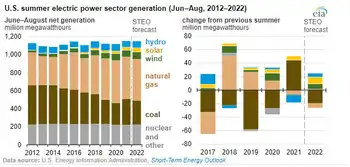
As you can see in the charts above, wind and solar energy generation increased notably from the first half of 2017 to the first half of 2018, and the EIA expected larger summer solar and wind generation in subsequent months, reinforcing that momentum.

A large positive when it comes to the environment and human health is that coal generation dropped a great deal year over year — by even more than renewables increased, though the EIA later noted an increase in coal-fired generation in a subsequent year, complicating the trend. However, on the down side, natural gas soared as it became the #1 source of electricity generation in the United States (32% of US electricity). Furthermore, coal was still solidly in the #2 position (27% of US electricity). Renewables and nuclear were essentially in a tie at 19.8% of generation, with renewables just a tad above nuclear.

Actually, combined with an increase in nuclear power generation, natural gas electricity production increased so much that the renewable energy share of electricity generation actually dropped in the first half of 2018 versus the first half of 2017, even amid declining electricity use in some periods. It was 19.8% this year and 20% last year.

Again, solar and wind saw a significant growth in its market share, from 9% to 9.9%, but hydro brought the whole category down due to a decrease from 9% to 8%.

The visuals above are probably the best way to examine it all. The H1 2018 chart was still dominated by fossil fuels, which together accounted for approximately 60% of electricity generation, even though by 2021 non-fossil sources supplied about 40% of U.S. electricity, highlighting the longer-term shift. In H1 2017, the figure was 59.7%. Furthermore, if you switch to the “Change H1 2018 vs H1 2017 (GWh)” chart, you can watch a giant grey bar representing natural gas take over the top of the chart. It almost looks like it’s part of the border of the chart. The biggest glimmer of positivity in that chart is seeing the decline in coal at the bottom.

What will the second half of the year bring? Well, the gigantic US electricity generation market shifts slowly, even as monthly figures can swing, as January generation jumped 9.3% year over year according to the EIA, reminding us about volatility. There is so much base capacity, and power plants last so long, that it takes a special kind of magic to create a rapid transition to renewable energy. As you know from reading this quarter’s US renewable energy capacity report, only 43% of new US power capacity in the first half of the year was from renewables. The majority of it was from natural gas. Along with other portions of the calculation, that means that electricity generation from natural gas is likely to increase more than electricity generation from renewables.

Jump into the numbers below and let us know if you have any more thoughts.


Related News

View more

Sign Up for Electricity Forum’s Newsletter

Stay informed with our FREE Newsletter — get the latest news, breakthrough technologies, and expert insights, delivered straight to your inbox.

Electricity Today T&D Magazine Subscribe for FREE

Stay informed with the latest T&D policies and technologies.
  • Timely insights from industry experts
  • Practical solutions T&D engineers
  • Free access to every issue

Live Online & In-person Group Training

Advantages To Instructor-Led Training – Instructor-Led Course, Customized Training, Multiple Locations, Economical, CEU Credits, Course Discounts.

Request For Quotation

Whether you would prefer Live Online or In-Person instruction, our electrical training courses can be tailored to meet your company's specific requirements and delivered to your employees in one location or at various locations.