By New York Times


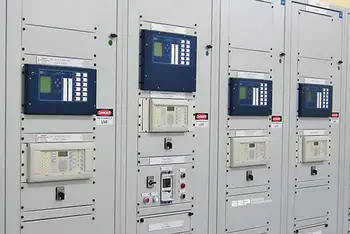
Protective Relay Training - Basic

Our customized live online or in‑person group training can be delivered to your staff at your location.
  • Live Online
  • 12 hours Instructor-led
  • Group Training Available
Regular Price:
$699
Coupon Price:
$599
Reserve Your Seat Today
Snags Delay Final Version of Energy Bill

WASHINGTON -- Republicans trying to finish the first major energy legislation in a decade continued to hit obstacles in recent talks and postponed a scheduled meeting that would have allowed a House-Senate negotiating committee to approve the measure.

House Republicans had hoped to bring the bill to the floor earlier, but that timetable was in jeopardy after House and Senate Republicans writing the measure were unable to make public a final proposal by Sunday evening. Senate Democrats have requested at least 24 hours to review the measure before a final meeting of the conference committee.

Congressional officials said negotiators had resolved the chief policy issues like new standards for the electric utility industry, initiatives to spur oil and gas production and a plan to increase ethanol in gasoline. But lawmakers had not agreed on the amount and type of tax incentives, issues that House and Senate tax writers negotiate.

Democrats, who say that for the most part they have been cut out of the negotiations, called on Republicans to make public the agreements that have been reached so they could begin to digest the proposal.

But Congressional aides said Republicans were reluctant to do that without a completed agreement because it could provide opponents more opportunity to attack the measure while giving lawmakers time to push for adding proposals.

Meanwhile, new problems surfaced. A bipartisan group of 29 senators wrote to the conference committee to reinforce their support for ethanol provisions passed by the Senate. Environmental groups raised concern over a last-minute plan to relax some air-pollution requirements. And in a proposal covering producers of a gasoline additive blamed for contaminating groundwater, an agreement giving them immunity retroactive to Oct. 1 in product liability cases came under scrutiny because of lawsuits in the last few weeks.

"It is another reason to vote against it," said Senator Judd Gregg, Republican of New Hampshire, a state where lawsuits have been recently filed.

Industry officials said they did not believe the suits would be affected.

Related News
ACORE tells FERC that DOE Proposal to Subsidize Coal, Nuclear Power Plants is unsupported by Record

FERC Grid Resiliency Pricing Opposition underscores industry groups, RTOs, and ISOs rejecting DOE's NOPR, warning against out-of-market subsidies for coal and nuclear, favoring competitive markets, reliability, and true grid resilience.


Key Points

Coalition urging FERC to reject DOE's NOPR subsidies, protecting reliability and competitive power markets.

✅ Industry groups, RTOs, ISOs oppose DOE NOPR

✅ PJM reports sufficient reliability and resilience

✅ Reject out-of-market aid to coal, nuclear


A diverse group of a dozen energy industry associations representing oil, natural gas, wind, solar, efficiency, and other energy technologies today submitted reply comments to the Federal Energy Regulatory Commission (FERC) continuing their opposition to the Department of Energy's (DOE) proposed rulemaking on grid resiliency pricing and electricity pricing changes within competitive markets, in the next step in this FERC proceeding.

Action by FERC, as lawmakers urge movement on aggregated DERs to modernize markets, is expected by December 11.

In these comments, this broad group of energy industry associations notes that most of the comments submitted initially by an unprecedented volume of filers, including grid operators whose markets would be impacted by the proposed rule, urged FERC not to adopt DOE'sproposed rule to provide out-of-market financial support to uneconomic coal and nuclear power plants in the wholesale electricity markets overseen by FERC.

Just a small set of interests - those that would benefit financially from discriminatory pricing that favors coal and nuclear plants - argued in favor of the rule put forward by DOE in its Notice of Proposed Rulemaking, or NOPR, as did coal and business interests in related regulatory debates. But even those interests - termed 'NOPR Beneficiaries' by the energy associations - failed to provide adequate justification for FERC to approve the rule, and their specific alternative proposals for implementing the bailout of these plants were just as flawed as the DOE plan, according to the energy industry associations.

'The joint comments filed today with partners across the energy spectrum reflect the overwhelming majority view that this proposed rulemaking by FERC is unprecedented and unwarranted, said Todd Foley, Senior Vice President, Policy & Government Affairs, American Council on Renewable Energy.

We're hopeful that FERC will rule against an anti-competitive distortion of the electricity marketplace and avoid new unnecessary initiatives that increase power prices for American consumers and businesses.'

In the new reply comments submitted in response to the initial comments filed by hundreds of stakeholders on or before October 23 - the energy industry associations made the following points: Despite hundreds of comments filed, no new information was brought forth to validate the assertion - by DOE or the NOPR Beneficiaries - that an emergency exists that requires accelerated action to prop up certain power plants that are failing in competitive electricity markets: 'The record in this proceeding, including the initial comments, does not support the discriminatory payments proposed' by DOE, state the industry groups.

Nearly all of the initial comments filed in the matter take issue with the DOE NOPR and its claim of imminent threats to the reliability and resilience of the electric power system, despite reports of coal and nuclear disruptions cited by some advocates: 'Of the hundreds of comments filed in response to the DOE NOPR, only a handful purported to provide substantive evidence in support of the proposal. In contrast, an overwhelming majority of initial comments agree that the DOE NOPR fails to substantiate its assertions of an immediate reliability or resiliency need related to the retirement of merchant coal-fired and nuclear generation.'

Grid operators filed comments refuting claims that the potential retirement of coal and nuclear plants which could not compete for economically present immediate or near-term challenges to grid management, even as a coal CEO criticism targeted federal decisions: 'Even the RTOs and ISOs themselves filed comments opposing the DOE NOPR, noting that the proposed cost-of-service payments to preferred generation would disrupt the competitive markets and are neither warranted nor justified.... Most notably, this includes PJM Interconnection, ... the RTO in which most of the units potentially eligible for payments under the DOE NOPR are located. PJM states that its region 'unquestionably is reliable, and its competitive markets have for years secured commitments from capacity resources that well exceed the target reserve margin established to meet [North American Electric Reliability Corp.] requirements.' And PJM analysis has confirmed that the region's generation portfolio is not only reliable, but also resilient.'

The need for NOPR Beneficiaries to offer alternative proposals reflects the weakness of DOE'srule as drafted, but their options for propping up uneconomic power plants are no better, practically or legally: 'Plans put forward by supporters of the power plant bailout 'acknowledge, at least implicitly, that the preferential payment structure proposed in the DOE NOPR is unclear, unworkable, or both. However, the alternatives offered by the NOPR Beneficiaries, are equally flawed both substantively and procedurally, extending well beyond the scope of the DOE NOPR.'

Citing one example, the energy groups note that the detailed plan put forward by utility FirstEnergy Service Co. would provide preferential payments far more costly than those now provided to individual power plants needed for immediate reasons (and given a 'reliability must run' contract, or RMR): 'Compensation provided under [FirstEnergy's proposal] would be significantly expanded beyond RMR precedent, going so far as to include bailing [a qualifying] unit out of debt based on an unsupported assertion that revenues are needed to ensure long-term operation.'

Calling the action FERC would be required to take in adopting the DOE proposal 'unprecedented,' the energy industry associations reiterate their opposition: 'While the undersigned support the goals of a reliable and resilient grid, adoption of ill-considered discriminatory payments contemplated in the DOE NOPR is not supportable - or even appropriate - from a legal or policy perspective.


About ACORE

The American Council on Renewable Energy (ACORE) is a national non-profit organization leading the transition to a renewable energy economy. With hundreds of member companies from across the spectrum of renewable energy technologies, consumers and investors, ACORE is uniquely positioned to promote the policies and financial structures essential to growth in the renewable energy sector. Our annual forums in Washington, D.C., New York and San Franciscoset the industry standard in providing important venues for key leaders to meet, discuss recent developments, and hear the latest from senior government officials and seasoned experts.


Related News

View more

BC Hydro completes major milestone on Site C transmission line work

Site C 500 kV transmission lines strengthen the BC Hydro grid, linking the new substation and Peace Canyon via a 75 kilometre right-of-way to deliver clean energy, with 400 towers built and both circuits energized.


Key Points

High-voltage lines connecting Site C substation to the BC Hydro grid, delivering clean energy via Peace Canyon.

✅ Two 75 km circuits between Site C and Peace Canyon

✅ Connect new 500 kV substation to BC Hydro grid

✅ Over 400 towers built along existing right-of-way


The second and final 500 kilovolt, 75 kilometre transmission line on the Site C project, which has faced stability questions in recent years, has been completed and energized.

With this milestone, the work to connect the new Site C substation to the BC Hydro grid, amid treaty rights litigation that has at times shaped schedules, is complete. Once the Site C project begins generating electricity, much like when the Maritime Link first power flowed between Newfoundland and Nova Scotia, the transmission lines will help deliver clean energy to the rest of the province.

The two 75 kilometre transmission lines run along an existing right-of-way between Site C and the Peace Canyon generating station, a route that has seen community concerns from some northerners. The project’s first 500 kilovolt, 75 kilometre transmission line – along with the Site C substation – were both completed and energized in the fall of 2020.

BC Hydro awarded the Site C transmission line construction contract to Allteck Line Contractors Inc. (now Allteck Limited Partnership) in 2018. Since construction started on this part of the project in summer 2018, crews have built more than 400 towers and strung lines, even as other interties like the Manitoba-Minnesota line have faced scheduling uncertainty, over a total of 150 kilometres.

The two transmission lines are a major component of the Site C project, comparable to initiatives such as the New England Clean Power Link in scale, which also consists of the new 500 kilovolt substation and expanding the existing Peace Canyon 500 kilovolt gas-insulated switchgear to incorporate the two new 500 kilovolt transmission line terminals.

Work to complete three other 500 kilovolt transmission lines that will span one kilometre between the Site C generating station and Site C substation, similar to milestones on the Maritime Link project, is still underway. This work is expected to be complete in 2023.


Related News

View more

Annual U.S. coal-fired electricity generation will increase for the first time since 2014

U.S. coal-fired generation 2021 rose as higher natural gas prices, stable coal costs, and a recovering power sector shifted the generation mix; capacity factors rebounded despite low coal stocks and ongoing plant retirements.


Key Points

Coal output rose 22% on high gas prices and higher capacity factors; a 5% decline is expected in 2022.

✅ Natural gas delivered cost averaged $4.93/MMBtu, more than double 2020

✅ Coal capacity factor rose to ~51% from 40% in 2020

✅ 2022 coal generation forecast to fall about 5%


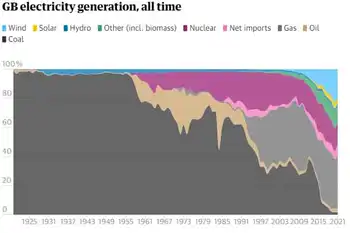
We expect 22% more U.S. coal-fired generation in 2021 than in 2020, according to our latest Short-Term Energy Outlook (STEO). The U.S. electric power sector has been generating more electricity from coal-fired power plants this year as a result of significantly higher natural gas prices and relatively stable coal prices, even as non-fossil sources reached 40% of total generation. This year, 2021, will yield the first year-over-year increase in coal generation in the United States since 2014, highlighted by a January power generation jump earlier in the year.

Coal and natural gas have been the two largest sources of electricity generation in the United States. In many areas of the country, these two fuels compete to supply electricity based on their relative costs and sensitivity to policies and gas prices as well. U.S. natural gas prices have been more volatile than coal prices, so the cost of natural gas often determines the relative share of generation provided by natural gas and coal.

Because natural gas-fired power plants convert fuel to electricity more efficiently than coal-fired plants, record natural gas generation has at times underscored that advantage, and natural gas-fired generation can have an economic advantage even if natural gas prices are slightly higher than coal prices. Between 2015 and 2020, the cost of natural gas delivered to electric generators remained relatively low and stable. This year, however, natural gas prices have been much higher than in recent years. The year-to-date delivered cost of natural gas to U.S. power plants has averaged $4.93 per million British thermal units (Btu), more than double last year’s price.

The overall decline in electricity demand in 2020 and record-low natural gas prices led coal plants to significantly reduce the percentage of time that they generated power. In 2020, the utilization rate (known as the capacity factor) of U.S. coal-fired generators averaged 40%. Before 2010, coal capacity factors routinely averaged 70% or more. This year’s higher natural gas prices have increased the average coal capacity factor to about 51%, which is almost the 2018 average, a year when wind and solar reached 10% nationally.

Although rising natural gas prices have resulted in more U.S. coal-fired generation than last year, this increase in coal generation will most likely not continue as solar and wind expand in the generation mix. The electric power sector has retired about 30% of its generating capacity at coal plants since 2010, and no new coal-fired capacity has come online in the United States since 2013. In addition, coal stocks at U.S. power plants are relatively low, and production at operating coal mines has not been increasing as rapidly as the recent increase in coal demand. For 2022, we forecast that U.S. coal-fired generation will decline about 5% in response to continuing retirements of generating capacity at coal power plants and slightly lower natural gas prices.


Related News

View more

Expanding EV Charging Infrastructure in Calgary's Apartments and Condos

Calgary EV Charging for Apartments and Condos streamlines permitting for multi-unit dwellings, guiding condo boards and property managers to install EV charging stations, expand infrastructure, and advance sustainability with cleaner air and lower emissions.


Key Points

A Calgary program simplifying permits and guidance to add EV charging stations in multi-unit residential buildings.

✅ Streamlined permitting for condo boards and property managers

✅ Technical assistance to install EV charging stations

✅ Boosts property value and reduces emissions citywide


As the demand for electric vehicles (EVs) continues to rise, and as national EV targets gain traction, Calgary is taking significant strides to enhance its charging infrastructure, particularly in apartment and condominium complexes. A recent initiative has been introduced to facilitate the installation of EV charging stations in these residential buildings, addressing a critical barrier for potential EV owners living in multi-unit dwellings.

The Growing EV Market

Electric vehicles are no longer a niche market; they have become a mainstream option for many consumers. As of late 2023, EV sales have surged, with projections indicating that the trend will only continue. However, a significant challenge remains for those who live in apartments and condos, where high-rise charging can be a mixed experience and the lack of accessible charging stations persists. Unlike homeowners with garages, residents of multi-unit dwellings often rely on public charging infrastructure, which can be inconvenient and limiting.

The New Initiative

In response to this growing concern, the City of Calgary has launched a new initiative aimed at easing the process of installing EV chargers in apartment and condo buildings. This program is designed to streamline the permitting process, reduce red tape, and provide clear guidelines for property managers and condo boards, similar to strata installation rules adopted in other jurisdictions to ease installations.

The initiative includes various measures, such as providing technical assistance and resources to building owners and managers. By simplifying the installation process, the city hopes to encourage more residential complexes to adopt EV charging stations. The initiative also emphasizes practical support, such as providing technical assistance, including condo retrofit guidance, and resources to building owners and managers. This is a significant step towards creating an eco-friendly urban environment and meeting the growing demand for sustainable transportation options.

Benefits of the Initiative

The benefits of this initiative are manifold. Firstly, it supports Calgary's broader climate goals by promoting electric vehicle adoption. As more residents gain access to charging stations, the city can expect a corresponding reduction in greenhouse gas emissions, contributing to cleaner air and a healthier urban environment.

Additionally, providing charging infrastructure can enhance property values. Buildings equipped with EV chargers become more attractive to potential tenants and buyers who prioritize sustainability. As the market for electric vehicles expands, properties that offer charging facilities are likely to see increased demand, making them a sound investment for landlords and developers.

Overcoming Challenges

While this initiative marks a positive step forward, there are still challenges to address. Property managers and condo boards may face initial resistance from residents who are uncertain about the costs associated with installing and maintaining EV chargers, though rebates for home and workplace charging can offset upfront expenses and ease adoption. Clear communication about the long-term benefits, including potential energy savings and the value of sustainable living, will be essential in overcoming these hurdles.

Furthermore, the city will need to ensure that the installation of EV chargers is done in a way that is equitable and inclusive. This means considering the needs of all residents, including those who may not own an electric vehicle but would benefit from a greener community.

Looking Ahead

As Calgary moves forward with this initiative, it sets a precedent for other cities, as seen in Vancouver's EV-ready policy, facing similar challenges in promoting electric vehicle adoption. By prioritizing charging infrastructure in multi-unit residential buildings, Calgary is taking important steps towards a more sustainable future.

In conclusion, the push for EV charging stations in apartments and condos is a critical move for Calgary. It reflects a growing recognition of the role that urban planning and infrastructure play in supporting the transition to electric vehicles, which complements corridor networks like the BC Electric Highway for intercity travel. With the right support and resources, Calgary can pave the way for a greener, more sustainable urban landscape that benefits all its residents. As the city embraces this change, it will undoubtedly contribute to a broader shift towards sustainable living, ultimately helping to combat climate change and improve the quality of life for all Calgarians.


Related News

View more

Hungary's Quiet Alliance with Russia in Europe's Energy Landscape

Hungary's Russian Energy Dependence underscores EU tensions, as TurkStream gas flows, discounted imports, and pipeline reliance challenge sanctions, energy security, diversification, and decoupling goals amid Ukraine war pressures and bloc unity concerns.


Key Points

It is Hungary's reliance on Russian gas and oil via TurkStream, complicating EU sanctions and energy independence.

✅ 85% gas, 60% oil imports from Russia via TurkStream pipelines.

✅ Discounted contracts seldom cut bills; security cited by Budapest.

✅ EU decoupling targets hampered; sanctions leverage and unity erode.


Hungary's energy policies have positioned it as a notable outlier within the European Union, particularly in the context of the ongoing geopolitical tensions stemming from Russia's invasion of Ukraine. While the EU has been actively working to reduce its dependence on Russian energy sources through an EU $300 billion plan to dump Russian energy, Hungary has maintained and even strengthened its energy ties with Moscow, raising concerns about EU unity and the effectiveness of sanctions.

Strategic Energy Dependence

Hungary's energy infrastructure is heavily reliant on Russian supplies. Approximately 85% of Hungary's natural gas and more than 60% of its oil imports originate from Russia. This dependence is facilitated through pipelines such as TurkStream, which delivers Russian gas to Hungary via Turkey and the Balkans amid Europe's energy nightmare over price volatility and security. In 2025, Hungary's gas imports through TurkStream are projected to reach 8 billion cubic meters, a significant increase from previous years. These imports are often secured at discounted rates, although such savings may not always be passed on to Hungarian consumers.

Political and Economic Considerations

Prime Minister Viktor Orbán has been a vocal critic of EU sanctions against Russia and has consistently blocked EU initiatives aimed at providing military aid to Ukraine, even as Ukraine leans on power imports to keep the lights on. His government argues that Russia's military capabilities make it an unyielding adversary and that a ceasefire would only solidify its territorial gains. Orbán's stance has led to Hungary's isolation within the EU on matters related to the conflict in Ukraine.

Economically, Hungary's reliance on Russian energy has been justified by the government as a means to maintain low energy prices for consumers and ensure energy security. However, critics argue that this strategy undermines EU efforts to achieve energy independence and reduces the bloc's leverage over Russia amid a global energy war marked by price hikes and instability.

EU's Response and Challenges

The European Union has set ambitious goals to reduce its reliance on Russian energy, aiming to halt imports of Russian natural gas by the end of 2027 and prohibit new contracts starting in 2025 while exploring gas price cap strategies to contain market volatility. However, Hungary's continued imports of Russian energy complicate these efforts. The TurkStream pipeline, in particular, has become a focal point in discussions about the EU's energy strategy, as it enables ongoing Russian gas exports to Europe despite the bloc's broader decoupling initiatives.

Hungary's actions have raised concerns among other EU member states about the effectiveness of the sanctions regime and the potential for other countries to exploit similar loopholes. There are calls for stricter policies, including banning spot gas purchases and enforcing traceability of gas origins, and consideration of emergency measures to limit electricity prices to ensure genuine energy independence and reduce overreliance on external suppliers.

Hungary's steadfast energy relationship with Russia presents a significant challenge to the European Union's collective efforts to reduce dependence on Russian energy sources. While Hungary argues that its energy strategy is in the national interest, it risks undermining EU solidarity and the bloc's broader geopolitical objectives. As the EU continues to navigate its energy transition and response to the ongoing conflict in Ukraine, including energy ceasefire violations reported by both sides, Hungary's position will remain a critical point of contention within the union.


Related News

View more

Romania moves to terminate talks with Chinese partner in nuke project

Romania Ends CGN Cernavoda Nuclear Deal, as Nuclearelectrica moves to terminate negotiations on reactors 3 and 4, citing the EU Green Deal, US partnership, NATO, and a shift to alternative nuclear capacity options.


Key Points

Romania orders Nuclearelectrica to end CGN talks on Cernavoda units 3-4 and pursue alternative nuclear options.

✅ Negotiations on Cernavoda units 3-4 to be formally terminated

✅ EU Green Deal and US partnership cited over security concerns

✅ Board to draft strategies for new domestic nuclear capacity


Romania's government has mandated the managing board of local nuclear power producer Nuclearelectrica to initiate procedures for terminating negotiations with China General Nuclear Power Group (CGN) on building two new reactors at the Cernavoda nuclear power plant, where IAEA safety reports continue to shape operations.

The government also mandated the managing board to analyse and draw up strategic options on the construction of new electricity generation capacities from nuclear sources, as other countries such as India take steps to get nuclear back on track in response to demand.

The company will negotiate the termination of the agreement signed in 2015 for developing and operating units 3 and 4 at Cernavoda, even as Germany turns away from nuclear within the European landscape. 

At the end of last month, Economy Minister Virgil Popescu said that the collaboration with the Chinese company couldn't continue as it has yielded no results in seven years, despite China's nuclear program expanding steadily elsewhere.

"We have a strategic partnership with the US, and we hold on to it, we respect our partners. We are members of the EU and Nato, even as Germany's final reactor closures unfold in Europe. Aside from that, I think that seven years since this collaboration with the Chinese company began is enough to realise that we can't move on," Popescu said at that time.

Liberal Prime Minister Ludovic Orban announced in January that the government would exit the deal with its Chinese partner. He invoked the European Union's Green Deal rather than security issues or cost concerns circulated previously as the main reason behind a potential end of the deal with CGN to expand Romania's only nuclear power plant, amid concerns that Europe is losing nuclear power when it needs energy.

In August last year, the US included CGN on a blacklist for allegedly trying to get nuclear technology from the US to be used for military purposes in China, even as nuclear cooperation with Cambodia expands in the region.


Related News

View more

Sign Up for Electricity Forum’s Newsletter

Stay informed with our FREE Newsletter — get the latest news, breakthrough technologies, and expert insights, delivered straight to your inbox.

Electricity Today T&D Magazine Subscribe for FREE

Stay informed with the latest T&D policies and technologies.
  • Timely insights from industry experts
  • Practical solutions T&D engineers
  • Free access to every issue

Live Online & In-person Group Training

Advantages To Instructor-Led Training – Instructor-Led Course, Customized Training, Multiple Locations, Economical, CEU Credits, Course Discounts.

Request For Quotation

Whether you would prefer Live Online or In-Person instruction, our electrical training courses can be tailored to meet your company's specific requirements and delivered to your employees in one location or at various locations.