Protective Relay Training - Basic
Our customized live online or in‑person group training can be delivered to your staff at your location.

- Live Online
- 12 hours Instructor-led
- Group Training Available
Regular Price:
$699
Coupon Price:
$599
Greenpeace co-founder Dr. Patrick Moore said public consultations on Ontario's energy supply are an opportunity to communicate the vital importance of nuclear energy to the province's future.
"Nuclear energy is the only non-greenhouse-gas-emitting power source that can effectively replace fossil fuels while helping to alleviate the massive shortfall of 24,000 megawatts in Ontario's energy supply expected by 2025," said Moore, Chairman and Chief Scientist of Greenspirit Strategies Ltd.
"Greenspirit Strategies Senior Vice President Trevor Figueiredo will be attending the consultations on my behalf to emphasize the importance of nuclear power to Ontario's energy future," said Moore.
"The Ontario Power Authority expects by 2025 a shortfall of 24,000 megawatts resulting from increasing demand combined with the scheduled retirements of pollution-prone, greenhouse-gas emitting coal-fired power plants by 2009 and the loss of most of Ontario's existing nuclear facilities as these plants reach the end of their design life," said Moore.
"That shortfall of 24,000 megawatts is equivalent to 80 per cent of Ontario's existing capacity," said Moore.
"We strongly support cost-effective renewables such as wind, hydro and geothermal, but there is no practical way renewables alone will be able to alleviate the expected shortfall," said Moore.
"It is simply not realistic - as the anti-nuclear energy activists argue - to replace existing nuclear and coal-fired plants, which currently make up 68 per cent of Ontario's electricity production, with renewables," said Moore.
"The only way to alleviate this shortfall is by building new nuclear facilities, and since these plants take 10 years to build, we must start planning for them now," said Moore.
"Nuclear power is an extremely safe, clean and reliable form of energy," said Moore.
"There has never been a serious accident at any Canadian nuclear facility since the establishment of the industry over 40 years ago," said Moore.
Related News

Hydro One launches Ultra-Low Overnight Electricity Price Plan
Ultra-Low Overnight Price Plan delivers flexible electricity pricing from Hydro One and the Ontario Energy…
View more
Ontario announces SMR plans to four reactors at Darlington
Ontario Darlington SMR Expansion advances four GE Hitachi BWRX-300 reactors with OPG, adding 1,200 MW…
View more
Pickering NGS life extensions steer Ontario towards zero carbon horizon
OPG Pickering Nuclear Refurbishment extends four CANDU reactors to bolster Ontario clean energy, grid reliability,…
View more
Zero-emission electricity in Canada by 2035 is practical and profitable
Canada 100% Renewable Power by 2035 envisions a decentralized grid built on wind, solar, energy…
View more
Ukraine Helps Spain Amid Blackouts
Ukraine-Spain Power Aid highlights swift international solidarity as Kyiv offers grid restoration expertise to Spain…
View more
Buyer's Remorse: Questions about grid modernization affordability
Grid Modernization drives utilities to integrate DER, AMI, and battery storage while balancing reliability, safety,…
View more
Sign Up for Electricity Forum’s Newsletter
Stay informed with our FREE Newsletter — get the latest news, breakthrough technologies, and expert insights, delivered straight to your inbox.
Electricity Today T&D Magazine Subscribe for FREE
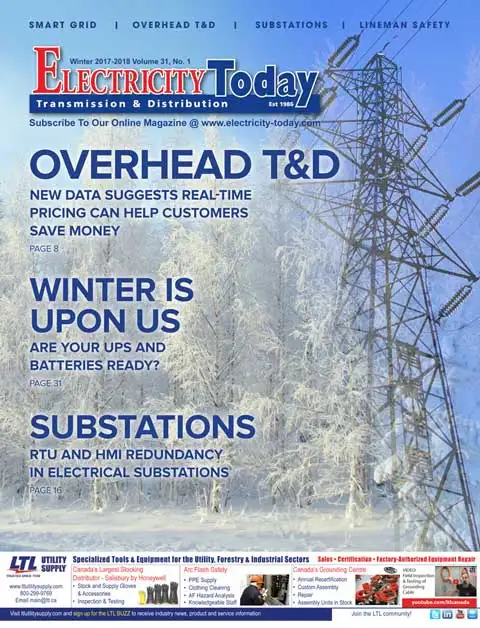
Stay informed with the latest T&D policies and technologies.
- Timely insights from industry experts
- Practical solutions T&D engineers
- Free access to every issue