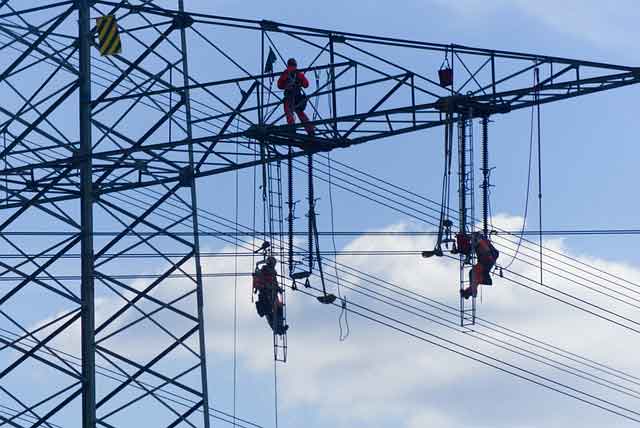
By Hydro spokeswoman Anita Mitchell says the linemen were working on a new installation and no lines had yet been placed on the pole.


High Voltage Maintenance Training Online

Our customized live online or in‑person group training can be delivered to your staff at your location.

  • Live Online
  • 12 hours Instructor-led
  • Group Training Available
Regular Price:
$599
Coupon Price:
$499
Reserve Your Seat Today
-- Two Manitoba Hydro workers were injured Wednesday morning when a pole they were installing equipment on apparently fell over.

The accident happened around 11:30, just a few kilometres southeast of Winnipeg.

One of the linemen was treated at hospital and released.

The second is listed in stable condition in the St. Boniface Hospital.

Related News

Sub-Saharan Africa has a huge electricity problem - but with challenge comes opportunity

Sub-Saharan Africa Energy Access faces critical deficits; SDG7, clean energy finance, off-grid solar, and microgrids drive electrification for health, education, and economy amid World Bank and IEA efforts to expand reliable, affordable power.


Key Points

Reliable, affordable power in sub-Saharan Africa via renewables, off-grid solar, and SDG7-led electrification.

✅ SDG7 targets universal, modern energy access by 2030

✅ Off-grid solar and microgrids boost rural electrification

✅ Health, education, and business depend on reliable power


Sub-Saharan Africa has an electricity problem. While the world as a whole has made great strides when it comes to providing access to electricity and moving toward universal electricity access worldwide (the world average is now 90 per cent with access, up from 83 per cent in 2010), southern and western African states still lag far behind.

According to Tracking SDG7: The Energy Progress Report, produced by a consortium of organisations including the World Bank, the International Energy Agency and the World Health Organization, 759 million people were without electricity in 2019 and threequarters of them were based in sub-Saharan Africa. At just seven per cent, South Sudan had the lowest access figures; Chad, Burundi and Malawi were only marginally higher. What’s more, due to a combination of factors, the situation is getting worse. In total, the region’s access deficit increased from 556 million people in 2010 to 570 million people in 2019.

These days, being without electricity has an impact on every sphere of life. The Covid-19 pandemic only served to put this into sharper relief. Intermittent electricity meant vaccination doses that rely on cold storage were impossible to deliver and, as more than 70 per cent of the health facilities in sub-Saharan Africa have no access to reliable electricity, the problem was vast. But even without a global pandemic, having no power stymies opportunity in every field, from education to economics.

French photojournalist Pascal Maitre, who has spent much of his career writing about sub-Saharan Africa, wanted to document the problems faced by people in areas with no electricity. He thought particularly carefully about the location for his project. ‘First, I was thinking I could take images in the Democratic Republic of the Congo,’ he says. ‘But then I thought that if you chose a place that has war, it’s logical that electricity won’t really work. So, instead, I wanted to find a place that is quite stable. I decided to go to Benin, where they have a democracy. It is a good example of a country that’s not in really bad shape but where they still have this problem. Also, I didn’t want to go to a place that is very remote, where it is normal not to have good service. So I decided to go to a place around 50 kilometres from the capital that you can get to by road.’

Maitre visited several villages in the region, as well as making trips to Chad and Senegal, and encountered the full range of limitations engendered by the power shortage. From teachers struggling to conduct lessons in the dark to midwives forced to work with only the weak light from a phone, the situation was clearly unacceptable. ‘People were very, very, very upset,’ he says. ‘I conducted a lot of interviews in different villages and lack of electricity touches education, economy, business, security and also emigration, because people have to move to big cities or maybe to Europe to get jobs.’

Where once the situation might have been accepted as the norm, people today are fully aware of the ways in which they are held back by the lack of power. As Maitre remembers: ‘A guy said to me one day, “Do you think it is normal that last time my wife delivered a baby, the midwife had to hold her phone between her teeth in order to see what she was doing?” You feel very frustrated.’ He adds that the fact that most people now have mobile phones only highlights the hardship. ‘Before, maybe it was not so frustrating. But now, most of these people have cellphones. The cellphone company puts antennae everywhere so the phones work, but people cannot recharge their phones. They have to go to the market, where someone will come with a generator to recharge.’

Governments and global organisations are very aware of the problem across the world as a whole. Sustainable Development Goal 7 (SDG7) – one of the 17 goals set out in 2015 by the United Nations General Assembly – was designed to ensure universal access to affordable, reliable, sustainable and modern energy by 2030, underscoring the push for clean, affordable and sustainable electricity for all by 2030. As part of this goal, international financial flows to developing countries in support of clean energy reached US$17 billion in 2018. As a result, some areas have seen huge improvement. According to the Energy Progress Report, in Latin America and the Caribbean, and in Eastern and South-Eastern Asia, the advance of electrification has been enough to approach universal access. By 2019, in Western Asia and North Africa, and Central and South Asia, 94 and 95 per cent of the population respectively had access to electricity.

But these statistics only serve to emphasise just how bad the situation is in sub-Saharan Africa, where electricity systems are unlikely to go green this decade according to several analyses. As the report states: ‘While renewable energy has demonstrated remarkable resilience during the pandemic, the unfortunate fact is that gains in energy access throughout Africa are being reversed: the number of people lacking access to electricity is set to increase in 2020, making basic electricity services unaffordable for up to 30 million people who had previously enjoyed access.’

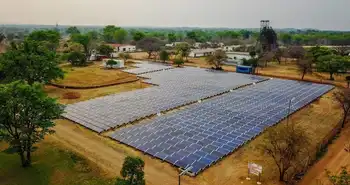
The small silver lining is that if the situation is dealt with properly, the region could build a renewable-energy system from the ground up, rather than having to undergo the costly and complex transitions underway in developed countries. In rural areas, small-scale or off-grid renewable systems (mostly solar) are expected to play an important role, as highlighted by a recent IRENA report on decarbonisation, in increasing access. In fact, solar panels are already used in many areas. In 2019, 105 million people had access to off-grid solar solutions, up from 85 million in 2016, and almost half lived in sub-Saharan Africa, with 17 million in Kenya and eight million in Ethiopia.

Rachel Kyte is currently serving as the 14th dean of the Fletcher School at Tufts University in the USA, but her CV is long. She was previously CEO of the UN-affiliated Sustainable Energy for All (SeforALL), as well as the World Bank Group vice president and special envoy for climate change, leading the run-up to the Paris Agreement. According to her, a focus on renewables is absolutely essential, both for wider efforts to tackle climate change, with some advocating a fossil fuel lockdown to drive a climate revolution, but also for the people of sub-Saharan Africa. ‘The fossil fuel industry has said it will just extend the centralised fossil-fuel power systems that we have today to reach these people,’ she says.


Related News

View more

Africa's Electricity Unlikely To Go Green This Decade

Africa 2030 Energy Mix Forecast finds electricity generation doubling, with fossil fuels dominant, non-hydro renewables under 10%, hydro vulnerable to droughts, and machine-learning analysis of planned power plants shaping climate and investment decisions.


Key Points

An analysis predicting Africa's 2030 power mix, with fossil fuels dominant, limited renewables growth, and hydro risks.

✅ ML model assesses 2,500 planned plants' commissioning odds

✅ Fossil fuels ~66% of generation; non-hydro RE <10% by 2030

✅ Policy shifts and finance reallocation to scale solar and wind


New research today from the University of Oxford predicts that total electricity generation across the African continent will double by 2030, with fossil fuels continuing to dominate the energy mix posing potential risk to global climate change commitments.

The study, published in Nature Energy, uses a state-of-the art machine-learning technique to analyse the pipeline of more than 2,500 currently-planned power plants and their chances of being successfully commissioned. It shows the share of non-hydro renewables in African electricity generation is likely to remain below 10% in 2030, although this varies by region.

'Africa's electricity demand is set to increase significantly as the continent strives to industrialise and improve the wellbeing of its people, which offers an opportunity to power this economic development and expand universal electricity access through renewables' says Galina Alova, study lead author and researcher at the Oxford Smith School of Enterprise and the Environment.

'There is a prominent narrative in the energy planning community that the continent will be able to take advantage of its vast renewable energy resources and rapidly decreasing clean technology prices to leapfrog to renewables by 2030 but our analysis shows that overall it is not currently positioned to do so.'

The study predicts that in 2030, fossil fuels will account for two-thirds of all generated electricity across Africa. While an additional 18% of generation is set to come from hydro-energy projects across Africa. These have their own challenges, such as being vulnerable to an increasing number of droughts caused by climate change.

The research also highlights regional differences in the pace of the transition to renewables across Sub-Saharan Africa, with southern Africa leading the way. South Africa alone is forecast to add almost 40% of Africa's total predicted new solar capacity by 2030.

'Namibia is committed to generate 70% of its electricity needs from renewable sources, including all the major alternative sources such as hydropower, wind and solar generation, by 2030, as specified in the National Energy Policy and in Intended Nationally Determined Contributions under Paris Climate Change Accord,' says Calle Schlettwein, Namibia Minister of Water (former Minister of Finance and Minister of Industrialisation). 'We welcome this study and believe that it will support the refinement of strategies for increasing generation capacity from renewable sources in Africa and facilitate both successful and more effective public and private sector investments in the renewable energy sector.'

Minister Schlettwein adds: 'The more data-driven and advanced analytics-based research is available for understanding the risks associated with power generation projects, the better. Some of the risks that could be useful to explore in the future are the uncertainties in hydrological conditions and wind regimes linked to climate change, and economic downturns such as that caused by the COVID-19 pandemic.'

The study further suggests that a decisive move towards renewable energy in Africa would require a significant shock to the current system. This includes large-scale cancellation of fossil fuel plants currently being planned. In addition, the study identifies ways in which planned renewable energy projects can be designed to improve their success chances for example, smaller size, fitting ownership structure, and availability of development finance for projects.

'The development community and African decision makers need to act quickly if the continent wants to avoid being locked into a carbon-intense energy future' says Philipp Trotter, study author and researcher at the Smith School. 'Immediate re-directions of development finance from fossil fuels to renewables are an important lever to increase experience with solar and wind energy projects across the continent in the short term, creating critical learning curve effects.'


Related News

View more

Ontario Reducing Burden on Industrial Electricity Ratepayers

Ontario Industrial Electricity Pricing Reforms aim to cut regulatory burden for industrial ratepayers through an energy concierge service, IESO billing reviews, GA estimation enhancements, clearer peak demand data, and contract cost savings.


Key Points

Measures to reduce industrial power costs via an energy concierge, IESO and GA reviews, and better peak demand data.

✅ Energy concierge eases pricing and connection inquiries

✅ IESO to simplify bills and refine GA estimation

✅ Real-time peak data and contract savings under review


Ontario's government is pursuing burden reduction measures for industrial electricity ratepayers, including legislation to lower rates to help businesses compete, and stimulate growth and investment.

Over the next year, Ontario will help industrial electricity ratepayers focus on their businesses instead of their electricity management practices by establishing an energy concierge service to provide businesses with better customer service and easier access to information about electricity pricing and changes for electricity consumers as well as connection processes.

Ontario is also tasking the Independent Electricity System Operator (IESO) to review and report back on its billing, settlement and customer service processes, building on initiatives such as electricity auctions that aim to reduce costs.


Improve and simplify industrial electricity bills, including clarifying the recovery rate that affects charges;

Review how the monthly Global Adjustment (GA) charge is estimated and identify potential enhancements related to cost allocation across classes; and,

Improve peak demand data publication processes and assess the feasibility of using real-time data to determine the factors that allocate GA costs to consumers.

Further, as part of the government's continued effort to finding efficiencies in the electricity system, Ontario is also directing IESO to review generation contracts to find opportunities for cost savings.

These measures are based on industry feedback received during extensive industrial electricity price consultations held between April and July 2019, which underscored how high electricity rates have impacted factories across the province.

"Our government is focused on finding workable electricity pricing solutions that will provide the greatest benefit to Ontario," said Greg Rickford, Minister of Energy, Northern Development and Mines. "Reducing regulatory burden on businesses can free up resources that can then be invested in areas such as training, new equipment and job creation."

The government is also in the process of developing further changes to industrial electricity pricing policy, amid planned rate increases announced by the OEB, informed by what was heard during the industrial electricity price consultations.

"It's important that we get this right the first time," said Minister Rickford. "That's why we're taking a thoughtful approach and listening carefully to what businesses in Ontario have to say."

Helping industrial ratepayers is part of the government's balanced and prudent plan to build Ontario together through ensuring our province is open for business and building a more transparent and accountable electricity system.


Related News

View more

B.C. Diverting Critical Minerals, Energy from U.S

Canadian Softwood Lumber Tariffs challenge British Columbia's forestry sector, strain U.S.-Canada trade, and risk redirecting critical minerals and energy resources, threatening North American supply chains, manufacturing, and energy security across integrated markets.


Key Points

Duties imposed by the U.S. on Canadian lumber, affecting BC forestry, trade flows, and North American energy security.

✅ U.S. duties strain BC forestry and cross-border supply chains

✅ Risks redirecting critical minerals and energy exports

✅ Tariff rollback could bolster North American energy security


British Columbia Premier David Eby has raised concerns that U.S. tariffs on Canadian softwood lumber are prompting the province to redirect its critical minerals and energy resources, while B.C. challenges Alberta's electricity export restrictions domestically, away from the United States. In a recent interview, Eby emphasized the broader implications of these tariffs, suggesting they could undermine North American energy security and put electricity exports at risk across the border.

Since 2017, the U.S. Department of Commerce has imposed tariffs on Canadian softwood lumber imports, alleging that Canadian producers benefit from unfair subsidies. These duties have been a persistent source of tension between the two nations, coinciding with Canadian support for energy and mineral tariffs and significantly impacting British Columbia's forestry sector—a cornerstone of the province's economy.

Premier Eby highlighted that the financial strain imposed by these tariffs not only jeopardizes the Canadian forestry industry but also has unintended repercussions for the United States. He pointed out that the economic challenges faced by Canadian producers might lead them to seek alternative markets for their critical minerals and energy resources, as tariff threats boost support for Canadian energy projects domestically, thereby reducing the supply to the U.S. British Columbia is endowed with an abundance of critical minerals essential for various industries, including technology and defense.

The potential redirection of these resources could have significant consequences for American industries that depend on a stable and affordable supply of critical minerals and energy. Eby suggested that the tariffs might incentivize Canadian producers to explore other international markets, even as experts advise against cutting Quebec's energy exports amid the tariff dispute, diminishing the availability of these vital resources to the U.S.

In light of these concerns, Premier Eby has advocated for a reassessment of the tariffs, urging a more cooperative approach between Canada and the United States. He contends that eliminating the tariffs would be mutually beneficial, aligning with views that Biden is better for Canada's energy sector and cross-border collaboration, ensuring a consistent supply of critical resources and fostering economic growth in both countries.

The issue of U.S. tariffs on Canadian softwood lumber remains complex and contentious, with far-reaching implications for trade relations and resource distribution between the two nations. As discussions continue, stakeholders on both sides of the border are closely monitoring the situation, noting that Ford has threatened to cut U.S. electricity exports amid trade tensions, recognizing the importance of collaboration in addressing shared economic and security challenges.


Related News

View more

Atlantic Canadians less charged up to buy electric vehicle than rest of Canada

Atlantic Canada EV adoption lags, a new poll finds, as fewer buyers consider electric vehicles amid limited charging infrastructure, lower provincial rebates, and affordability pressures in Nova Scotia and Newfoundland compared to B.C. and Quebec.


Key Points

Atlantic Canada EV adoption reflects demand, shaped by rebates, charging access, costs, and the regional energy mix.

✅ Poll shows lowest purchase intent in Atlantic Canada

✅ Lack of rebates and charging slows EV consideration

✅ Income and energy mix affect affordability and benefits


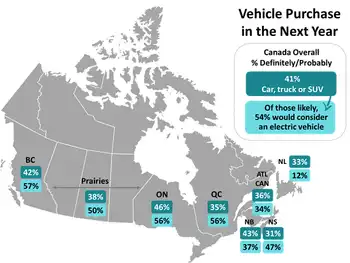
Atlantic Canadians are the least likely to buy a car, truck or SUV in the next year and the most skittish about going electric, according to a new poll. 

Only 31 per cent of Nova Scotians are looking at buying a new or used vehicle before December 2021 rolls around. And just 13 per cent of Newfoundlanders who are planning to buy are considering an electric vehicle. Both those numbers are the lowest in the country. Still, 47 per cent of Nova Scotians considering buying in the next year are thinking about electric options, according to the numbers gathered online by Logit Group and analyzed by Halifax-based Narrative Research. That compares to 41 per cent of Canadians contemplating a vehicle purchase within the next year, with 54 per cent of them considering going electric. 

“There’s still a high level of interest,” said Margaret Chapman, chief operating officer at Narrative Research.  

“I think half of people who are thinking about buying a vehicle thinking about electric is pretty significant. But I think it’s a little lower in Atlantic Canada compared to other parts of the country probably because the infrastructure isn’t quite what it might be elsewhere. And I think also it’s the availability of vehicles as well. Maybe it just hasn’t quite caught on here to the extent that it might have in, say, Ontario or B.C., where the highest level of interest is.” 


Provincial rebates
Provincial rebates also serve to create more interest, she said, citing New Brunswick's rebate program as an example in the region. 

“There’s a $7,500 rebate on top of the $5,000 you get from the feds in B.C. But in Nova Scotia there’s no provincial rebate,” Chapman said. “So I think that kind of thing actually is significant in whether you’re interested in buying an electric vehicle or not.” 

The survey was conducted online Nov. 11–13 with 1,231 Canadian adults. 

Of the people across Canada who said they were not considering an electric vehicle purchase, 55 per cent said a provincial rebate would make them more likely to consider one, she said.  

In Nova Scotia, that number drops to 43 per cent. 

Nova Scotia families have the lowest median after-tax income in the country, according to numbers released earlier this year.  

The national median in 2018 was $61,400, according to Statistics Canada. Nova Scotia was at the bottom of the pack with $52,200, up from $51,400 in 2017. 

So big price tags on electric vehicles might put them out of reach for many Nova Scotians, and a recent cost-focused survey found similar concerns nationwide. 

“I think it’s probably that combination of cost and infrastructure,” Chapman said. 

“But you saw this week in the financial update from the federal government that they’re putting $150 million into new charging station, so were some of that cash to be spread in Atlantic Canada, I’m sure there would be an increase in interest … The more charging stations around you see, you think ‘Alright, it might not be so hard to ensure that I don’t run out of power for my car.’ All of that stuff I think will start to pick up. But right now it is a little bit lagging in Atlantic Canada, and in Labrador infrastructure still lags despite a government push in N.L. to expand EVs.” 


'Simple dollars and cents'
The lack of a provincial government rebate here for electric vehicles definitely factors into the equation, said Sean O’Regan, president and chief executive officer of O'Regan's Automotive Group.  

“Where you see the highest adoption are in the provinces where there are large government rebates,” he said. “It’s a simple dollars and cents (thing). In Quebec, when you combine the rebates it’s up to over $10,000, if not $12,000, towards the car. If you can get that kind of a rebate on a car, I don’t know that it would matter much what it was – it would help sell it.” 

A lot of people who want to buy electric cars are trying to make a conscious decision about the environment, O’Regan said. 

While Nova Scotia Power is moving towards renewable energy, he points out that much of our electricity still comes from burning coal and other fossil fuels, and N.L. lags in energy efficiency as the region works to improve.  

“So the power that you get is not necessarily the cleanest of power,” O’Regan said. “The green advantage is not the same (in Nova Scotia as it is in provinces that produce a lot of hydro power).” 

Compared to five years ago, the charging infrastructure here is a lot better, he said. But it doesn’t compare well to provinces including Quebec and B.C., though Newfoundland recently completed its first fast-charging network for electric car owners. 

“Certainly (with) electric cars – we're selling more and more and more of them,” O'Regan said, noting the per centage would be in the single digits of his overall sales. “But you're starting from zero a few years ago.” 

The highest number of people looking at buying electric cars was in B.C., with 57 per cent of those looking at buying a car saying they’d go electric, and even in southern Alberta interest is growing; like Bob Dylan in 1965 at the Newport Folk Festival.  

“The trends move from west to east across Canada,” said Jeff Farwell, chief executive officer of the All EV Canada electric car store in Burnside.  

“I would use the example of the craft beer market. It started in B.C. about 15 years before it finally went crazy in Nova Scotia. And if you look at Vancouver right now there’s (electric vehicles) everywhere.” 


Expectations high
Farwell expects electric vehicle sales to take off faster in Atlantic Canada than the craft beer market. “A lot faster.” 

His company also sells used electric vehicles in Prince Edward Island and is making moves to set up in Moncton, N.B. 

He’s been talking to Nova Scotia’s Department of Energy and Mines about creating rebates here for new and used electric vehicles. 

 “I guess they’re interested, but nothing’s happened,” Farwell said.  

Electric vehicles require “a bit of a lifestyle change,” he said. 

“The misconception is it takes a lot longer to charge a vehicle if it’s electric and gas only takes me 10 minutes to fill up at the gas station,” Farwell said.  

“The reality is when I go home at night, I plug my vehicle in,” he said. “I get up in the morning and I unplug it and I never have to think about it. It takes two seconds.”  


Related News

View more

Nuclear plant workers cite lack of precautions around virus

Millstone COVID-19 safety concerns center on a nuclear refueling outage in Connecticut, temporary workers, OSHA complaints, PPE shortages, and disinfecting protocols, as Dominion Energy addresses virus precautions, staffing, and cybersecurity for safe voting infrastructure.


Key Points

Employee and union claims about PPE, cleaning, and OSHA compliance during a refueling outage at the nuclear plant.

✅ 10 positive cases; 750 temporary workers during refueling outage

✅ Union cites PPE gaps, partitions, and disinfectant effectiveness

✅ Dominion Energy notes increased cleaning, communication, staffing


Workers at Connecticut's only nuclear power plant worry that managers are not taking enough precautions against the coronavirus, as some utilities weigh on-site staffing measures to maintain operations, after 750 temporary employees were brought in to help refuel one of the two active reactors.

Ten employees at the Millstone Power Station in Waterford have tested positive for the virus, and, amid a U.S. grid pandemic warning, the arrival of the temporary workers alarms some of the permanent employees, The Day newspaper reported Sunday.

"Speaking specifically for the guard force, there's a lot of frustration, there's a lot of concern, and I would say there's anger," said Millstone security officer Jim Foley.

Foley, vice president of the local chapter of the United Government Security Officers of America, noted broader labor concerns such as unpaid wages for Kentucky miners while saying security personnel have had to fight for personal protective equipment and for partitions at access points to separate staff from security.

Foley also has filed a complaint with the Occupational Safety and Health Administration saying Millstone staff are using ineffective cleaning materials and citing a lack of cleaning and sanitizing, as telework limits at the EPA drew scrutiny during the pandemic, he said.

Officials at Millstone, owned by Dominion Energy, have not heard internal criticism about the plant's virus precautions, Millstone spokesman Kenneth Holt said.

"We've actually gotten a lot of compliments from employees on the steps we've taken," he said. "We've stepped up communications with employees to let them know what's going on."

As another example of communication efforts, COVID-19 updates at Site C have been published to keep workers informed.

Millstone recently increased cleaning staff on the weekends, Holt said, and there is regular disinfecting at the plant.

Separately, utility resilience remains a concern, as extended outages for tornado survivors in Kentucky may last weeks, affecting essential services.

Responding to the complaint about ineffective cleaning materials, Holt said staff members early in the pandemic went to a Home Depot and got a bottle of disinfectant that wasn't approved by the federal government as effective against the coronavirus. An approved disinfectant was brought in the next day, he said.

The deaths of nearly 2,500 Connecticut residents have been linked to COVID-19, the disease caused by the virus. More than 29,000 state residents have tested positive. As of Sunday, hospitalizations had declined for 11 consecutive days, to over 1,480.

With more people working remotely, utilities have reported higher residential electricity use during the pandemic, affecting household bills.

For most people, the coronavirus causes mild or moderate symptoms, such as fever and cough, that clear up in two to three weeks. For some, especially older adults and people with existing health problems, it can cause more severe illness, including pneumonia, and death.

In other developments related to the coronavirus:

SAFE VOTING

Secretary of the State Denise Merrill released a plan Monday aimed at making voting safe during the Aug. 11 primary and Nov. 3 general election.

Merrill said her office is requiring all cities and towns in the state to submit plans for the two elections that include a list of cleaning and safety products to be used, a list of polling locations, staffing levels at each polling location, and the names of polling workers and moderators.

Municipalities will be eligible for grants to cover the extra costs of holding elections during a pandemic, including expenses for cleaning products and increased staffing.

Merrill also announced her office and the Connecticut National Guard will perform a high-level cybersecurity assessment of the election infrastructure of all 169 towns in the state to guard against malicious actors.

Merrill's office also will provide network upgrades to the election infrastructures of 20 towns that have had chronic problems with connecting to the elections system.


Related News

View more

Sign Up for Electricity Forum’s Newsletter

Stay informed with our FREE Newsletter — get the latest news, breakthrough technologies, and expert insights, delivered straight to your inbox.

Electricity Today T&D Magazine Subscribe for FREE

Stay informed with the latest T&D policies and technologies.
  • Timely insights from industry experts
  • Practical solutions T&D engineers
  • Free access to every issue

Download the 2025 Electrical Training Catalog

Explore 50+ live, expert-led electrical training courses –

  • Interactive
  • Flexible
  • CEU-cerified