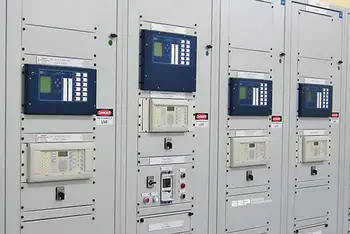
Protective Relay Training - Basic
Our customized live online or in‑person group training can be delivered to your staff at your location.
- Live Online
- 12 hours Instructor-led
- Group Training Available
Regular Price:
$699
Coupon Price:
$599
The deputy nuclear chief said that Iran intends to move toward large-scale uranium enrichment involving 54,000 centrifuges, signalling the country's resolve to expand a program the United Nations has demanded it halt.
Mohammad Saeedi made the comments a day after Iran announced it had succeeded in enriching uranium on a small scale for the first time, using 164 centrifuges, at a facility in the central town of Natanz.
"We will expand uranium enrichment to industrial scale at Natanz," Saeedi told state-run television. He said Iran has informed the UN nuclear watchdog agency that it plans to install 3,000 centrifuges at Natanz by late 2006 and that it will then expand to 54,000 centrifuges, though he did not say when.
He said using 54,000 centrifuges will be able to produce enough enriched uranium to provide fuel for a 1,000-megawatt nuclear power plant like the one Russia is currently putting the finishing touches on in southern Iran.
Iranian President Mahmoud Ahmadinejad announced the enrichment success in a nationally televised ceremony, saying the country's nuclear ambitions are peaceful and warning the West that trying to force Iran to abandon enrichment would "cause an everlasting hatred in the hearts of Iranians."
But the announcement quickly raised condemnations from the United States. The UN Security Council has demanded that Iran stop all enrichment activity by April 28 because of suspicions the program really aims to make weapons.
The head of the UN nuclear watchdog agency, Mohamed ElBaradei, was heading to Iran for talks aimed at resolving the standoff. The timing of the announcement suggested Iran wanted to present him with a fait accompli and argue that it cannot be expected to entirely give up a program showing progress.
Former Iranian president Hashemi Rafsanjani — a powerful figure in the country's clerical regime — warned that pressuring Iran over enrichment "might not have good consequences for the area and the world."
If the West wants "to solve issues in good faith, that could be easily possible, and if they want to... pressure us on our nuclear activities, things will become difficult and thorny for all," Rafsanjani said in an interview with the Kuwaiti newspaper Al-Rai Al-Aam, published recently.
Rafsanjani — who heads Iran's Expediency Council, a powerful body that arbitrates between the parliament and the clerical hierarchy — said planned talks between Iran and the United States on stabilizing Iraq could lead to discussions on the nuclear dispute.
"We don't have a mandate to discuss the nuclear issue with the Americans... but if the talks on Iraq go in the right direction, there might be a possibility for that issue," Rafsanjani said in an interview with the Al-Hayat daily. "There have been many cases where big and wide-ranging decisions had small beginnings."
Iranian and U.S. officials have insisted the talks will deal only with Iraq. So far, no date for the talks has been set.
Enrichment is a key process that can produce either fuel for a reactor or the material needed for a nuclear reactor. But thousands of centrifuges — arranged in a network called a cascade — are needed for either purpose, and getting any number of centrifuges to work together is a very delicate and difficult task.
Iran resumed research on enrichment at Natanz in February. Saeedi said scientists there slowly built up the number of centrifuges in the cascade — first using four, then 10, then 20. On Sunday, they succeeded in enriching an amount of uranium to the 3.5 per cent needed for a reactor, using 164 centrifuges.
"The next stage is to install 3,000 centrifuges. We definitely won't have problems doing that. We just need to increase our production line," he said.
Enriching uranium to the much higher levels needed for a nuclear warhead is even more difficult, requiring tens of thousands of centrifuges or much longer periods of time.
The IAEA is due to report to the UN Security Council on April 28 whether Iran has met its demand for a full halt to uranium enrichment. If Tehran has not complied, the council will consider the next step. The U.S. and Europe are pressing for sanctions against Iran, a step Russia and China have so far opposed.
Iran is pressing for further negotiations with the IAEA or with Western countries, hinting that it could agree to keep its enrichment program on a small scale under IAEA inspection without giving it up entirely.
Related News
Germany’s renewable energy dreams derailed by cheap Russian gas, electricity grid expansion woes
Germany Energy Transition faces offshore wind expansion, grid bottlenecks, and North-South transmission delays, while Nord…
View more
Alberta shift from coal to cleaner energy
Alberta Coal-to-Gas Transition will retire coal units, convert plants to natural gas, boost renewables, and…
View more

Pennsylvania lawmaker drafts bill requiring data centers to pay grid costs
Pennsylvania Data Center Grid Costs are the focus of draft legislation requiring large-load projects to…
View more
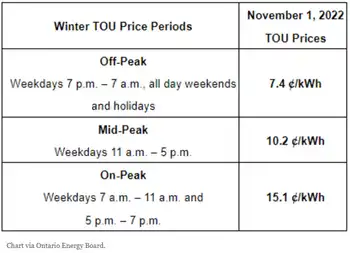
Electricity rates are about to change across Ontario
Ontario Electricity Rate Changes lower OEB Regulated Price Plan costs, adjust Time-of-Use winter hours and…
View more
Global Energy War Escalates: Price Hikes and Instability
Russia-Ukraine Energy War disrupts infrastructure, oil, gas, and electricity, triggering supply shocks, price spikes, and…
View more

Ambitious clean energy target will mean lower electricity prices, modelling says
Australia Clean Energy Target drives renewables in the National Electricity Market, with RepuTex modelling and…
View more
Sign Up for Electricity Forum’s Newsletter
Stay informed with our FREE Newsletter — get the latest news, breakthrough technologies, and expert insights, delivered straight to your inbox.
Electricity Today T&D Magazine Subscribe for FREE

Stay informed with the latest T&D policies and technologies.
- Timely insights from industry experts
- Practical solutions T&D engineers
- Free access to every issue
