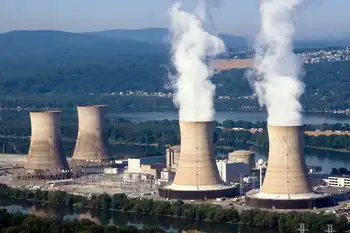
Nuclear Power Plant in South China

By XINHUA NEWS AGENCY


NFPA 70e Training - Arc Flash

Our customized live online or in‑person group training can be delivered to your staff at your location.

  • Live Online
  • 6 hours Instructor-led
  • Group Training Available
Regular Price:
$199
Coupon Price:
$149
Reserve Your Seat Today
South China just got a new power plant.

The 2-million-kw Ling'ao Nuclear Power Plant in Shenzhen, in south China's Guangdong Province, was completed when its second generating unit officially began commercial operations.

As a result, the prosperous province now has two nuclear power plants working with a combined capacity of 4 million kilowatts. The other nuclear plant is in Daya Bay, only one kilometer from Ling'ao.

Ling'ao and Daya Bay each has two 1-million-kw generating units in operation.

Sources with the Ling'ao Nuclear Power Plant said the plant was built and managed by Chinese specialists.

Related News

More people are climbing dangerous hydro dams and towers in search of 'social media glory,' utility says

BC Hydro Trespassing Surge highlights risky social media stunts at dams and power stations, with restricted areas breached for selfies, electrocution hazards ignored, and safety signage violated across Buntzen Lake, Jones Lake, and Jordan River.


Key Points

A spike in illegal entries at BC Hydro sites for social media, increasing electrocution and drowning risks.

✅ 200% rise in trespassing over five years

✅ Risks: electrocution, drowning, deadly falls

✅ Obey signage; avoid restricted dam and substation areas


More and more daredevils are climbing onto dangerous dams and power stations to gain likes and social media followers, according to a new report from BC Hydro.

The power provider says it's seen a 200 per cent uptick in trespassing into restricted areas over the past five years, with many of the incidents posted onto sites like YouTube, Facebook and Instagram.

"It's concerning for us because our infrastructure has risk with it," said David Conway, a community relations manager for BC Hydro.

"There's a risk of electrocution in regards to our transmission towers and our substations ... and people can be severely injured, as seen in serious injuries cases, or killed," he said.

The company released a report Tuesday, noting specific incidents of users trespassing onto sites at Buntzen Lake in Anmore, Jones Lake in the Fraser Valley and Jordan River near Victoria; it has also been issuing Site C updates during the pandemic. The incidents ranged from climbing transmission towers to swimming in restricted areas at dam sites.

In a separate matter, an external investigation at Manitoba Hydro has examined alleged assaults by workers.

Conway says annual incidents climbed from a handful to about one dozen, but BC Hydro expects the figures to be even higher. He says many more events likely go unreported.

The report ties the increase in incidents to the pursuit of "social media glory." Between 2011 and 2017, at least 259 people were killed worldwide in selfie-related incidents, according to the Journal of Family Medicine and Primary Care, and a knowledge gap in electrical safety remains a factor. Many of the incidents involved water, electrical equipment or dangerous heights.

In 2018, three social media personalities died after falling off a cliff at Shannon Falls near Squamish, B.C.

North Shore Rescue attributes about 30 per cent of its calls to outdoor users attempting to capture content for social media.

Survey results highlighted in the BC Hydro report show that 15 per cent of British Columbians admit to putting themselves in a dangerous position "to achieve the 'perfect' shot."

Awareness also influences careers, as many young Canadians say they would work in electricity if they knew more.

The survey was conducted online by 800 B.C. residents. For comparison purposes, a probability sample of the same size would yield a margin of error of plus or minus 3.5 per cent, 19 times out of 20.

During the pandemic, the U.S. grid overseer issued a coronavirus warning to highlight operational risks.

Risky activities include standing at the edge of a cliff, knowingly disobeying safety signage or trespassing, or taking a selfie from a dangerous height.

Two per cent of British Columbians admit to injuring themselves in the name of a selfie.

"We want people to stay safe. We want to remind the public to stay a safe distance away from our infrastructure, and follow safety guidance near downed lines, as electricity and generating facilities can be dangerous," said Conway.

BC Hydro is urging all visitors to obey signage, steer clear of power-generating equipment and to stay on designated trails.


Related News

View more

A new material made from carbon nanotubes can generate electricity by scavenging energy from its environment

Carbon Nanotube Solvent Electricity enables wire-free electrochemistry as organic solvents like acetonitrile pull electrons, powering alcohol oxidation and packed bed reactors, energy harvesting, and micro- and nanoscale robots via redox-driven current.


Key Points

Solvent-driven electron extraction from carbon nanotube particles generates current for electrochemistry.

✅ 0.7 V per particle via solvent-induced electron flow

✅ Packed bed reactors drive alcohol oxidation without wires

✅ Scalable for micro- and nanoscale robots; energy harvesting


MIT engineers have discovered a new way of generating electricity, alongside advances in renewable power at night that broaden what's possible, using tiny carbon particles that can create a current simply by interacting with liquid surrounding them.

The liquid, an organic solvent, draws electrons out of the particles, generating a current, unlike devices based on a cheap thermoelectric material that rely on heat, that could be used to drive chemical reactions or to power micro- or nanoscale robots, the researchers say.

"This mechanism is new, and this way of generating energy is completely new," says Michael Strano, the Carbon P. Dubbs Professor of Chemical Engineering at MIT. "This technology is intriguing because all you have to do is flow a solvent through a bed of these particles. This allows you to do electrochemistry, but with no wires."

In a new study describing this phenomenon, the researchers showed that they could use this electric current to drive a reaction known as alcohol oxidation—an organic chemical reaction that is important in the chemical industry.

Strano is the senior author of the paper, which appears today in Nature Communications. The lead authors of the study are MIT graduate student Albert Tianxiang Liu and former MIT researcher Yuichiro Kunai. Other authors include former graduate student Anton Cottrill, postdocs Amir Kaplan and Hyunah Kim, graduate student Ge Zhang, and recent MIT graduates Rafid Mollah and Yannick Eatmon.

Unique properties
The new discovery grew out of Strano's research on carbon nanotubes—hollow tubes made of a lattice of carbon atoms, which have unique electrical properties. In 2010, Strano demonstrated, for the first time, that carbon nanotubes can generate "thermopower waves." When a carbon nanotube is coated with layer of fuel, moving pulses of heat, or thermopower waves, travel along the tube, creating an electrical current that exemplifies turning thermal energy into electricity in nanoscale systems.

That work led Strano and his students to uncover a related feature of carbon nanotubes. They found that when part of a nanotube is coated with a Teflon-like polymer, it creates an asymmetry, distinct from conventional thermoelectric materials approaches, that makes it possible for electrons to flow from the coated to the uncoated part of the tube, generating an electrical current. Those electrons can be drawn out by submerging the particles in a solvent that is hungry for electrons.

To harness this special capability, the researchers created electricity-generating particles by grinding up carbon nanotubes and forming them into a sheet of paper-like material. One side of each sheet was coated with a Teflon-like polymer, and the researchers then cut out small particles, which can be any shape or size. For this study, they made particles that were 250 microns by 250 microns.

When these particles are submerged in an organic solvent such as acetonitrile, the solvent adheres to the uncoated surface of the particles and begins pulling electrons out of them.

"The solvent takes electrons away, and the system tries to equilibrate by moving electrons," Strano says. "There's no sophisticated battery chemistry inside. It's just a particle and you put it into solvent and it starts generating an electric field."

Particle power
The current version of the particles can generate about 0.7 volts of electricity per particle. In this study, the researchers also showed that they can form arrays of hundreds of particles in a small test tube. This "packed bed" reactor, unlike thin-film waste-heat harvesters for electronics, generates enough energy to power a chemical reaction called an alcohol oxidation, in which an alcohol is converted to an aldehyde or a ketone. Usually, this reaction is not performed using electrochemistry because it would require too much external current.

"Because the packed bed reactor is compact, it has more flexibility in terms of applications than a large electrochemical reactor," Zhang says. "The particles can be made very small, and they don't require any external wires in order to drive the electrochemical reaction."

In future work, Strano hopes to use this kind of energy generation to build polymers using only carbon dioxide as a starting material. In a related project, he has already created polymers that can regenerate themselves using carbon dioxide as a building material, in a process powered by solar energy and informed by devices that generate electricity at night as a complement. This work is inspired by carbon fixation, the set of chemical reactions that plants use to build sugars from carbon dioxide, using energy from the sun.

In the longer term, this approach could also be used to power micro- or nanoscale robots. Strano's lab has already begun building robots at that scale, which could one day be used as diagnostic or environmental sensors. The idea of being able to scavenge energy from the environment, including approaches that produce electricity 'out of thin air' in ambient conditions, to power these kinds of robots is appealing, he says.

"It means you don't have to put the energy storage on board," he says. "What we like about this mechanism is that you can take the energy, at least in part, from the environment."


Related News

View more

This Floating Hotel Will Generate Electricity By Rotating All Day

Floating Rotating Eco Hotel harnesses renewable energy via VAWTAU, recycles rainwater for greywater, and follows zero-waste principles. This mobile, off-grid, Qatar-based resort generates electricity by slow 360-degree rotation while offering luxury amenities.


Key Points

A mobile, off-grid hotel that rotates to generate power, uses VAWTAU, recycles greywater, and targets zero-waste.

✅ Rotates 360 deg in 24 hours to produce electricity

✅ VAWTAU system: vertical-axis turbine and sun umbrella

✅ Rain capture and greywater recycling minimize waste


A new eco-friendly, floating hotel plans to generate its own electricity by rotating while guests relax on board, echoing developments like the solar Marriott hotel in sustainable hospitality.

Led by Hayri Atak Architectural Design Studio (HAADS), the structure will be completely mobile, meaning it can float from place to place, never sitting in a permanent position. Building began in March 2020 and the architects aim for it to be up and running by 2025.

It will be based in Qatar, but has the potential to be located in different areas due to its mobility, and it sits within a region advancing projects such as solar hydrogen production that signal a broader clean-energy shift.

The design includes minimum energy loss and a zero waste principle at its core, aligning with progress in wave energy research that aims to power a clean future. As it will rotate around all day long, this will generate electrical energy to power the whole hotel.

But guests won’t feel too dizzy, as it takes 24 hours for the hotel to spin 360 degrees.

The floating hotel will stay within areas with continuous currents, to ensure that it is always rotating, drawing on ideas from ocean and river power systems that exploit natural flows. This type of green energy production is called ‘vawtau’ (vertical axis wind turbine and umbrella) which works like a wind turbine on the vertical axis, while alternative approaches like kite-based wind energy target stronger, high-altitude currents as well, and functions as a sun umbrella on the coastal band.

Beyond marine-current concepts such as underwater kites, the structure will also make use of rainwater to create power. A cover on the top of the hotel will collect rain to be used for greywater recycling. This is when wastewater is plumbed straight back into toilets, washing machines or outside taps to maximise efficiency.

The whole surface area is around 35,000 m², comparable in scale to emerging floating solar plants that demonstrate modular, water-based infrastructure, and there are a total of 152 rooms. It will have three different entrances so that there is access to the land at any time of the day, thanks to the 140-degree pier that surrounds it.

There will also be indoor and outdoor swimming pools, a sauna, spa, gym, mini golf course and other activity areas.


Related News

View more

ABO to build 10MW Tunisian solar park

ABO Wind Tunisia 10MW Solar Project will build a photovoltaic park in Gabes with a STEG PPA, fixed tariff, 2,500 m grid connection, producing 18 million kWh annually, targeted for 2020 commissioning with local partners.


Key Points

A 10MW photovoltaic park in Gabes with a 20-year STEG PPA and fixed tariff, slated for 2020 commissioning.

✅ 18 million kWh/year; 2,500 m grid tie, 20-year fixed tariff

✅ Electricity supplied to STEG under PPA; 2020 commissioning

✅ Located in Gabes; built with local partners, 10MW capacity


ABO Wind has received a permit and a tariff for a 10MW photovoltaic project in Tunisia, amid global activity such as Spain's 90MW wind project now underway, which it plans to build and commission in 2020.

The solar park, in the governorate of Gabes, is 400km south of the country’s capital Tunis and aligns with renewable funding initiatives seen across developing markets.

The developer said it plans to build the project next year in close cooperation with local partners, as regional markets from North Africa to the Gulf expand, with Saudi Arabia boosting wind capacity as well.

ABO Wind department head Nicolas Konig said: “The solar park will produce more than 18 million kilowatt hours of electricity per year and will feed it into the grid at a distance of 2500 metres.”

The developer will conclude an electricity supply contract with the state-owned energy supplier (Societe tunisienne de l’electricite et du gaz (STEG), which will provide a fixed remuneration over 20 years, a model echoed by Germany's wind-solar tender for the electricity fed into the grid.

Earlier this year, ABO Wind had already secured a tariff for a wind farm with a capacity of 30MW in a tender, 35km south-east of Tunis, underscoring Tunisia's wind investments under its long-term plan.

The company is working on half a dozen Tunisian wind and solar projects, as institutions like the World Bank support wind growth in developing countries.

“We are making good progress on our way to assemble a portfolio of several ready-to-build wind and solar projects attractive to investors, as Saudi clean energy targets continue to expand globally,” said ABO Wind general manager responsible for international business development Patrik Fischer.


Related News

View more

Price Spikes in Ireland Fuel Concerns Over Dispatachable Power Shortages in Europe

ISEM Price Volatility reflects Ireland-Northern Ireland grid balancing pressures, driven by dispatchable power shortages, day-ahead market dynamics, renewable shortfalls, and interconnector constraints, affecting intraday trading, operational reserves, and cross-border electricity flows.


Key Points

ISEM price volatility is Irish power price swings from grid balancing stress and limited dispatchable capacity.

✅ One-off spike linked to plant outage and low renewables

✅ Day-ahead market settling; intraday trading integration pending

✅ Interconnectors and reserves vital to manage adequacy


Irish grid-balancing prices soared to €3,774 ($4,284) per megawatt-hour last month amid growing concerns over dispatchable power capacity across Europe.

The price spike, triggered by an alert regarding generation losses, came only four months after Ireland and Northern Ireland launched an Integrated Single Electricity Market (ISEM) designed to make trading more competitive and improve power distribution across the island.

Evie Doherty, senior consultant for Ireland at Cornwall Insight, a U.K.-based energy consultancy, said significant price volatility was to be expected while ISEM is still settling down, aligning with broader 2019 grid edge trends seen across markets.

When the U.K. introduced a single market for Great Britain, called British Electricity Trading and Transmission Arrangements, in 2005, it took at least six months for volatility to subside, Doherty said.

In the case of ISEM, “it will take more time to ascertain the exact drivers behind the high prices,” she said. “We are being told that the day-ahead market is functioning as expected, but it will take time to really be able to draw conclusions on efficiency.”

Ireland and Northern Ireland have been operating with a single market “very successfully” since 2007, said Doherty. Although each jurisdiction has its own regulatory authority, they make joint decisions regarding the single market.

ISEM, launched in October 2018, was designed to help include Ireland and Northern Ireland day-ahead electricity prices in a market pricing system called the European Union Pan-European Hybrid Electricity Market Integration Algorithm.

In time, ISEM should also allow the Irish grids to participate in European intraday markets, and recent examples like Ukraine's grid connection underline the pace of integration efforts across Europe. At present, they are only able to do so with Great Britain. “The idea was to...integrate energy use and create more efficient flows between jurisdictions,” Doherty said.

EirGrid, the Irish transmission system operator, has reported that flows on its interconnector with Northern Ireland are more efficient than before, she said.

The price spike happened when the System Operator for Northern Ireland issued an alert for an unplanned plant outage at a time of low renewable output and constraints on the north-south tie-line with Ireland, according to a Cornwall Insight analysis.


Not an isolated event

Although it appears to have been a one-off event, there are increasing worries that a shortage of dispatchable power could lead to similar situations elsewhere across Europe, as seen in Nordic grid constraints recently.

Last month, newspaper Frankfurter Allgemeine Zeitung (FAZ) reported that German industrial concerns had been forced to curtail more than a gigawatt of power consumption to maintain operational reserves on the grid in December, after renewable production fell short of expectations and harsh weather impacts strained systems elsewhere.

Paul-Frederik Bach, a Danish energy consultant, has collected data showing that this was not an isolated incident. The FAZ report said German aluminum smelters had been forced to cut back on energy use 78 times in 2018, he noted.

Energy availability was also a concern last year in Belgium, where six out of seven nuclear reactors had been closed for maintenance. The closures forced Belgium to import 23 percent of its electricity from neighboring countries, Bach reported.

In a separate note, Bach revealed that 11 European countries that were net importers of energy had boosted their imports by 26 percent between 2017 and 2018. It is important to note that electricity imports do not necessarily imply a shortage of power, he stated.

However, it is also true that many European grid operators are girding themselves for a future in which dispatchable power is scarcer than today.

EirGrid, for example, expects dispatchable generation and interconnection capacity to drop from 10.6 gigawatts in 2018 to 9 gigawatts in 2027.

The Swedish transmission system operator Svenska Kraftnät, meanwhile, is forecasting winter peak power deficits could rise from 400 megawatts currently to 2.5 gigawatts in 2020-21.

Research conducted by the European Network of Transmission System Operators for Electricity, suggests power adequacy will fall across most of Europe up to 2025, although perhaps not to a critical degree.

The continent’s ability to deal with the problem will be helped by having more efficient trading systems, Bach told GTM. That means developments such as ISEM could be a step in the right direction, despite initial price volatility.

In the long run, however, Europe will need to make sure market improvements are accompanied by investments in HVDC technology and interconnectors and reserve capacity. “Somewhere there must be a production of electricity, even when there is no wind,” said Bach. 


Related News

View more

Franklin Energy and Consumers Energy Support Small Businesses During COVID-19 with Virtual Energy Coaching

Consumers Energy Virtual Energy Coaching connects Michigan small businesses with remote efficiency experts to cut utility costs, optimize energy usage, and access rebates and incentives, delivering safe COVID-19-era support and long-term savings through tailored assessments.


Key Points

A remote coaching service helping small businesses improve energy efficiency, access rebates, and cut utility costs.

✅ Three-call virtual coaching with usage review and savings plan

✅ Connects to rebates, incentives, and financing options

✅ Eligibility: <=1,200,000 kWh, <=15,000 MCF annually


Franklin Energy, a leading provider in energy efficiency and grid optimization solutions, announced today that they will implement Consumers Energy's Small Business Virtual Energy Coaching Service in response to the COVID-19 pandemic and broader industry coordination with federal partners across the power sector.

This Michigan-wide offering to natural gas, electric and combination small business customers provides a complimentary virtual energy-coaching service to help small businesses find ways to reduce electricity bills and benefit from lower utility costs, both now during COVID-19 and into the future, informed by similar Ontario electricity bill support efforts in other regions. To be eligible for the program, small businesses must have electric usage at or below 1,200,000 kWh annually and gas usage at or below 15,000 MCF annually.

"By developing lasting customer relationships and delivering consistent solutions through conversation, the Energy Coaching Program offers the next level of support for small business customers," said Hollie Whitmire, Franklin Energy program manager. "Energy coaching is suitable for all small businesses, but it's ideal for businesses that are new to energy efficiency or for those that have had low engagement with energy efficiency offerings and emerging new utility rate designs in years past."

Through a series of three calls, eligible small businesses can speak with an energy coach to help them connect to the right program offering available through Consumers Energy's energy efficiency programs for businesses, including demand response models like the Ontario Peak Perks program that support load management. From answering questions to reviewing energy usage, conducting assessments, identifying savings opportunities, and more, the energy coach is available to help small businesses put money back into their pocket now, when it matters most.

"Consumers Energy is committed to helping Michigan's small business community prosper, now more than ever, with examples such as Entergy's COVID-19 relief fund underscoring industry support," said Lauren Youngdahl Snyder, Consumers Energy's vice president of customer experience. "We are excited to work with Franklin Energy to develop an innovative solution for our small business customers. The Virtual Energy Coaching Service lets us engage our customers in a safe and effective manner, as seen with utilities waiving fees in Texas during the crisis, and has the potential to last even past the COVID-19 pandemic."


Related News

View more

Sign Up for Electricity Forum’s Newsletter

Stay informed with our FREE Newsletter — get the latest news, breakthrough technologies, and expert insights, delivered straight to your inbox.

Electricity Today T&D Magazine Subscribe for FREE

Stay informed with the latest T&D policies and technologies.
  • Timely insights from industry experts
  • Practical solutions T&D engineers
  • Free access to every issue

Download the 2025 Electrical Training Catalog

Explore 50+ live, expert-led electrical training courses –

  • Interactive
  • Flexible
  • CEU-cerified