Tennessee Valley To Expand Wind Generation

By Associated Press


High Voltage Maintenance Training Online

Our customized live online or in‑person group training can be delivered to your staff at your location.
  • Live Online
  • 12 hours Instructor-led
  • Group Training Available
Regular Price:
$599
Coupon Price:
$499
Reserve Your Seat Today
The largest public utility in the US has signed an agreement to expand its wind power generating facility, the company said.

The Tennessee Valley Authority has been operating three wind turbines on Buffalo Mountain, a reclaimed strip mine in eastern Tennessee, since 2001.

The authority will add 18 turbines to give the site a capacity of more than 28 megawatts, up from 1.8 megawatts.

The added wind power is a significant shift for the utility, which was founded in the 1930s to generate power from hydroelectric dams.

"This is a significant commitment to wind in our region," said Stephen Smith, executive director of the Southern Alliance for Clean Energy, a watchdog group.

Across the United States, wind power is the fastest growing electric power source - outpacing gas turbines, coal plants or nuclear plants, he said. The US Department oof Energy lists 4,558 megawatts of US wind power.

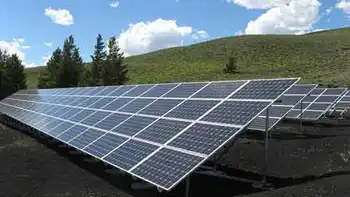
The authority's Green Power Switch alternative energy program also uses electricity generated by solar collectors and reclaimed landfill gas.

TVA provides electricity to 8.3 million people in Tennessee and parts of Kentucky, Virginia, North Carolina, Georgia, Alabama and Mississippi.

Related News

27 giant parts from China to be transported to wind farm in Saskatchewan

Port of Vancouver Wind Turbine Blades arrive from China for a Saskatchewan wind farm, showcasing record oversized cargo logistics, tandem crane handling, renewable energy capacity, and North America's longest blades from Goldwind.


Key Points

Record-length blades for a Canadian wind farm, boosting renewable energy and requiring heavy-lift logistics at the port.

✅ 27 blades unloaded via tandem cranes with cage supports

✅ 50 turbines headed to Assiniboia over 21 weeks

✅ Largest 250 ft blades to arrive; reduced CO2 vs coal


A set of 220-foot-long wind turbine blades arrived at the Port of Vancouver from China over the weekend as part a shipment bound for a wind farm in Canada, alongside BC generating stations coming online in the region.

They’re the largest blades ever handled by the port, and this summer, even larger blades will arrive as companies expand production such as GE’s blade factory in France to meet demand — the largest North America has ever seen.

Alex Strogen described the scene as crews used two tandem cranes to unload 27 giant white blades from the MV Star Kilimanjaro, which picked up the wind turbine assemblies in China. They were manufactured by Goldwind Co.

“When you see these things come off and put onto these trailers, it’s exceptional in the sheer length of them,” Strogen said. “It looks as long as an airplane.”

In fact, each blade is about as long as the wingspan of a Boeing 747.

Groups of longshoremen attached the cranes to each blade and hoisted it into the air and onto a waiting truck. Metal cage-like devices on both ends kept the blades from touching the ground. Once loaded onto the trucks, the blades and shaft parts head to a terminal to be unloaded by another group of workers.

Another fleet of trucks will drive the wind turbines, towers and blades to Assiniboia, Saskatchewan, Canada, over the course of 21 weeks. Potentia Renewables of Toronto is erecting the turbines on 34,000 acres of leased agriculture land, amid wind farm expansion in PEI elsewhere in the country, according to a news release from the Port of Vancouver.

Potentia’s project, called the Golden South Wind Project, will generate approximately 900,000 megawatt-hours of electricity. It also has greatly reduced CO2 emissions compared with a coal-fired plant, and complements tidal power in Nova Scotia in Canada’s clean energy mix, according to the news release.

The project is expected to be operating in 2021, similar to major UK offshore wind additions coming online.

The Port of Vancouver will receive 50 full turbines of two models for the project, as Manitoba invests in new turbines across Canada. In August, the larger of the models, with blades measuring 250 feet, will arrive. They’ll be the longest blades ever imported into any port in North America.

“It’s an exciting year for the port,” said Ryan Hart, chief external affairs officer.

The Port of Vancouver is following all the recommended safety precautions during the COVID-19 pandemic, including social distancing and face masks, Strogen said, with support from initiatives like Bruce Power’s PPE donation across Canada.
As for crews onboard the ships, the U.S. Coast Guard is the agency in charge, and it is monitoring the last port-of-call for all vessels seeking to enter the Columbia River, Hart wrote in an email.

Vessel masters on each ship are responsible for monitoring the health of the crew and are required to report sick or ill crew members to the USCG prior to arrival or face fines and potential arrest.


Related News

View more

New Orleans Levees Withstood Hurricane Ida as Electricity Failed

Hurricane Ida New Orleans Infrastructure faced a split outcome: levees and pumps protected against storm surge, while the power grid collapsed as transmission lines failed, prompting large-scale restoration efforts across Louisiana and Mississippi.


Key Points

It summarizes Ida's impact: levees and pumps held, but the power grid failed, causing outages and slow restoration.

✅ Levees and pumps mitigated flooding and storm surge impacts.

✅ All transmission lines failed, crippling the power grid.

✅ Crews and drones assess damage; restoration may take weeks.


Infrastructure in the city of New Orleans turned in a mixed performance against the fury of Hurricane Ida, with the levees and pumps warding off catastrophic flooding even as the electrical grid, part of the broader Louisiana power grid, failed spectacularly.

Ida’s high winds, measuring 150 miles (240 kilometers) an hour at landfall, took out all eight transmissions lines that deliver power into New Orleans, ripped power poles in half and crumpled at least one steel transmission tower into a twisted metal heap, knocking out electricity to all of the city. A total of more than 1.2 million homes and businesses in Louisiana and Mississippi lost power. While about 90,000 customers were reconnected by Monday afternoon, many could face days without electricity, and frustration can mount as seen during the Houston outage after major storms.

In contrast, the New Orleans area’s elaborate flood defenses seem to have held up, a vindication of the Army Corps of Engineers’ $14.5 billion project to rebuild levees, flood gates and pumps in the wake of the devastation wrought by Hurricane Katrina in 2005. While there were reports of scattered deaths tied to Ida, the city escaped the kind of flooding that destroyed entire neighborhoods in Katrina’s wake, left parts of the city uninhabitable for months and claimed 1,800 lives. 

“The situation in New Orleans, as bad as it is today with the power, could be so much worse,” Louisiana Governor John Bel Edwards said Monday on the Today Show, praising the levee system’s performance. “All you have to do is go back 16 years to get a glimpse of what that would have been like.”

While the levees’ resiliency is no doubt due to the rebuilding effort that followed Katrina, the starkly different outcomes also stems from the storms’ different characteristics. Katrina slammed the coast with a 30-foot storm surge of ocean water, while preliminary estimates from Ida put its surge far lower. 


Ida’s winds, however, were stronger than Katrina’s, and that’s what ultimately took out so many power lines, a dynamic that also saw Texas utilities struggle during Harvey. Deanna Rodriguez, the chief executive officer of power provider Entergy New Orleans, declined to comment on when service would be restored, saying the company was using helicopters and drones to help assess the damage.

Michael Webber, an energy and engineering professor at the University of Texas at Austin, estimated power restoration will take days and possibly weeks, a pattern seen in Florida restoration timelines after major hurricanes, based on the initial damage reports from the storm. More than 25,000 workers from at least 32 states and Washington are mobilized to assist with power restoration efforts, similar to FPL's massive response after Irma, according to the Edison Electric Institute.

“The question is, how long will it take to rebuild these lines,” Webber said. The utilities will first need to complete their damage assessments before they can get a sense of repair timelines, a step that Gulf Power crews have highlighted in past recoveries, he said. “You can imagine that will take days at least, possibly weeks.”

The loss of electricity will have other affects as well, and even though grid resilience during the pandemic was strong, local systems face immediate constraints. Sewer substations, for example, need electricity to keep wastewater moving, said Ghassan Korban, executive director of the New Orleans Sewerage & Water Board. The storm knocked out power to about 80 of the city’s 84 pumping stations, he said at a Monday press conference. “Without electricity, wastewater backs up and can cause overflows,” he said, adding that residents should conserve water to lessen stress on the system.


Related News

View more

Next Offshore Wind in U.S. Can Compete With Gas, Developer Says

Offshore Wind Cost Competitiveness is rising as larger turbines boost megawatt output, cut LCOE, and trim maintenance and installation time, enabling projects in New England to rival natural gas pricing while scaling reliably.


Key Points

It describes how larger offshore turbines lower LCOE and O&M, making U.S. projects price competitive with natural gas.

✅ Larger turbines boost MW output and reduce LCOE.

✅ Lower O&M and faster installation cut lifecycle costs.

✅ Competes with gas in New England bids, per BNEF.


Massive offshore wind turbines keep getting bigger, as projects like the biggest UK offshore wind farm come online, and that’s helping make the power cheaper — to the point where developers say new projects in U.S. waters can compete with natural gas.

The price “is going to be a real eye-opener,” said Bryan Martin, chairman of Deepwater Wind LLC, which won an auction in May to build a 400-megawatt wind farm southeast of Rhode Island.

Deepwater built the only U.S. offshore wind farm, a 30-megawatt project that was completed south of Block Island in 2016. The company’s bid was selected by Rhode Island the same day that Massachusetts picked Vineyard Wind to build an 800-megawatt wind farm in the same area, while international investors such as Japanese utilities in UK projects signal growing confidence.

#google#

Bigger turbines that make more electricity have cut the cost per megawatt by about half, a trend aided by higher-than-expected wind potential in many markets, said Tom Harries, a wind analyst at Bloomberg New Energy Finance. That also reduces maintenance expenses and installation time. All of this is helping offshore wind vie with conventional power plants.

“You could not build a thermal gas plant in New England for the price of the wind bids in Massachusetts and Rhode Island,” Martin said Friday at the U.S. Offshore Wind Conference in Boston. “It’s very cost-effective for consumers.”

The Massachusetts project could be about $100 to $120 a megawatt hour, according to a February estimate from Harries, though recent UK price spikes during low wind highlight volatility. The actual prices there and in Rhode Island weren’t disclosed.

For comparison, a new U.S. combine-cycle gas turbine ranges from $40 to $60 a megawatt-hour, and a new coal plant is $67 to $113, according to BNEF data.


A new power plant in land-constrained New England would probably be higher than that, and during winter peaks the region has seen record oil-fired generation in New England that underscores reliability concerns. More importantly, gas plants get a significant portion of their revenue from being able to guarantee that power is always available, something wind farms can’t do, said William Nelson, a New York-based analyst with BNEF. Looking only at the price at which offshore turbines can deliver electricity is a “narrow mindset,” he said.


Related News

View more

Bill Gates’ Nuclear Startup Unveils Mini-Reactor Design Including Molten Salt Energy Storage

Natrium small modular reactor pairs a sodium-cooled fast reactor with molten salt storage to deliver load-following, dispatchable nuclear power, enhancing grid flexibility and peaking capacity as TerraPower and GE Hitachi pursue factory-built, affordable deployment.


Key Points

A TerraPower-GE Hitachi SMR joining a sodium-cooled reactor with molten salt storage for flexible, dispatchable power.

✅ 345 MW base; 500 MW for 5.5 hours via thermal storage

✅ Sodium-cooled coolant and molten salt storage enable load-following

✅ Backed by major utilities; factory-built modules aim lower costs


Nuclear power is the Immovable Object of generation sources. It can take days just to bring a nuclear plant completely online, rendering it useless as a tool to manage the fluctuations in the supply and demand on a modern energy grid.  

Now a firm launched by Bill Gates in 2006, TerraPower, in partnership with GE Hitachi Nuclear Energy, believes it has found a way to make the infamously unwieldy energy source a great deal nimbler, drawing on next-gen nuclear ideas — and for an affordable price. 

The new design, announced by TerraPower on August 27th, is a combination of a "sodium-cooled fast reactor" — a type of small reactor in which liquid sodium is used as a coolant — and an energy storage system. While the reactor could pump out 345 megawatts of electrical power indefinitely, the attached storage system would retain heat in the form of molten salt and could discharge the heat when needed, increasing the plant’s overall power output to 500 megawatts for more than 5.5 hours. 

“This allows for a nuclear design that follows daily electric load changes and helps customers capitalize on peaking opportunities driven by renewable energy fluctuations,” TerraPower said. 

Dubbed Natrium after the Latin name for sodium ('natrium'), the new design will be available in the late 2020s, said Chris Levesque, TerraPower's president and CEO.

TerraPower said it has the support of a handful of top U.S. utilities, including Berkshire Hathaway Energy subsidiary Pacificorp, Energy Northwest, and Duke Energy. 

The reactor's molten salt storage add-on would essentially reprise the role currently played by coal- or gas-fired power stations or grid-scale batteries: each is a dispatchable form of power generation that can quickly ratchet up or down in response to changes in grid demand or supply. As the power demands of modern grids become ever more variable with additions of wind and solar power — which only provide energy when the wind is blowing or the sun shining — low-carbon sources of dispatchable power are needed more and more, and Europe is losing nuclear power at a difficult moment for energy security. California’s rolling blackouts are one example of what can happen when not enough power is available to be dispatched to meet peak demand. 

The use of molten salt, which retains heat at extremely high temperatures, as a storage technology is not new. Concentrated solar power plants also collect energy in the form of molten salt, although such plants have largely been abandoned in the U.S. The technology could enjoy new life alongside nuclear plants: TerraPower and GE Hitachi Nuclear are only two of several private firms working to develop reactor designs that incorporate molten salt storage units, including U.K.- and Canada-based developer Moltex Energy.

The Gates-backed venture and its partner touted the "significant cost savings" that would be achieved by building major portions of their Natrium plants through not a custom but an industrial process — a defining feature of the newest generation of advanced reactors is that their parts can be made in factories and assembled on-site — although more details on cost weren't available. Reuters reported earlier that each plant would cost around $1 billion.

NuScale Power

A day after TerraPower and GE Hitachi's unveiled their new design, another nuclear firm — Portland, Oregon-based NuScale Power — announced that the U.S. Nuclear Regulatory Commission (NRC) had completed its final safety evaluation of NuScale’s new small modular reactor design.

It was the first small modular reactor design ever to receive design approval from the NRC, NuScale said. 

The approval means customers can now pursue plans to develop its reactor design confident that the NRC has signed off on its safety aspects. NuScale said it has signed agreements with interested parties in the U.S., Canada, Romania, the Czech Republic, and Jordan, and is in the process of negotiating more. 

NuScale previously said that construction on one of its plants could begin in Utah in 2023, with the aim of completing the first Power Module in 2026 and the remaining 11 modules in 2027.

NuScale
An artist’s rendering of NuScale Power’s small modular nuclear reactor plant. NUSCALE POWER
NuScale’s reactor is smaller than TerraPower’s. Entirely factory-built, each of its Power Modules would generate 60 megawatts of power. The design, typical of advanced reactors, uses pressurized water reactor technology, with one power plant able to house up to 12 individual Power Modules. 

In a sign of the huge amounts of time and resources it takes to get new nuclear technology to the market’s doorstep, NuScale said it first completed its Design Certification Application in December 2016. NRC officials then spent as many as 115,000 hours reviewing it, NuScale said, in what was only the first of several phases in the review process. 

In January 2019, President Donald Trump signed into law the Nuclear Energy Innovation and Modernization Act (NEIMA), designed to speed the licensing process for advanced nuclear reactors, and the DOE under Secretary Rick Perry moved to advance nuclear development through parallel initiatives. The law had widespread bipartisan support, underscoring Democrats' recent tentative embrace of nuclear power.

An industry eager to turn the page

After a boom in the construction of massive nuclear power plants in the 1960s and 70s, the world's aging fleet of nuclear plants suffers from rising costs and flagging public support. Nuclear advocates have for years heralded so-called small modular reactors or SMRs as the cheaper and more agile successors to the first generation of plants, and policy moves such as the UK's green industrial revolution lay out pathways for successive waves of reactors. But so far a breakthrough on cost has proved elusive, and delays in development timelines have been abundant. 

Edwin Lyman, the director of nuclear power safety at the Union of Concerned Scientists, suggested on Twitter that the nuclear designs used by TerraPower and GE Hitachi had fallen short of a major innovation. “Oh brother. The last thing the world needs is a fleet of sodium-cooled fast reactors,” he wrote.  

Still, climate scientists view nuclear energy as a crucial source of zero-carbon energy, with analyses arguing that net-zero emissions may be impossible without nuclear in many scenarios, if the world stands a chance at limiting global temperature increases to well below 2 degrees Celsius above pre-industrial levels. Nearly all mainstream projections of the world’s path to keeping the temperature increase below those levels feature nuclear energy in a prominent role, including those by the United Nations and the International Energy Agency (IEA). 

According to the IEA: “Achieving the clean energy transition with less nuclear power is possible but would require an extraordinary effort.”


Related News

View more

Neo-Nazi, woman accused of plotting 'hate-fueled attacks' on power stations, federal complaint says

Baltimore Substation Attack Plot highlights alleged neo-Nazi plans targeting electrical substations and the power grid, as FBI and DHS warn of domestic extremism threats to critical infrastructure, with arrests in Maryland disrupting potential sniper attacks.


Key Points

An alleged extremist plot to disable Baltimore's power grid by shooting substations, thwarted by federal arrests.

✅ Two suspects charged in Maryland conspiracy

✅ Targets included five substations around Baltimore

✅ FBI cites domestic extremism threat to infrastructure


A neo-Nazi in Florida and a Maryland woman conspired to attack several electrical substations in the Baltimore area, federal officials say.

Sarah Beth Clendaniel and Brandon Clint Russell were arrested and charged in a conspiracy to disable the power grid by shooting out substations via "sniper attacks," according to a criminal complaint from the U.S. Attorney's Office for the District of Maryland.

Clendaniel allegedly said she wanted to "completely destroy this whole city" and was planning to target five substations situated in a "ring" around Baltimore, the complaint said. Russell is part of a violent extremist group that has cells in multiple states, and he previously planned to attack critical infrastructure in Florida, the complaint said.

"This planned attack threatened lives and would have left thousands of Marylanders in the cold and dark," Maryland U.S. Attorney Erek Barron said in a press release. "We are united and committed to using every legal means necessary to disrupt violence, including hate-fueled attacks."

The news comes as concerns grow about an increase in targeted substation attacks on U.S. substations tied to domestic extremism.


What to know about substation attacks

Federal data shows vandalism and suspicious activities at electrical facilities soared nationwide last year, and cyber actors have accessed utilities' control rooms as well.

At the end of the year, attacks or potential attacks were reported on more than a dozen substations and one power plant across five states, and Symantec documented Russia-linked Dragonfly activity targeting the energy sector earlier. Several involved firearms.

In December, targeted attacks on substations in North Carolina left tens of thousands without power amid freezing temperatures, spurring renewed focus on protecting the U.S. power grid among officials. The FBI is investigating.

Vandalism at facilities in Washington left more than 21,000 without electricity on Christmas Day, even as hackers breached power-plant systems in other states. Two men were arrested, and one told police he planned to disrupt power to commit a burglary.

The Department of Homeland Security last year said domestic extremists had been developing "credible, specific plans" since at least 2020 and would continue to "encourage physical attacks against electrical infrastructure," and the U.S. government has condemned Russia for power grid hacking as well.

Last February, three neo-Nazis pleaded guilty to federal crimes related to a scheme to attack the grid with rifles, with each targeting a substation in a different region of the U.S., even as reports that Russians hacked into US electric utilities drew widespread attention.


Related News

View more

NB Power signs three deals to bring more Quebec electricity into the province

NB Power and Hydro-Québec Electricity Agreements expand clean hydroelectric exports, support Mactaquac dam refurbishment, add grid interconnections, and advance decarbonization, climate goals, reliability, and transmission capacity across Atlantic Canada and U.S. markets through 2040.


Key Points

Deals for hydro exports, Mactaquac upgrades, and new interconnections to improve reliability and cut emissions.

✅ 47 TWh to NB by 2040 over existing transmission lines

✅ HQ expertise to address Mactaquac concrete swelling

✅ Talks on new interconnections for Atlantic and U.S. exports


NB Power and Hydro-Quebec have signed three deals that will see Quebec sell more electricity to New Brunswick and provide help with the refurbishment of the Mactaquac hydroelectric generating station.

Under the first agreement, Hydro-Quebec will export 47 terawatt hours of electricity to New Brunswick between now and 2040 over existing power lines — expanding on an agreement in place since 2012 and on related regional agreements such as the Churchill Falls deal in Newfoundland and Labrador.

The second deal will see Hydro-Quebec share expertise for part of the refurbishment of the Mactaquac dam to extend the useful life of the generating station until at least 2068, when the 670 megawatt facility on the St. John River will be 100 years old.

Since the 1980s, concrete portions of the facility have been affected by a chemical reaction that causes the concrete to swell and crack.

Hydro-Quebec has been dealing with the same problem, and has developed expertise in addressing the issue.

“This is why we have signed a technical collaboration agreement between Hydro-Quebec and us for part of the refurbishment of the Mactaquac generating station,” NB Power president Gaetan Thomas said Friday.

Eric Martel, CEO of Hydro-Quebec, said hydroelectric plants provide long-term clean power that’s important in the fight against climate change as the province has ruled out nuclear power for now.

“We understand how important it is to ensure the long term sustainability of these facilities and we are happy to share the expertise that Hydro-Quebec has acquired over the years,” Martel said.

The refurbishment of the Mactaquac generating station is expected to cost between $2.9 billion and $3.5 billion. Once the work begins, each of the facility’s six generators will have to be taken offline for months at a time, and Thomas said that’s where the increased power from Quebec, supported by Hydro-Quebec's capacity expansion in recent years, will come into use.

He expects the power could cost about $100 million per year but will be much cheaper than other sources.

The third agreement calls for talks to begin for the construction of additional power connections between Quebec and New Brunswick to increase exports to Atlantic Canada and the United States, where transmission constraints have limited incremental deliveries in recent years.

“Building new interconnections and allowing for increased power transfer between our systems could be mutually beneficial, even as historic tensions in Newfoundland and Labrador linger. More than ever, we are looking to the future,” Martel said.

“Partnering will permit us to seize new business opportunities together and pool our effort to support de-carbonization, including Hydro-Quebec's non-fossil strategy that is now underway, and fight against climate change, both here and in our neighbourhood market,” he said. 


Related News

View more

Sign Up for Electricity Forum’s Newsletter

Stay informed with our FREE Newsletter — get the latest news, breakthrough technologies, and expert insights, delivered straight to your inbox.

Electricity Today T&D Magazine Subscribe for FREE

Stay informed with the latest T&D policies and technologies.
  • Timely insights from industry experts
  • Practical solutions T&D engineers
  • Free access to every issue

Download the 2025 Electrical Training Catalog

Explore 50+ live, expert-led electrical training courses –

  • Interactive
  • Flexible
  • CEU-cerified