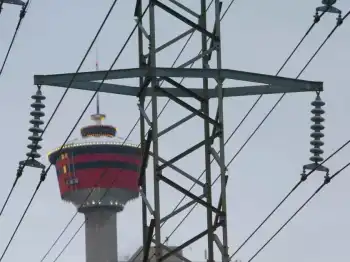
Election Should Precede Hydro Sale

By The Toronto Star


NFPA 70e Training - Arc Flash

Our customized live online or in‑person group training can be delivered to your staff at your location.
  • Live Online
  • 6 hours Instructor-led
  • Group Training Available
Regular Price:
$199
Coupon Price:
$149
Reserve Your Seat Today
No Ontario government should be allowed to sell off what has been one of the best public power systems in the world without the approval of voters, New Democrat Leader Howard Hampton said.

It's especially important given that the public power system was created in the first place by the will of the people, Hampton said.

"Ontario's public power system was created through three referendums," said Hampton. "I say to (Premier) Eves: allow the people of Ontario to have their say again."

The Ontario government is currently trying to privatize 49 per cent of the province's publicly owned electricity-distribution grid.

That decision last spring followed a public outcry over plans to sell off the entire grid sparked by a court decision that the province had no authority to make the sale.

The government has also ordered publicly owned Ontario Power Generation, which produces about 70 per cent of the province's power, to slash its share of hydro production.

Eves rejects Hampton's call for an election before further deregulation or privatization of electricity, a spokesman for the premier said.

"We do not agree with Mr. Hampton," said Barry Wilson. "Our government will continue, as it has in the past, to make any decisions regarding hydro to serve the best interests of the people of this province."

The Conservative government deregulated the generating market last May, but despite the advent of competition, prices soared, forcing Eves to cap prices to consumers.

In the early 20th century, concern over high power prices and the reliability of supply prompted the move to public power.

"If you look at the political history of Ontario, or the economic history of Ontario, over the past 100 years, this has been a defining issue," said Hampton.

"The battle for public power in the elections of 1905, the referendums of 1907, 1908 and 1917 were a triumph of public purpose over private greed and private monopoly."

Hampton, who has long crusaded against the deregulation and privatization of power in the province, also announced he had just finished co-writing a book on hydro, which will be published in March.

Related News

South Africa's Eskom could buy less power from wind farms during lockdown

Eskom Wind Power Curtailment reflects South Africa's lockdown-driven drop in electricity demand, prompting grid-balancing measures as Eskom signals reduced IPP procurement from renewable energy projects during low-demand hours, despite guarantees and flexible generation constraints.


Key Points

A temporary reduction of wind IPP purchases by Eskom to balance surplus grid capacity during the COVID-19 lockdown slump

✅ Demand drop of 7,500 MW reduced need for variable renewables.

✅ Curtailment likely during low-demand early-morning hours.

✅ IPP revenues protected via contract extensions and guarantees.


South African state utility Eskom has told independent wind farms that it could buy less of their power in the coming days, as electricity demand has plummeted during a lockdown, reflecting the Covid-19 impact on renewables worldwide, aimed at curbing the spread of the coronavirus.

Eskom, which is mired in a financial crisis and has struggled to keep the lights on in the past year, said on Tuesday that power demand had dropped by more than 7,500 megawatts since the lockdown started on Friday and that it had taken offline some of its own generators.

The utility supplements its generating capacity, which is mainly derived from coal, by buying power from solar and wind farms, as wind becomes a competitive source of electricity globally, under contracts signed as part of the government’s renewable energy programme.

Spokesman Sikonathi Mantshantsha said Eskom had not yet curtailed power procurement from wind farms but that it had told them, echoing industry warnings on wind investment risk seen by the sector, this could happen “for a few hours a day during the next few days, perhaps until the lockdown is lifted”.

“Most of them are able to feed power into the grid in the early hours of the day. That coincides with the lowest demand period and can highlight curtailment challenges when supply exceeds need. And we now have a lot more capacity than needed,” Mantshantsha said.

During the lockdown imposed by President Cyril Ramaphosa, businesses apart from those deemed “essential services” are closed, mirroring Spanish wind factory closures elsewhere. Many power-hungry mines and furnaces have suspended operations.

Eskom has relatively little of its own “flexible generation” capacity, which can be ramped up or down easily, unlike regions riding a renewables boom in South Australia to export power.

The government has committed to buy up to 200 billion rand ($11.1 billion) of electricity from independent power producers and has issued state guarantees for those purchases.

“They will be compensated for their losses, amid U.S. utility-solar slowdowns being reported - each day lost will be added to their contracts,” Mantshantsha said of the wind farms. “In the end they will not be worse off.”


Related News

View more

Australia PM rules out taxpayer funded power plants amid energy battle

ACCC energy underwriting guarantee proposes government-backed certainty for new generation, cutting electricity prices and supporting gas, pumped hydro, renewables, batteries, and potentially coal-fired power, addressing market failure without direct subsidies.


Key Points

A tech-neutral, government-backed plan underwriting new generation revenue to increase certainty and cut power prices.

✅ Government guarantee provides a revenue floor for new generators.

✅ Technology neutral: coal, gas, renewables, pumped hydro, batteries.

✅ Intended to reduce bills by up to $400 and address market failure.


Australian Taxpayers won't directly fund any new power plants despite some Coalition MPs seizing on a new report to call for a coal-fired power station.

The Australian Competition and Consumer Commission recommended the government give financial certainty to new power plants, guaranteeing energy will be bought at a cheap price if it can't be sold, as part of an electricity market plan to avoid threats to supply.

It's part of a bid to cut up to $400 a year from average household power prices.

Prime Minister Malcolm Turnbull said the finance proposal had merit, but he ruled out directly funding specific types of power generation.

"We are not in the business of subsidising one technology or another," he told reporters in Queensland today.

"We've done enough of that. Frankly, there's been too much of that."

Renewable subsidies, designed in the 1990s to make solar and wind technology more affordable, have worked and will end in 2020.

Some Coalition MPs claim the ACCC's recommendation to underwrite power generation is vindication for their push to build new coal-fired power plants.

But ACCC chair Rod Sims said no companies had proposed building new coal plants - instead they're trying to build new gas projects, pumped hydro or renewable projects.

Opposition Leader Bill Shorten said Mr Turnbull was offering solutions years away, having overseen a rise in power prices over the past year.

"You don't just go down to K-Mart and get a coal-fired power station off the shelf," Mr Shorten told reporters, admitting he had not read the ACCC report.

Energy Minister Josh Frydenberg said the recommendation to underwrite new power generators had a lot of merit, as it would address a market failure highlighted by AEMO warnings about reduced reserves.

"What they're saying is the government needs to step in here to provide some sort of assurance," Mr Frydenberg told 9NEWS today.

He said that could include coal, gas, renewable energy or battery storage.

Deputy Nationals leader Bridget McKenzie said science should determine which technology would get the best outcomes for power bills, with a scrapping coal report suggesting it can be costly.

Mr Turnbull said there was strong support for the vast majority of the ACCC's 56 recommendations, but the government would carefully consider the report, which sets out a blueprint to cut electricity bills by 25 percent.

Acting Greens leader Adam Bandt said Australia should exit coal-fired power in favour of renewable energy to cut pollution.

In contrast, Canada has seen the Stop the Shock campaign advocate a return to coal power in some provinces.

The Australian Energy Council, which represents 21 major energy companies, said the government should consult on changes to avoid "unintended consequences".


Related News

View more

Berlin Launches Electric Flying Ferry

Berlin Flying Electric Ferry drives sustainable urban mobility with zero-emission water transit, advanced electric propulsion, quiet operations, and smart-city integration, easing congestion, improving air quality, and connecting waterways for efficient, climate-aligned public transport.


Key Points

A zero-emission electric ferry for Berlin's waterways, cutting congestion and pollution to advance sustainable mobility.

✅ Zero emissions with advanced electric propulsion systems

✅ Quiet, efficient water transit that eases road congestion

✅ Smart-city integration, improving access and air quality


Berlin has taken a groundbreaking step toward sustainable urban mobility with the introduction of its innovative flying electric ferry. This pioneering vessel, designed to revolutionize water-based transportation, represents a significant leap forward in eco-friendly travel options and reflects the city’s commitment to addressing climate change, complementing its zero-emission bus fleet initiatives while enhancing urban mobility.

A New Era of Urban Transport

The flying electric ferry, part of a broader initiative to modernize transportation in Berlin, showcases cutting-edge technology aimed at reducing carbon emissions and improving efficiency in urban transit, and mirrors progress seen with hybrid-electric ferries in the U.S.

Equipped with advanced electric propulsion systems, the ferry operates quietly and emits zero emissions during its journeys, making it an environmentally friendly alternative to traditional diesel-powered boats.

This innovation is particularly relevant for cities like Berlin, where water transportation can play a crucial role in alleviating congestion on roads and enhancing overall mobility. The ferry is designed to navigate the city’s extensive waterways, providing residents and visitors with a unique and efficient way to traverse the urban landscape.

Features and Design

The ferry’s design emphasizes both functionality and comfort. Its sleek, aerodynamic shape minimizes resistance in the water, allowing for faster travel times while consuming less energy, similar to emerging battery-electric high-speed ferries now under development in the U.S. Additionally, the vessel is equipped with state-of-the-art navigation systems that ensure safety and precision during operations.

Passengers can expect a comfortable onboard experience, complete with spacious seating and amenities designed to enhance their journey. The ferry aims to offer an enjoyable ride while contributing to Berlin’s vision of a sustainable and interconnected transportation network.

Addressing Urban Challenges

Berlin, like many major cities worldwide, faces significant challenges related to transportation, including traffic congestion, pollution, and the need for efficient public transit options. The introduction of the flying electric ferry aligns with the city’s goals to promote greener modes of transportation and reduce reliance on fossil fuels, as seen with B.C.'s electric ferries supported by public investment.

By offering an alternative to conventional commuting methods and complementing battery-electric buses deployments in Toronto that expand zero-emission options, the ferry has the potential to significantly reduce the number of vehicles on the roads. This shift could lead to lower traffic congestion levels, improved air quality, and a more pleasant urban environment for residents and visitors alike.

Economic and Environmental Benefits

The economic implications of the flying electric ferry are equally promising. As an innovative mode of transportation, it can attract tourism and stimulate local businesses near docking areas, especially as ports adopt an all-electric berth model that reduces local emissions. Increased accessibility to various parts of the city may lead to greater foot traffic in commercial districts, benefiting retailers and service providers.

From an environmental standpoint, the ferry contributes to Berlin’s commitment to achieving climate neutrality. The city has set ambitious targets to reduce greenhouse gas emissions, and the implementation of electric vessels is a key component of this strategy. By prioritizing clean energy solutions, Berlin is positioning itself as a leader in sustainable urban transport.

A Vision for the Future

The introduction of the flying electric ferry is not merely a technological advancement; it represents a vision for the future of urban mobility. As cities around the world grapple with the impacts of climate change and the need for sustainable infrastructure, Berlin’s innovative approach could serve as a model for other urban centers looking to enhance their transportation systems, alongside advances in electric planes that could reshape regional travel.

Furthermore, this initiative is part of a broader trend toward electrification in the maritime sector. With advancements in battery technology and renewable energy sources, electric ferries and boats are becoming more viable options for urban transportation. As more cities embrace these solutions, the potential for cleaner, more efficient public transport grows.

Community Engagement and Education

To ensure the success of the flying electric ferry, community engagement and education will be vital. Residents must be informed about the benefits of using this new mode of transport, and outreach efforts can help build excitement and awareness around its launch. By fostering a sense of ownership among the community, the ferry can become an integral part of Berlin’s transportation landscape.


Related News

View more

EDF and France reach deal on electricity prices-source

EDF Nuclear Power Price Deal sets a 70 euros/MWh reference price, adds consumer protection if wholesale electricity prices exceed 110 euros/MWh, and outlines taxation mechanisms to shield bills while funding nuclear investment.


Key Points

A government-EDF deal setting 70 euros/MWh with safeguards above 110 euros/MWh to protect consumers.

✅ Reference price fixed at 70 euros/MWh, near EDF costs.

✅ Consumer shield above 110 euros/MWh; up to 90% extra-revenue tax.

✅ Review clauses maintain 70 euros/MWh through market swings.


State-controlled power group EDF and the French government have reached a tentative deal on future nuclear power prices, echoing a new electricity pricing scheme France has floated, a source close to the government said on Monday, ending months of tense negotiations.

The two sides agreed on 70 euros per megawatt hour (MWH) as a reference level for power prices, aligning with EU plans for more fixed-price contracts for consumers, the source said, cautioning that details of the deal are still being finalised.

The negotiations aimed to find a compromise between EDF, which is eager to maximise revenues to fund investments, and the government, keen to keep electricity bills for French households and businesses as low as possible, amid ongoing EU electricity reform debates across the bloc.

EDF declined to comment.

The preliminary deal sets out mechanisms that would protect consumers if power market prices rise above 110 euros/MWH, similar to potential emergency electricity measures being weighed in Europe, the source said, adding that the deal also includes clauses that would provide a price guarantee for EDF.

The 70 euros/MWH agreed reference price level is close to EDF's nuclear production costs, as Europe moves to revamp its electricity market more broadly. The nuclear power produced by the company provides 70% of France's electricity.

The agreement would allow the government to tax EDF's extra revenues at 90% if prices surpass 110 euros/MWH, in order to offset the impact on consumers. It would also enable a review of conditions in case of market fluctuations to safeguard the 70 euro level for EDF, reflecting how rolling back electricity prices is tougher than it appears, the source said.

French wholesale electricity prices are still above 100 euros/MWH, after climbing to 1,200 euros during last year's energy crisis, even as diesel prices have returned to pre-conflict levels.

A final agreement should be officially announced on Tuesday after a meeting between Finance Minister Bruno Le Maire, Energy Transition Minister Agnes Pannier-Runacher and EDF chief Luc Remont.

That meeting will work out the final details on price thresholds and tax rates between the reference level and the upper limit, the source said.

Negotiations between the two sides were so fraught that at one stage they raised questions about the future of EDF chief Luc Remont, who was appointed by President Emmanuel Macron a year ago to turn around EDF.

The group ended 2022 with a 18 billion-euro loss and almost 65 billion euros of net debt, hurt by a record number of reactor outages that coincided with soaring energy prices in the wake of Russia's invasion of Ukraine.

With its output at a 30-year low, EDF was forced to buy electricity on the market to supply customers. The government, meanwhile, imposed a cap on electricity prices, leaving EDF selling power at a discount.


Related News

View more

Demise of nuclear plant plans ‘devastating’ to Welsh economy, MP claims

Wylfa Nuclear Project Cancellation reflects Hitachi's withdrawal, pulling £16bn from North Wales, risking jobs, reshaping UK nuclear power plans as renewables grow and Chinese involvement rises amid shifting energy market policies.


Key Points

An indefinite halt to Hitachi's Wylfa Newydd nuclear plant, removing about £16bn investment and jobs from North Wales.

✅ Hitachi withdraws funding amid changing energy market costs

✅ Puts 400 local roles and up to 10,000 construction jobs at risk

✅ UK shifts toward renewables as nuclear project support stalls


Chris Ruane said Japanese firm Hitachi’s announcement this morning about the Wylfa project would take £16 billion of investment out of the region.

He said it was the latest in a list of energy projects which had been scrapped as he responded to a statement from business secretary Greg Clark.

Mr Ruane, the Labour member for the Vale of Clywd, said: “In his statement he said the Government are relying now more on renewables, can I put the North Wales picture to him; 1,500 wind turbines were planned off the coast of North Wales. They were removed, those plans were cancelled by the private sector.

“The tidal lagoons for Wales were key to the development of the Welsh economy – the Government itself pulled the support for the Swansea Bay tidal lagoon. That had a knock-on effect for the huge lagoon planned off the coast of North Wales.

“And now today we hear of the cancellation of a £16 billion investment in the North Wales economy. This will devastate the North Wales economy. The people of North Wales need to know that the Prime Minister is batting for them and batting for the UK.”

Mr Clark blamed the changing landscape of the energy market for today’s announcement, and said Wales has been a “substantial and proud leader” in renewable energy during the UK’s green industrial revolution over recent years.

But another Labour MP from North Wales, Albert Owen, of Ynys Mon, said the Wylfa plant’s cancellation in his constituency is putting 400 jobs at risk, as well as the “potential of 8-10,000 construction jobs”, as well as hundreds of operational jobs and 33 apprenticeships.

He asked Mr Clark: “Can I say straightly can we work together to keep this project alive, to ensure that we create the momentum so it can be ready for a future developer or this developer with the right mechanism?”

The minister replied that he and his officials would “work together in a completely open-book way on the options” to try and salvage the project.

But in the Lords, Labour former security minister Lord West of Spithead said the UK’s nuclear industry was in crisis, noting that Europe is losing nuclear power as well.

“In the 1950s our nation led the world in nuclear power generation and decisions by successive governments, of all hues, have got us in the position today where we cannot even construct a large civil nuclear reaction,” he told peers at question time.

Lord West asked: “Are we content that now the only player seems to be Chinese and that by 2035… we are happy for the Chinese to control one third of the energy supply of our nation?”

Business, Energy and Industrial Strategy minister Lord Henley said the Government had hoped for a better announcement from Hitachi but that was not the case.

He said costs in the nuclear sector were rising, amid setbacks at Hinkley Point C, while costs for many renewables were coming down and this was one of the reasons for the problem.

Tory former energy secretary Lord Howell of Guildford said the Chinese were in “pole position” for the rebuilding and replacement “of our nuclear fleet” and this would have a major impact on UK energy policy and plans to meet net zero targets in the 2030s.

Plaid Cymru’s Lord Wigley warned that putting the Wylfa Newydd on indefinite hold would cause economic planning blight in north-west Wales and urged the Government to raise the level of support allocated to the region.

Lord Henley acknowledged the announcement was not welcome but added: “We remain committed to nuclear power. We will look to see what we can do. We still have a great deal of expertise in this country and we can work on that.”


Related News

View more

Let’s make post-COVID Canada a manufacturing hub again

Canada Manufacturing Policy prioritizes affordable energy, trims carbon taxes, aligns with Buy America, and supports the resource sector, PPE and plastics supply, nearshoring, and resilient supply chains amid COVID-19, correcting costly green energy policies.


Key Points

A policy to boost industry with affordable energy, lower carbon taxes, resource ties, and aligned U.S. trade.

✅ Cuts energy costs and carbon tax burdens for competitiveness

✅ Rebuilds resource-sector linkages and domestic supply chains

✅ Seeks Buy America relief and clarity on plastics regulation


By Jocelyn Bamford

Since its inception in 2017, the Coalition of Concerned Manufacturers and Businesses has warned all levels of government that there would be catastrophic effects if policies that drove both the manufacturing and natural resources sectors out of the country were adopted.

The very origins of our coalition was in the fight for a competitive landscape in Ontario, a cornerstone of which is affordable energy and sounding the alarm that the Green Energy Policy in Ontario pushed many manufacturers out of the province.


The Green Energy Policy made electricity in Ontario four times the average North American rate. These unjust prices were largely there to subsidize the construction of expensive and inefficient wind and solar energy infrastructure, even as cleaning up Canada's grid is cited as critical to meeting climate pledges.

My company’s November hydro bill was $55,000 and $36,500 of that was the so-called global adjustment charge, the name given to these green energy costs.

Unaffordable electricity, illustrated by higher Alberta power costs in recent years, coupled with ever-more burdensome carbon taxes, have pushed Canadian manufacturing into the open arms of other countries that see the importance of affordable energy to attract business.

One can’t help but ask the question: If Canada had policies that attracted and maintained a robust manufacturing sector, would we be in the same situation with a lack of personal protective equipment and medical supplies for our front-line medical workers and our patients during this pandemic?  If our manufacturing sector wasn’t crippled by taxes and regulation, would it be more nimble and able to respond to a national emergency?

It seems that the federal government’s policies are designed to push manufacturing out, stifle our resource sector, and kill the very plastics industry that is so essential to keeping our front-line medical staff, patients, and citizens safe, even as the net-zero race accelerates federally.

As the federal government chased its obsession with a new green economy – a strange obsession given our country’s small contribution to global GHGs – including proposals for a fully renewable grid by 2030 advocated by some leaders, it has been blinded from the real threats to our country, threats that became very, very real with COVID-19.

After the pandemic has passed, the federal government must work to make Canada manufacturing and resource friendly again, recognizing that the IEA net-zero electricity report projects the need for more power. COVID-19 proves that Canada relies on a robust resource economy and manufacturing sector to survive. We need to ensure that we are prepared for future crises like the one we are facing now.

Here are five things our government can do now to meet that end:

1. End all carbon taxes immediately.

2. Create a mandate to bring manufacturing back to Canada through competitive offerings and favourable tax regimes.

3. Recognize the interconnections between the resource sector and manufacturing, including how fossil-fuel workers support the transition across supply chains. Many manufacturers supply parts and pieces to the resource sector, and they rely on affordable energy to compete globally.

4. Stop the current federal government initiative to label plastic as toxic. At a time when the government is appealing to manufacturers to re-tool and produce needed plastic products for the health care sector, labelling plastics as toxic is counterproductive.

5. Work to secure a Canadian exemption to Buy America. This crisis has clearly shown us that dependency on China is dangerous. We must forge closer ties with America and work as a trading block in order to be more self-sufficient.

These are troubling times. Many businesses will not survive.

We need to take back our manufacturing sector.  We need to take back our resource sector.

We need to understand the interconnected nature of these two important segments of our gross domestic production, and opportunities like an Alberta–B.C. grid link to strengthen reliability.
If we do not, in the next pandemic we may find ourselves not only without ventilators, masks and gowns but also without energy to operate our hospitals.

Jocelyn Bamford is a Toronto business executive and President of the Coalition of Concerned Manufacturers and Businesses of Canada


Related News

View more

Sign Up for Electricity Forum’s Newsletter

Stay informed with our FREE Newsletter — get the latest news, breakthrough technologies, and expert insights, delivered straight to your inbox.

Electricity Today T&D Magazine Subscribe for FREE

Stay informed with the latest T&D policies and technologies.
  • Timely insights from industry experts
  • Practical solutions T&D engineers
  • Free access to every issue

Download the 2025 Electrical Training Catalog

Explore 50+ live, expert-led electrical training courses –

  • Interactive
  • Flexible
  • CEU-cerified