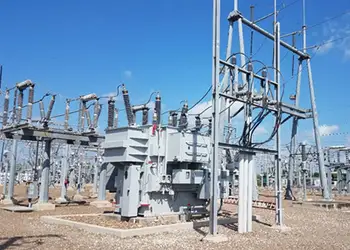
Substation Protection Training - Protect Transformers, Buses and Lines
Our customized live online or in‑person group training can be delivered to your staff at your location.
- Live Online
- 12 hours Instructor-led
- Group Training Available
Regular Price:
$799
Coupon Price:
$699
Looking out across the construction site where 150 workers are busily laying the groundwork for the new Quail Run Energy Center, Navasota Energy President Frank Giacalone said, "The cost of fuel drives the cost of power."
In fact, the energy company president added, "Better than 50 percent of our cost is the cost of the fuel." Quail Run, one of two 550 megawatt power plants Navasota is currently building in Texas, will be fueled by natural gas. It could be fueled by coal at some later time if, for example, coal was being transported through Odessa on the way to a coal-fired facility such as FutureGen.
Odessa is one of two Texas sites in the running for that $1 billion near-zero emissions power plant the federal government is seeking. But that would depend on the price of that type of fuel making it more economical to do the conversion to a coal-fired plant. With either type of fuel, the end result is electrical power which can be added to the electricity grid by routing into the Midland East 345kv Tie transmission lines running along the south side of Quail Run's 40-acre site near Interstate 20 on Odessa's outskirts. "Electricity goes where the demand is," Giacalone said. "You can make it when you need it and stop when you don't need it." MORE POWER It's imperative to have enough power plants to meet the peak demand, Giacalone noted.
The two plants now under construction in Texas are the first non- utility, natural gas-fired plants to be built since 2003, he noted earlier. The other plant is located at Wharton, southwest of Houston. Ronald Gabrick, site manager for the Quail Run Energy Center construction for Design Build Professionals Inc. of Matawan, N.J., said the construction has been proceeding at a good pace. Combined cycle power plants operate by combining the gas cycle and steam cycle for higher efficiency. In such a power plant, thermodynamic cycles - the Brayton cycle, which defines how a steam turbine converts fuel to energy, and the Rankine cycle, which defines how a steam turbine converts steam to energy - are integrated to form a higher efficiency power plant.
That results, Giacalone said, in the production of more energy with less fuel and the production of lower emissions for each unit of electricity. "How it works," Giacalone said, "the gas turbine burns fuel like natural gas and rotates a generator, creating electricity." Hot exhaust gases exiting the gas turbine are routed to the steam cycle where they are recovered or recycled in the heat recovery steam generator or HRSG unit. Typically these exhaust gases carry away as much as 70 percent of the energy in the fuel before it is burned, Giacalone said. But by routing it to an HRSG unit and recovering the energy, the efficiency rating of the power plant can be increased to over 50 percent, he said.
The HRSG converts energy that would otherwise be wasted into useful energy by heating water into steam that passes through a steam turbine. The steam turbine rotates another generator that makes more electricity. Cooling towers cool the hot steam back to water after it leaves the steam turbine that is then routed back through the process to be reheated into steam again, Giacalone said. All the electricity generated then is routed to the transformers, ready to enter the power grid. Sounds simple enough, but making it all fall into place requires an orchestration of engineering.
In fact, Giacalone said, "The last few months of construction get pretty interesting because you have to make sure everything can run because the whole plant has to work in unison." Even at that, he said, "You always want a good backup system." THE PLANT Phase I of the plant construction is scheduled to be completed by May 2007, with a second phase - which will add an additional 275 Mw - scheduled six months after completion of the first phase.
The plant, Giacalone said, has a design life of 50 years and that longevity is achieved by replacing worn parts. The facility will receive its gas supply from WAHA Market Hub, transported on Enterprise Texas Pipeline LP and Oneok-West TX LP. Electrical interconnection is through TXU's transmission system. Giacalone noted Odessa Concrete Supply Co. has been supplying the concrete for the base of the power plant and Engineered Pipeline Inc., another local firm, has been laying water and gas pipelines in the complex. The concrete, he stressed, has to be tested and retested to make certain it will not crumble under the weight of the huge generators and other equipment.
The facility was needed, Giacalone said, to meet growing energy needs in Texas and displace less efficient natural gas steam generating facilities in ERCOT (Electric Reliability Council of Texas).
Related News
Met Office joins REVISE to protect United Kingdom overhead transmission lines
Met Office REVISE Project will provide high-resolution weather data to refine static line ratings for…
View more
Nova Scotia Power says it now generates 30 per cent of its power from renewables
Nova Scotia Power Renewable Energy delivers 30% in 2018, led by wind power, hydroelectric and…
View more
Ontario Teachers Pension Plan agrees to acquire a 25% stake in SSEN Transmission
Ontario Teachers SSEN Transmission Investment advances UK renewable energy, with a 25% minority stake in…
View more
Climate change: Electrical industry's 'dirty secret' boosts warming
Sulphur Hexafluoride (SF6) Emissions drive rising greenhouse gas impacts in electrical switchgear, power grids, and…
View more
Heatwave Sparks Unprecedented Electricity Demand Across Eastern U.S
Eastern U.S. Heatwave Electricity Demand surges to record peak load, straining the power grid, lifting…
View more
We Energies refiles rate hike request driven by rising nuclear power costs
We Energies rate increase driven by nuclear energy costs at Point Beach, Wisconsin PSC filings,…
View more
Sign Up for Electricity Forum’s Newsletter
Stay informed with our FREE Newsletter — get the latest news, breakthrough technologies, and expert insights, delivered straight to your inbox.
Electricity Today T&D Magazine Subscribe for FREE

Stay informed with the latest T&D policies and technologies.
- Timely insights from industry experts
- Practical solutions T&D engineers
- Free access to every issue

