Siemens awarded second Baltic Sea contract

By Industrial Info Resources


CSA Z462 Arc Flash Training - Electrical Safety Essentials

Our customized live online or in‑person group training can be delivered to your staff at your location.

  • Live Online
  • 6 hours Instructor-led
  • Group Training Available
Regular Price:
$249
Coupon Price:
$199
Reserve Your Seat Today
Energy company Siemens Energy Incorporated recently signed a contract with Energie Baden-Wuerttemberg AG EnBW for the supply of 80 wind turbines for the 288-megawatt MW EnBW Baltic 2 offshore windfarm project.

Each wind turbine will have a capacity of 3.6 MW and a rotor diameter of 120 meters. Siemens Energy is a division of the Energy Sector of electrical and electronics engineering company Siemens AG, while EnBW is the holding company of the EnBW Group. The commercial value of the contract has not been disclosed, although both companies said that the order was valued in the triple-digit millions range.

The EnBW Baltic 2, previously known as Kriegers Flak, will be Germany's second commercial offshore windfarm in the Baltic Sea. The 27-square-kilometer windfarm will be about 32 kilometers north of Rügen Island, in the western Baltic. The initial maritime civil works are set to begin in 2012, and the windfarm is expected to be ready for operations by 2013. When fully operational, EnBW Baltic 2 will generate 1.2 terawatt-hours per year of electricity that will be supplied to about 340,000 households. CO2 emissions are expected to be brought down by 900,000 tons per year.

Speaking at the contract signing, Dr. Hans-Josef Zimmer, EnBW's chief technical officer and a member of the management board, said that EnBW Baltic 2 would be about six times larger than EnBW Baltic 1. He said that Baltic 1 and Baltic 2 are two of the four windfarms that the company plans to build in the Baltic Sea and the North Sea. The combined power generation capacity of the four windfarms would be 1,200 MW, and the estimated investment in the four projects is 300 billion euros US$363.18 billion.

Dr. René Umlauft, the chief executive officer of the Renewable Energy Division of Siemens Energy, said that this was the second association between Siemens and EnBW, after Baltic 1, and that both companies are pioneers in the development of offshore wind power in Germany. He added, "With our reliable, field-proven wind power technology, we can make a significant contribution toward the expansion of sustainable power supply in Germany."

The Baltic 1 is Germany's first offshore windfarm project. The windfarm will be spread across 7 square kilometers at a site about 16 kilometers to the north of the Darss-Zingst Peninsula, at the Mecklenburg-Vorpommern coast on the Baltic Sea. Work on the 48.3-MW windfarm was scheduled to begin early this year and to be completed before the end of the year. Siemens will be supplying the project with 21 of its SWT 2.3-93 wind turbines. The 3 billion-euro US$3.63 billion project is expected to have a 20-year life. The generated electricity is expected to power about 27,000 households, while the windfarm is expected to reduce CO2 emissions by about 55,000 tons per year.

EnBW's proposed windfarms on the North Sea are the Hochsee Windpark Nordsee and the Hochsee Windpark He dreiht, both of which will be set up in the Niedersachsen region. Both windfarms will have a generation capacity of 400 MW each, accounted for by 80 wind turbines of 5 MW each. The Hochsee Windpark Nordsee will be about 100 kilometers from the coast and will cover about 42 square kilometers. The windfarm is expected generate enough electricity for 223,660 households and reduce CO2 emissions by about 452,000 tons per year. Project work is expected to begin in early 2011 and to be completed in late 2011.

The Hochsee Windpark He dreiht will be set up about 97 kilometers from the coast and be spread across about 44 square kilometers. The electricity generated and the CO2 emission reduction will be of the same scale as that of the Hochsee Windpark Nordsee. The project is expected to be completed in 2015. There also are plans for a 140-MW He dreiht II.

EnBW is Germany's third-largest utility company, and it focuses on various aspects of the electricity business: generation, trading, grid, sales, transmission and distribution. Gas, energy and environmental services are other areas that the company focuses on. EnBW aims to enhance its share of renewable business from the existing 11 to 20 by 2020. Expansion of its wind power generation capacity is high on the company's priority list.

The two primary shareholders of EnBW, each with 45, are energy operator Électricité de France S.A. EDF and the association Oberschwäbischen Elektrizitätswerke. Under mutual agreement, EDF will operate EnBW until 2012. EnBW has more than 21,000 employees and close to 6 million customers in Germany and across Europe.


Related News
How to Get Solar Power on a Rainy Day? Beam It From Space

Space solar power promises wireless energy from orbital solar satellites via microwave or laser power beaming, using photovoltaics and rectennas. NRL and AFRL advances hint at 24-7 renewable power delivery to Earth and airborne drones.


Key Points

Space solar power beams orbital solar energy to Earth via microwaves or lasers, enabling continuous wireless electricity.

✅ Harvests sunlight in orbit and transmits via microwaves or lasers

✅ Provides 24-7 renewable power, independent of weather or night

✅ Enables wireless power for remote sites, grids, and drones


Earlier this year, a small group of spectators gathered in David Taylor Model Basin, the Navy’s cavernous indoor wave pool in Maryland, to watch something they couldn’t see. At each end of the facility there was a 13-foot pole with a small cube perched on top. A powerful infrared laser beam shot out of one of the cubes, striking an array of photovoltaic cells inside the opposite cube. To the naked eye, however, it looked like a whole lot of nothing. The only evidence that anything was happening came from a small coffee maker nearby, which was churning out “laser lattes” using only the power generated by the system as ambitions for cheap abundant electricity gain momentum worldwide.

The laser setup managed to transmit 400 watts of power—enough for several small household appliances—through hundreds of meters of air without moving any mass. The Naval Research Lab, which ran the project, hopes to use the system to send power to drones during flight. But NRL electronics engineer Paul Jaffe has his sights set on an even more ambitious problem: beaming solar power to Earth from space. For decades the idea had been reserved for The Future, but a series of technological breakthroughs and a massive new government research program suggest that faraway day may have finally arrived as interest in space-based solar broadens across industry and government.

Since the idea for space solar power first cropped up in Isaac Asimov’s science fiction in the early 1940s, scientists and engineers have floated dozens of proposals to bring the concept to life, including inflatable solar arrays and robotic self-assembly. But the basic idea is always the same: A giant satellite in orbit harvests energy from the sun and converts it to microwaves or lasers for transmission to Earth, where it is converted into electricity. The sun never sets in space, so a space solar power system could supply renewable power to anywhere on the planet, day or night, as recent tests show we can generate electricity from the night sky as well, rain or shine.

Like fusion energy, space-based solar power seemed doomed to become a technology that was always 30 years away. Technical problems kept cropping up, cost estimates remained stratospheric, and as solar cells became cheaper and more efficient, and storage improved with cheap batteries, the case for space-based solar seemed to be shrinking.

That didn’t stop government research agencies from trying. In 1975, after partnering with the Department of Energy on a series of space solar power feasibility studies, NASA beamed 30 kilowatts of power over a mile using a giant microwave dish. Beamed energy is a crucial aspect of space solar power, but this test remains the most powerful demonstration of the technology to date. “The fact that it’s been almost 45 years since NASA’s demonstration, and it remains the high-water mark, speaks for itself,” Jaffe says. “Space solar wasn’t a national imperative, and so a lot of this technology didn’t meaningfully progress.”

John Mankins, a former physicist at NASA and director of Solar Space Technologies, witnessed how government bureaucracy killed space solar power development firsthand. In the late 1990s, Mankins authored a report for NASA that concluded it was again time to take space solar power seriously and led a project to do design studies on a satellite system. Despite some promising results, the agency ended up abandoning it.

In 2005, Mankins left NASA to work as a consultant, but he couldn’t shake the idea of space solar power. He did some modest space solar power experiments himself and even got a grant from NASA’s Innovative Advanced Concepts program in 2011. The result was SPS-ALPHA, which Mankins called “the first practical solar power satellite.” The idea, says Mankins, was “to build a large solar-powered satellite out of thousands of small pieces.” His modular design brought the cost of hardware down significantly, at least in principle.

Jaffe, who was just starting to work on hardware for space solar power at the Naval Research Lab, got excited about Mankins’ concept. At the time he was developing a “sandwich module” consisting of a small solar panel on one side and a microwave transmitter on the other. His electronic sandwich demonstrated all the elements of an actual space solar power system and, perhaps most important, it was modular. It could work beautifully with something like Mankins' concept, he figured. All they were missing was the financial support to bring the idea from the laboratory into space.

Jaffe invited Mankins to join a small team of researchers entering a Defense Department competition, in which they were planning to pitch a space solar power concept based on SPS-ALPHA. In 2016, the team presented the idea to top Defense officials and ended up winning four out of the seven award categories. Both Jaffe and Mankins described it as a crucial moment for reviving the US government’s interest in space solar power.

They might be right. In October, the Air Force Research Lab announced a $100 million program to develop hardware for a solar power satellite. It’s an important first step toward the first demonstration of space solar power in orbit, and Mankins says it could help solve what he sees as space solar power’s biggest problem: public perception. The technology has always seemed like a pie-in-the-sky idea, and the cost of setting up a solar array on Earth is plummeting, as proposals like a tenfold U.S. solar expansion signal rapid growth; but space solar power has unique benefits, chief among them the availability of solar energy around the clock regardless of the weather or time of day.

It can also provide renewable energy to remote locations, such as forward operating bases for the military, which has deployed its first floating solar array to bolster resilience. And at a time when wildfires have forced the utility PG&E to kill power for thousands of California residents on multiple occasions, having a way to provide renewable energy through the clouds and smoke doesn’t seem like such a bad idea. (Ironically enough, PG&E entered a first-of-its-kind agreement to buy space solar power from a company called Solaren back in 2009; the system was supposed to start operating in 2016 but never came to fruition.)

“If space solar power does work, it is hard to overstate what the geopolitical implications would be,” Jaffe says. “With GPS, we sort of take it for granted that no matter where we are on this planet, we can get precise navigation information. If the same thing could be done for energy, especially as peer-to-peer energy sharing matures, it would be revolutionary.”

Indeed, there seems to be an emerging race to become the first to harness this technology. Earlier this year China announced its intention to become the first country to build a solar power station in space, and for more than a decade Japan has considered the development of a space solar power station to be a national priority. Now that the US military has joined in with a $100 million hardware development program, it may only be a matter of time before there’s a solar farm in the solar system.


Related News

View more

EIA: Pennsylvania exports the most electricity, California imports the most from other states

U.S. Electricity Trade by State, 2013-2017 highlights EIA grid patterns, interstate imports and exports, cross-border flows with Canada and Mexico, net exporters and importers, and market regions like ISOs and RTOs shaping consumption and generation.


Key Points

Brief EIA overview of interstate and cross-border power flows, ranking top net importers and exporters.

✅ Pennsylvania was the largest net exporter, averaging 59 million MWh.

✅ California was the largest net importer, averaging 77 million MWh.

✅ Top cross-border: NY, CA, VT, MN, MI imports; WA, TX, CA, NY, MT exports.


According to the U.S. Energy Information Administration (EIA) State Electricity Profiles, from 2013 to 2017, Pennsylvania was the largest net exporter of electricity, while California was the largest net importer.

Pennsylvania exported an annual average of 59 million megawatt-hours (MWh), while California imported an average of 77 million MWh annually.

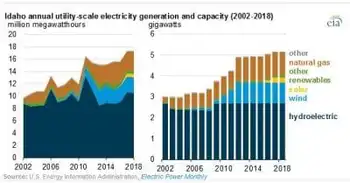
Based on the share of total consumption in each state, the District of Columbia, Maryland, Massachusetts, Idaho and Delaware were the five largest power-importing states between 2013 and 2017, highlighting how some clean states import 'dirty' electricity as consumption outpaces local generation. Wyoming, West Virginia, North Dakota, Montana and New Hampshire were the five largest power-exporting states. Wyoming and West Virginia were net power exporting states between 2013 and 2017.

New York, California, Vermont, Minnesota and Michigan imported the most electricity from Canada or Mexico on average from 2013 to 2017, reflecting the U.S. look to Canada for green power during that period. Similarly, Washington, Texas, California, New York, and Montana exported the most electricity to Canada or Mexico, on average, during the same period.

Electricity routinely flows among the Lower 48 states and, to a lesser extent, between the United States and Canada and Mexico. From 2013 to 2017, Pennsylvania was the largest net exporter of electricity, sending an annual average of 59 million megawatthours (MWh) outside the state. California was the largest net importer, receiving an average of 77 million MWh annually.

Based on the share of total consumption within each state, the District of Columbia, Maryland, Massachusetts, Idaho, and Delaware were the five largest power-importing states between 2013 and 2017. Wyoming, West Virginia, North Dakota, Montana, and New Hampshire were the five largest power-exporting states. States with major population centers and relatively less generating capacity within their state boundaries tend to have higher ratios of net electricity imports to total electricity consumption, as utilities devote more to electricity delivery than to power production in many markets.

Wyoming and West Virginia were net power exporting states (they exported more power to other states than they consumed) between 2013 and 2017. Customers residing in these two states are not necessarily at an economic disadvantage or advantage compared with customers in neighboring states when considering their electricity bills and fees and market dynamics. However, large amounts of power trading may affect a state’s revenue derived from power generation.

Some states also import and export electricity outside the United States to Canada or Mexico, even as Canada's electricity exports face trade tensions today. New York, California, Vermont, Minnesota, and Michigan are the five states that imported the most electricity from Canada or Mexico on average from 2013 through 2017. Similarly, Washington, Texas (where electricity production and consumption lead the nation), California, New York, and Montana are the five states that exported the most electricity to Canada or Mexico, on average, for the same period.

Many states within the continental United States fall within integrated market regions, referred to as independent system operators or regional transmission organizations. These integrated market regions allow electricity to flow freely between states or parts of states within their boundaries.

EIA’s State Electricity Profiles provide details about the supply and disposition of electricity for each state, including net trade with other states and international imports and exports, and help you understand where your electricity comes from more clearly.


Related News

View more

Tories 'taking the heart out of Manitoba Hydro' by promoting subsidiaries, scrapping low-cost pledges: NDP

Manitoba Hydro Privatization Debate centers on subsidiaries, Crown corporation governance, clean energy priorities, and electricity rates, as board terms shift oversight and transparency, sparking concerns about sell-offs and government control.


Key Points

A dispute over Hydro's governance, subsidiaries, electricity rates, and clean energy amid fears of partial privatization.

✅ Rewritten terms allow subsidiaries and shift board duties.

✅ Low rates and clean energy mandates softened in guidance.

✅ Govt cites Hydro Act; NDP warns of sell-off risks.


The board of Manitoba Hydro is being reminded it can divvy up some of the utility's work to subsidiaries — which the NDP is decrying as a step toward privatization. 

A sentence seemingly granting the board permission to create subsidiaries was included in the board's new terms of reference, which the NDP raised during question period Wednesday. 

The document also eliminated references asking Manitoba Hydro to keep electricity rates low, even as rate hike hearings proceed, and supply power in an environmentally-friendly fashion.

NDP raises spectre of Manitoba Hydro's privatization with new CEO
"They're essentially taking the heart out of Manitoba Hydro," NDP leader Wab Kinew said.

Cheap, clean energy is the basis by which the Crown corporation was formed, even as scaled-back rate increases are planned for next year, he said. 

"That's the whole reason we created this utility in the first place."

Another addition to the board's guidelines include stating the corporation is responsible to the government minister, who must be "proactively informed" when significant issues arise. 

The provincial government, however, says the rewritten terms of reference was the directive of the Manitoba Hydro board and not itself.

CBC's requests to the government for an interview were directed to Manitoba Hydro.

In an interview, Manitoba Hydro spokesperson Scott Powell said the energy utility has undergone no legislative changes, and is still governed by the Manitoba Hydro Act. 

The terms of reference were altered to align the board's duties with the new act overseeing Crown corporations, Powell said.

"Whether you have one or two words different in the terms of reference, the essence of the company hasn't changed."

While the new terms of reference no longer instructs the corporation to ensure an "environmentally responsible supply of energy for Manitobans," it encourages the board to "promote economy and efficiency in all phases of power generation and distribution."

On the cost to ratepayers, the updated directions asks the utility to deliver "safe, reliable energy services at a fair price," a standard clarified by a recent appeal court ruling on First Nations rates, but the board is not specifically instructed with keeping electricity rates low. 

Kinew contends the added sentence on subsidiaries permits Hydro to be broken off and sold for parts, although the terms of reference does not specify if any subsidiary would be wholly owned by Hydro or contracted to a private company.

Powell said Manitoba Hydro has been permitted to create subsidiaries since 1997, and nothing has changed since.

Kinew warned about Hydro's privatization last week when Jay Grewal was announced as Hydro's incoming CEO and president.

She was employed with B.C. Hydro when then-premier Gordon Campbell — hired by the Manitoba government to investigate costly overruns on two electricity megaprojects — sold off segments of the utility.

She then became managing director of Accenture, a global management consulting firm, which acquired several B.C. Hydro departments.

During question period Wednesday, Pallister disputed that Manitoba Hydro is bound to be sold.

He slammed the NDP's "Americanization strategy" of producing more electricity than it is capable of selling, which has saddled ratepayers with billions in debt and prompted proposed 2.5% annual increases in coming years. 

The makeup of the Hydro board has undergone a complete turnover in under a year, a contrast to Ontario's Hydro One shakeup vow during that period.

Nine of the 10 members resigned en masse this March over an impasse with the Pallister government. The lone holdover, Cliff Graydon, was dismissed from his post last month after the Progressive Conservatives removed him from caucus. 


Related News

View more

Sunrun and Tesla Unveil Texas Power Plant

Sunrun-Tesla Virtual Power Plant Texas leverages residential solar, Tesla Powerwall battery storage, and ERCOT demand response to enhance grid resilience, cut emissions, and supply backup power via a coordinated distributed energy resources network.


Key Points

A Texas VPP using residential solar and Tesla Powerwall to aid ERCOT with grid services resilience, and less emissions.

✅ Aggregates Powerwall storage for ERCOT demand response.

✅ Enhances grid reliability with distributed energy resources.

✅ Cuts emissions by shifting solar to peak and outage periods.


In a significant development for renewable energy and grid resilience, Sunrun and Tesla have announced a groundbreaking partnership to establish a distributed power plant in Texas. This collaboration represents a major step forward in harnessing solar energy and battery storage, with advances in affordable solar batteries helping to create a more reliable and sustainable power system. The initiative aims to address the growing demand for clean energy solutions while enhancing grid stability and resilience in one of the largest and most energy-dependent states in the U.S.

The new distributed power plant, a joint venture between Sunrun, a leading residential solar provider, and Tesla, renowned for its advanced battery technology and electric vehicles, will leverage the strengths of both companies to transform how energy is generated and used. The project will deploy Tesla's Powerwall battery systems alongside Sunrun's solar panels to create a network of interconnected residential energy storage units. This network will function as a virtual power plant, aligned with emerging peer-to-peer energy sharing models that are capable of providing electricity back to the grid during periods of high demand or outages.

Texas, with its vast and growing population, has faced significant energy challenges in recent years. The state’s power grid, managed by the Electric Reliability Council of Texas (ERCOT), has experienced strain during extreme weather events and high demand periods, and instances of Texas wind curtailment during grid stress, leading to concerns about reliability and stability. The partnership between Sunrun and Tesla seeks to address these concerns by introducing a more flexible and resilient energy solution.

The distributed power plant will consist of thousands of residential solar installations, each equipped with Tesla Powerwall batteries, reflecting the broader trend of pairing storage with solar across the U.S. as it scales. These batteries store excess solar energy generated during the day and release it when needed, such as during peak demand times or power outages. By connecting these systems through advanced software, the project will create a coordinated network of distributed energy resources that can respond dynamically to fluctuations in energy supply and demand.

One of the key benefits of this distributed approach is its ability to enhance grid reliability. Traditional power plants are centralized and can be vulnerable to disruptions, whether from extreme weather, technical failures, or other issues. In contrast, a distributed power plant spreads the generation and storage capacity across numerous locations, a principle echoed by renewable power developers pursuing multi-resource projects today, reducing the risk of widespread outages and increasing the overall resilience of the power grid.

Additionally, the project will contribute to the reduction of greenhouse gas emissions. By increasing the use of solar energy and reducing reliance on fossil fuels, and amid ongoing work to improve solar and wind technologies, the distributed power plant supports Texas’s climate goals and contributes to broader efforts to combat climate change. The integration of renewable energy sources into the grid helps to decrease carbon emissions and promote a cleaner, more sustainable energy system.

The partnership between Sunrun and Tesla also underscores the growing role of technology in transforming the energy landscape. Tesla's Powerwall battery systems represent some of the most advanced energy storage technology available, and amid record solar and storage growth nationwide this decade they showcase the capability to store and manage energy efficiently. Sunrun’s expertise in residential solar installations complements this technology, creating a powerful combination that leverages the latest advancements in clean energy.

The project is expected to deliver several benefits to both individual homeowners and the broader community. Homeowners who participate in the program will have access to solar energy and battery storage at reduced costs, thanks to the economies of scale and innovative financing options provided by Sunrun and Tesla. Additionally, they will have the added security of backup power during outages, contributing to greater energy independence and resilience.

For the broader community, the distributed power plant offers a more reliable and sustainable energy system. The ability to generate and store energy at the residential level reduces the strain on traditional power plants and enhances the overall stability of the grid. Furthermore, the project will contribute to local job creation, as the installation and maintenance of solar panels and battery systems require skilled workers.

As the project moves forward, Sunrun and Tesla will work closely with local stakeholders, regulators, and utility providers to ensure the successful implementation and integration of the distributed power plant. Collaboration with these parties will be essential to addressing any regulatory, technical, or logistical challenges and ensuring that the project delivers its intended benefits.

In conclusion, the partnership between Sunrun and Tesla to create a distributed power plant in Texas represents a significant advancement in clean energy technology and grid resilience. By combining solar power with advanced battery storage, the project aims to enhance grid stability, reduce emissions, and provide reliable energy solutions for homeowners. As Texas continues to face energy challenges, this innovative initiative offers a promising model for the future of distributed energy and highlights the potential for technology-driven solutions to address pressing environmental and infrastructure issues.


Related News

View more

City of Vancouver named Clean Energy Champion for Bloedel upgrades

BC Hydro Clean Energy Champions highlights Vancouver's Bloedel Conservatory electrification with a massive heat pump, clean electricity, LED lighting, deep energy efficiency, and 90% greenhouse gas reductions advancing climate action across buildings and industry.


Key Points

A BC Hydro program honoring clean electricity adoption in homes, transport, and industry to replace fossil fuels.

✅ Vancouver's Bloedel Conservatory cut GHGs by 90% with a heat pump

✅ LEDs and electrification boost efficiency, comfort, and reliability

✅ Nominations open for residents, businesses, and Indigenous groups


The City of Vancouver has been selected as BC Hydro’s first Clean Energy Champion for energy efficient upgrades made at the Bloedel Conservatory that cut greenhouse gas emissions by 90 per cent, a meaningful step given concerns about 2050 greenhouse gas targets in B.C.

BC Hydro’s Clean Energy Champions program is officially being launched today to recognize residents, businesses, municipalities, Indigenous and community groups across B.C. that have made the choice to switch from using fossil fuels to using clean electricity in three primary areas: homes and buildings, transportation, and industry, even as drought challenges power generation in B.C. The City of Vancouver is being recognized as the first champion for demonstrating its commitment to using clean energy, including power from projects like Site C's electricity, to fight climate change at its landmark Bloedel Conservatory.

Earlier this year, the City of Vancouver installed a large air source heat pump at Bloedel Conservatory – more than 50 times the size of a heat pump used in a typical B.C. home – that uses electricity instead of natural gas to heat and cool the dome's interior, which is home to more than 500 exotic plants and flowers, and 100 exotic birds, aligning with citywide debates such as Vancouver’s reversal on gas appliances policy. It is the biggest heat pump the City of Vancouver has ever installed, with 210 tonnes of cooling capacity.

A heat pump that provides cooling in the summer and heating in the winter, helping reduce reliance on wasteful air conditioning that can drive up energy bills, is ideal for the conservatory, as its dome is completely made of glass, which can be challenging for temperature regulation. While the dome experiences a lot of heat loss in the colder months, its need for cooling in warmer weather is even greater to ensure the safety of the wildlife and plants that call it home.

The clean energy upgrades do not end there though. All lighting in the building has been upgraded to energy-efficient LEDs, reflecting conservation themes highlighted by 2018 Earth Hour electricity use discussions, and outside colour-changing LEDs now surround the perimeter and light up the dome at night.

BC Hydro is calling for nominations from B.C. residents, businesses, municipalities or Indigenous and community groups that have taken steps to lower their carbon footprint and adopt new clean energy technologies, and continues to support customers through programs like its winter payment plan during colder months. If you or someone you know is a Clean Energy Champion, nominate them at bchydro.com/cleanenergychampions.


Related News

View more

We Need a Total Fossil Fuel Lockdown for a Climate Revolution

Renewables 2020 Global Status Report highlights renewable energy gaps beyond power, urging decarbonization in heating, cooling, and transport, greener COVID-19 recovery, market reforms, and rapid energy transition to cut CO2 emissions and fossil fuel dependence.


Key Points

REN21's annual report on renewable energy progress and policy gaps across power, heating, cooling, and transport.

✅ Calls for decarbonizing heating, cooling, and transport.

✅ Warns COVID-19 recovery must avoid fossil fuel lock-in.

✅ Urges market reforms to boost energy efficiency and renewables.


Growth in renewable power has been impressive over the past five years, with over 30% of global electricity now coming from renewables worldwide. But too little is happening in heating, cooling and transport. Overall, global hunger for energy keeps increasing and eats up progress, according to REN21's Renewables 2020 Global Status Report (GSR), released today. The journey towards climate disaster continues, unless we make an immediate switch to efficient and renewable energy in all sectors in the wake of the COVID-19 pandemic.

"Year after year, we report success after success in the renewable power sector. Indeed, renewable power has made fantastic progress. It beats all other fuels in growth and competitiveness. Many national and global organisations already cry victory. But our report sends a clear warning: The progress in the power sector is only a small part of the picture. And it is eaten up as the world's energy hunger continues to increase. If we do not change the entire energy system, we are deluding ourselves," says Rana Adib, REN21's Executive Director.

The report shows that in the heating, cooling and transport sectors, the barriers are still nearly the same as 10 years ago. "We must also stop heating our homes and driving our cars with fossil fuels," Adib claims.

There is no real disruption in the COVID-19 pandemic

In the wake of the extraordinary economic decline due to COVID-19, the IEA predicts energy-related CO2 emissions are expected to fall by up to 8% in 2020. But 2019 emissions were the highest ever, and the relief is only temporary. Meeting the Paris targets would require an annual decrease of at least 7.6% to be maintained over the next 10 years, and UN analysis on NDC ambition underscores the need for faster action. Says Adib: "Even if the lock-downs were to continue for a decade, the change would not be sufficient. At the current pace, with the current system and current market rules, it would take the world forever to come anywhere near a no-carbon system."

"Many recovery packages lock us into a dirty fossil fuel economy"

Recovery packages offer a once-in-a-lifetime chance to make the shift to a low-carbon economy, and green energy investments could accelerate COVID-19 recovery. But according to Adib there is a great risk for this enormous chance to be lost. "Many of these packages include ideas that will instead lock us further into a dirty fossil fuel system. Some directly promote natural gas, coal or oil. Others, though claiming a green focus, build the roof and forget the foundation," she says. "Take electric cars and hydrogen, for example. These technologies are only green if powered by renewables."

Choosing an energy system that supports job creation and social justice

The report points out that "green" recovery measures, such as investment in renewables and building efficiency, are more cost-effective than traditional stimulus measures and yield more returns. It also documents that renewables deliver on job creation, energy sovereignty, accelerated energy access in developing countries, and clean, affordable and sustainable electricity for all objectives worldwide, alongside reduced emissions and air pollution.

"Renewables are now more cost-effective than ever, and recent IRENA analysis shows their potential to decarbonise the energy sector, providing an opportunity to prioritize clean economic recovery packages and bring the world closer to meeting the Paris Agreement Goals. Renewables are a key pillar of a healthy, safe and green COVID-19 recovery that leaves no one behind," said Inger Andersen, Executive Director of the UN Environment Programme (UNEP). "By putting energy transition at the core of economic recovery, countries can reap multiple benefits, from improved air quality to employment generation."

This contrasts with the true cost of fossil fuels, estimated to be USD 5.2 trillion if costs of negative impacts such as air pollution, effects of climate change, and traffic congestion are counted.

Renewable energy systems support energy sovereignty and democracy, empowering citizens and communities, instead of big fossil fuel producers and consumers. "When spending stimulus money, we have to decide: Do we want an energy system that serves some or a system that serves many?", says Adib. "But it's not only about money. We must end any kind of support to the fossil economy, particularly when it comes to heating, cooling and transport. Governments need to radically change the market conditions and rules and demonstrate the same leadership as during the COVID-19 pandemic."

The report finds:

Total final energy demand continues to be on the rise (1.4% annually from 2013 to 2018). Despite significant progress in renewable power generation, the share of renewables in total final energy demand barely increased (9.6% in 2013 to 11% in 2018). Compared to the power sector, the heating, cooling and transport sectors lag far behind (renewable energy share in power, 26%, heating and cooling, 10%, transport, 3%).

Today's progress is largely the result of policies and regulations initiated years ago and focus on the power sector. Major barriers seen in heating, cooling and transport are still almost the same a decade on. Policies are needed to create the right market conditions.

The renewable energy sector employed around 11 million people worldwide in 2018

In 2019, the private sector signed power purchase agreements (PPAs) for a record growth of over 43% from 2018 to 2019 in new renewable power capacity.

The global climate strikes have reached unprecedented levels with millions of people across 150 countries. They have pushed governments to step up climate ambitions. As of April 2020, 1490 jurisdictions - spanning 29 countries and covering 822 million citizens - had issued "climate emergency" declarations, many of which include plans and targets for more renewable-based energy systems.

While some countries are phasing out coal, examples such as Europe's green surge show how renewables can soar as emissions fall, yet others continued to invest in new coal-fired power plants. In addition, funding from private banks for fossil fuel projects has increased each year since the signing of the Paris Agreement, totaling USD 2.7 trillion over the last three years.

"It is clear, renewable power has become mainstream and that is great to see. But the progress in this one sector should not lead us to believe that renewables are a guaranteed success. Governments need to take action beyond economic recovery packages. They also need to create the rules and the environment to switch to an efficient and renewables-based energy system, and action toward 100% renewables is urgently needed worldwide. Globally. Now." concludes Arthouros Zervos, President of REN21.


Related News

View more

Sign Up for Electricity Forum’s Newsletter

Stay informed with our FREE Newsletter — get the latest news, breakthrough technologies, and expert insights, delivered straight to your inbox.

Electricity Today T&D Magazine Subscribe for FREE

Stay informed with the latest T&D policies and technologies.
  • Timely insights from industry experts
  • Practical solutions T&D engineers
  • Free access to every issue

Live Online & In-person Group Training

Advantages To Instructor-Led Training – Instructor-Led Course, Customized Training, Multiple Locations, Economical, CEU Credits, Course Discounts.

Request For Quotation

Whether you would prefer Live Online or In-Person instruction, our electrical training courses can be tailored to meet your company's specific requirements and delivered to your employees in one location or at various locations.