ADMS Software for Distribution Grid Monitoring and Control
By R.W. Hurst, Editor
By R.W. Hurst, Editor

Request for Quotation Service
Buyers Submit Free RFQs to top suppliers, no obligation.
Suppliers Browse real project RFQs directly from buyers.
Trust Electricity Forum 40 years connection buyers and suppliers.
ADMS software enables utilities to monitor and control distribution networks in real time by integrating SCADA, outage management system OMS, and grid management functions. It allows operators to isolate faults, optimize power flows, and coordinate distributed energy resources safely.
Utilities operate energized distribution systems that cannot be observed directly. Every switching command, restoration action, and voltage control decision depends on reliable operational intelligence rather than visual confirmation. ADMS software provides this control authority by transforming telemetry, device status, and electrical connectivity into a continuously synchronized operational model that reflects actual system conditions.
Without this software layer, distribution grid operators cannot safely execute switching sequences or respond effectively to faults. Telemetry alone does not provide sufficient operational context. ADMS software reconciles data acquisition streams, validates network topology, and maintains a unified operational view. This capability forms the foundation of modern grid management solutions, allowing utilities to maintain operational awareness and execute control actions with confidence.
The defining capability of ADMS software is maintaining an accurate, continuously synchronized distribution network model. This model reflects feeder topology, breaker states, switching configurations, distributed energy resources, and real-time operating conditions. Operators rely on this model to evaluate system behavior before issuing commands, ensuring switching actions do not create instability or unsafe electrical conditions.
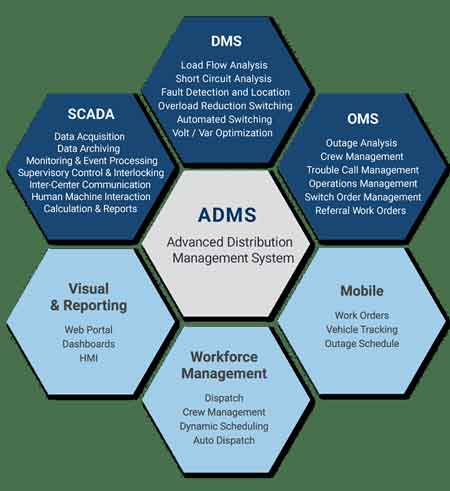
This model-driven architecture distinguishes advanced distribution management system platforms from traditional monitoring tools. SCADA systems provide telemetry and command pathways, but they do not validate switching logic or predict operational consequences. ADMS software integrates SCADA telemetry, OMS intelligence, and network topology into a unified control platform that enables safe, informed decision-making. This operational intelligence depends on advanced grid modeling, which ensures the digital network model accurately reflects energized infrastructure.
Stay informed with our FREE Grid Optimization, DER & Flexibility Newsletter — get the latest news, breakthrough technologies, and expert insights, delivered straight to your inbox.
By continuously synchronizing real-time data sources, this software allows utilities to detect faults, isolate affected sections, and restore service efficiently. This capability reduces outage duration and prevents operational errors that could damage equipment or endanger personnel. The broader architectural role of these systems is defined within the core ADMS, which governs distribution network control, topology validation, and operational safety.
The core function of ADMS software is maintaining an accurate, continuously updated representation of electrical distribution infrastructure. This includes feeders, breakers, switches, voltage regulators, distributed energy resources, and protective devices. The platform correlates real-time data from across the network to establish a reliable operational view. Modern implementations also incorporate geospatial intelligence, as described in geospatial ADMS, which aligns physical infrastructure location with operational network models.
This capability directly affects grid operations. When system topology changes due to switching activity, fault isolation, or equipment outages, the software immediately reflects those changes in the operational model. Distribution grid operators rely on this model to understand power flow direction, load conditions, and device states before issuing control commands.
If the model is incomplete or inaccurate, operational risk increases dramatically. Incorrect topology information can lead to switching errors, delayed fault isolation, or unintended energization of de-energized equipment. This software reduces these risks by ensuring system operations are based on validated electrical and graphical data rather than fragmented telemetry.
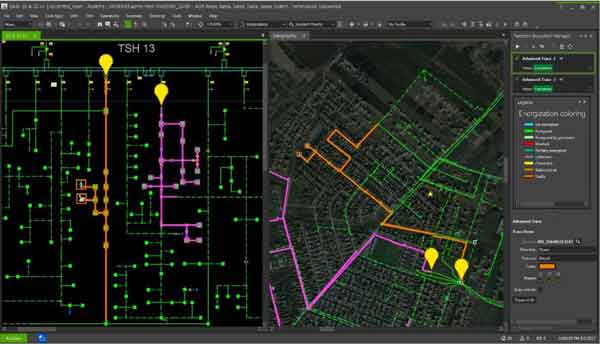
Modern advanced distribution management system platforms function as the operational core of the utility grid control system, continuously maintaining a synchronized distribution network model that reflects real-time electrical conditions. This model incorporates device telemetry, breaker status, and feeder connectivity, enabling distribution grid operators to view an accurate network topology before executing control actions. Through secure SCADA integration, the system validates switching operations, ensuring commands are issued safely and in the correct sequence. This capability is essential for preventing unintended energization, protecting field crews, and maintaining operational continuity across complex distribution infrastructure.
These systems also enable automated fault isolation and rapid service recovery through advanced FDIR logic, which identifies faulted sections and restores service by reconfiguring feeders and redirecting load. In parallel, Volt/VAR optimization continuously adjusts voltage regulators and capacitor banks to maintain stable voltage profiles and reduce electrical losses. Integrated with distribution automation, the platform enables faster response to system disturbances and improves overall operational efficiency. Together, these capabilities allow utilities to perform precise outage restoration, stabilize power flow, and maintain reliable service even as grid complexity and distributed energy resource penetration continue to increase.
One of the most critical operational capabilities enabled by ADMS software is fault location and restoration management. When a fault occurs, the system analyzes device status, fault indicators, and network configuration to determine the faulted section of the distribution network. This capability builds on modern electrical fault detection that provides telemetry and intelligence necessary for rapid fault identification and operational response. Operators can then isolate the faulted segment and restore service to unaffected customers by reconfiguring the network.
This process integrates directly with the OMS functionality. OMS identifies outage locations and customer impact, while software provides the electrical intelligence required to execute restoration safely. The combined system allows utilities to respond quickly and precisely, reducing outage duration and limiting operational disruption.
This coordinated response is essential as distribution networks become more complex. Increasing interconnection points, automation, and distributed generation introduce additional operational variables that cannot be managed manually. Software provides the decision support required to maintain reliable service under these conditions.
Download our FREE Electrical Training Catalog and explore a full range of expert-led electrical training courses.

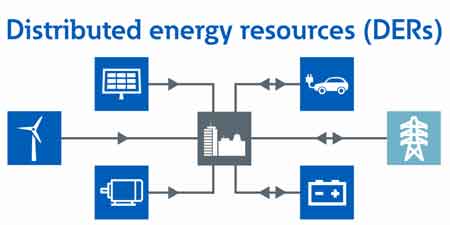
The rise of distributed energy resources has fundamentally changed the behavior of distribution systems. Solar generation, battery storage, and grid-interactive loads alter traditional load patterns and introduce bidirectional power flow. These changes require active coordination to maintain stability.
ADMS software enables this coordination by monitoring distributed energy resource output, evaluating system conditions, and adjusting network configuration accordingly. It allows operators to optimize power flows, manage voltage stability, and maintain operational limits even as generation sources fluctuate. This coordination operates alongside a dedicated distributed energy resource management system that manages individual resource behavior while ADMS maintains overall grid stability.
The effectiveness of ADMS software depends on continuous synchronization between telemetry, data sources, and the distribution network model. Data acquisition systems provide telemetry, but the software must validate and integrate this information into the operational model. Secure data acquisition and command pathways are essential, which is why utilities implement SCADA cybersecurity to protect control system integrity.
This requires rigorous data governance and validation processes. The system must reconcile device status, topology changes, and operational conditions in real time. Any discrepancy between the model and physical infrastructure introduces operational uncertainty.
Utilities invest significant effort in maintaining model accuracy because the consequences of model error can be severe. Incorrect model data can lead to improper switching sequences, voltage instability, or equipment damage. Software mitigates these risks by enforcing model validation, synchronization, and operational consistency.
Advantages To Instructor-Led Training – Instructor-Led Course, Customized Training, Multiple Locations, Economical, CEU Credits, Course Discounts.
Request For QuotationWhether you would prefer Live Online or In-Person instruction, our electrical training courses can be tailored to meet your company's specific requirements and delivered to your employees in one location or at various locations.