AI Grid Monitoring System Architecture
By Dr. Fivos Maniatakos, CEO & Co-Founder, Sensewaves
By Dr. Fivos Maniatakos, CEO & Co-Founder, Sensewaves
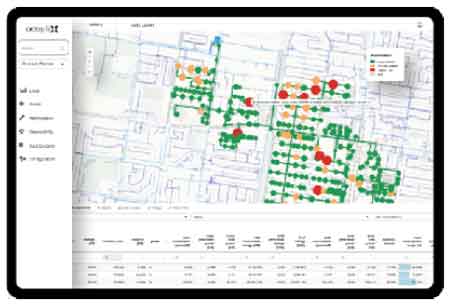
AI grid monitoring system platforms turn AMI, GIS, and SCADA data into a continuously verified digital twin, exposing overloads, connectivity errors, and outage risk before they escalate into restoration delays, switching misoperations, or avoidable asset failure.
Utilities do not lack data. They lack confidence in the model interpreting it. When AMI readings, GIS topology, and SCADA status disagree, restoration slows and switching decisions become defensive. In extreme weather or rapid DER ramping, small topology errors distort load transfer assumptions and amplify operational risk. The issue is not visibility. It is whether the digital twin can be trusted when a control room action redistributes load across stressed feeders.
In large distribution territories, blind spots at low and medium voltage compound this exposure. Non-instrumented assets and incomplete connectivity records create representations that appear stable until stress reveals their limits. An AI grid monitoring system continuously reconciles connectivity, loading, and voltage behavior so the model reflects electrical reality rather than database assumption.
An AI grid monitoring system in an OT environment is not a dashboard. It is a computational grid model built bottom-up from smart meter data and reconciled with GIS and SCADA. Instead of inferring feeder behavior from sparse telemetry, the system reconstructs load flow at every node using AMI as a distributed sensing layer.
This capability overlaps directly with Grid Endpoint Monitoring, where edge-level electrical signatures validate system state rather than merely report it.
Verification introduces discipline. Connectivity inferred from GIS is cross-checked against phase alignment and voltage correlation. When mapped topology conflicts with measured behavior, the discrepancy is flagged and resolved within the digital twin.
Stay informed with our FREE Asset Intelligence & Predictive Maintenance Newsletter — get the latest news, breakthrough technologies, and expert insights, delivered straight to your inbox.
Connectivity errors are not abstract. An incorrectly represented tie point can distort load-transfer calculations during storm restoration. Operators may close a normally open switch, assuming balanced loading, only to backfeed an already stressed transformer. Protection operates on unexpected current flow, creating a secondary outage on a feeder that was not faulted.
What begins as a topology inconsistency becomes a misoperation during switching. The digital twin does not just describe the grid. It shapes action. That is why validation thresholds matter.
Utilities extending this discipline into formal Grid Modeling environments rely on the same continuously verified topology for both operational switching studies and planning simulations.
Traditional state estimation assumes limited telemetry and extrapolates. An AI grid monitoring system reconstructs feeder loading from AMI inward, creating virtual telemetry across assets that lack physical sensors.
During extreme weather events, this exposes transformer overloads and imbalances before failure. Those overload signals become operationally decisive when integrated with Predictive Maintenance for Utilities, where reconstructed load history informs asset replacement prioritization.
DER penetration complicates interpretation. Reverse power flow and inverter control behavior can distort traditional load assumptions. Without phase-synchronized validation, reconstructed flows may misclassify DER export as an anomaly. That is where integration with AI Fault Detection becomes critical, distinguishing transient variability from genuine fault precursors.
AMI voltage data reveals sags, deviations, and phase imbalance patterns that SCADA alone cannot resolve. Event-driven outage detection cross-checks topology and voltage collapse signatures to reduce false positives.
Yet aggressive sensitivity creates risk. If threshold logic overreacts to widespread momentary sags, dispatch decisions may be driven by noise. Alignment with Fault Analysis in Power System workflows ensures anomaly interpretation remains grounded in feeder context rather than raw signal spikes.
A verified digital twin feeds planning tools with real load profiles and validated topology. Segmentation studies and resilience analysis compress significantly when the model no longer requires manual reconciliation.
When integrated with ADMS, switching logic and outage management decisions are grounded in a dynamically validated network representation rather than static assumptions.
This architecture reinforces the role of the AI Augmented Utility Workforce, where engineers leverage AI-driven insights rather than manually reconcile fragmented data. Supervision remains essential. The digital twin augments judgment. It does not replace it.
Grid visibility alone does not reduce risk. Operational confidence requires verified connectivity, reconstructed load behavior, disciplined anomaly thresholds, and predictive asset insight operating within a single OT framework.
An AI grid monitoring system integrates these layers into the decision infrastructure. It reduces restoration uncertainty, limits cascading switching exposure, and prevents overload conditions from remaining hidden until failure.
The difference between visibility and verified intelligence determines whether a switching action redistributes stress safely or amplifies it. That distinction is where monitoring becomes operationally decisive.

Explore 50+ live, expert-led electrical training courses –