Grid Endpoint Monitoring for Operational Grid State Control
By Dr. Fivos Maniatakos, CEO & Co-Founder, Sensewaves
By Dr. Fivos Maniatakos, CEO & Co-Founder, Sensewaves
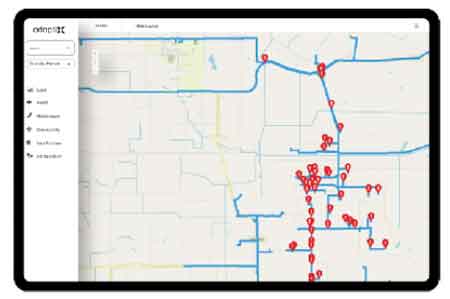
Grid endpoint monitoring turns AMI, GIS, and feeder data into a continuously verified grid model that exposes overloads, topology errors, voltage deviations, and outage risk before failure forces a reactive response.
In distribution operations, most failures are not sudden. They accumulate quietly at the edge of the network where instrumentation is thin, and models are outdated. When operators rely on partial SCADA visibility and static connectivity diagrams, restoration slows, switching confidence drops, and planning becomes defensive rather than predictive.
The practical question is not whether utilities have data. They do. The question is whether endpoint data can be trusted enough to support operational control decisions in real time. Without a validated model of connectivity and load behavior at the asset level, control room decisions are made with uncertainty embedded.
The traditional GIS relationship model assumes connectivity based on design intent. In practice, field modifications, undocumented jumpers, asset swaps, and service changes distort that intent. Grid endpoint monitoring rebuilds connectivity from the bottom up using AMI telemetry and network topology inference.
In the Sensewaves deployment at AEP Texas, connectivity was inferred and continuously cross-checked across 54 substations, 275 circuits, and 350,000 meters, identifying missing relationships, incorrect asset categorization, and disconnected segments. The operational implication is significant. When switching is executed during a storm event, operators are no longer acting on the assumed topology. They are acting on a model verified by live endpoint behavior.
This approach strengthens grid state validation in ways aligned with Grid Observability.
A recurring operational weakness in distribution systems is the absence of sensors at reclosers, midspan segments, and secondary assets. Grid endpoint monitoring extends visibility beyond installed devices through virtual metering and load flow reconstruction.

Using bottom-up load modeling derived from AMI Data, near real-time power flow can be calculated from the customer meter back to the breaker. In the AEP Texas case, load flow validation reached approximately 90 percent accuracy at the breaker level compared to SCADA measurements, while unmonitored asset load estimates exceeded 92 percent accuracy.
This changes operational posture. During a cold snap, overload conditions were detected on transformers without direct monitoring, with some units reaching 150 percent of rating. That level of visibility allows operators to intervene before insulation damage or fuse operation forces an outage.
Voltage deviations are rarely isolated events. They reflect loading patterns, topology anomalies, and increasingly, distributed energy resource behavior. Grid endpoint monitoring analyzes voltage quality at the meter level to detect sag events, persistent deviations, and emerging DER-induced drift.
In the Texas deployment, 4.6 percent of meters experienced voltage sags in a single week, and more than three-quarters of residential customers recorded occasional deviations between five and ten percent over a year. Those numbers are not academic. They influence regulatory compliance exposure and customer satisfaction risk.
Operational integration with ADMS platforms ensures that endpoint-derived voltage and phase intelligence feeds directly into switching and restoration logic.
Cyber resilience also becomes more important as endpoint data expands the attack surface, particularly with DER backfeed and bidirectional flows. The operational risk layer is addressed within DER Cybersecurity.
Distribution planning studies often stall on data preparation rather than analysis. When load profiles and connectivity are uncertain, engineers spend weeks reconciling models before evaluating segmentation or resilience scenarios.
With a continuously verified digital twin, real-world load profiles and peak behavior are injected directly into planning tools. In practice, targeted resilience studies reported time savings of up to 96 percent. The consequence is not merely efficiency. It is the ability to run more scenarios, stress-test critical feeders, and prioritize investment based on measured behavior rather than design assumptions.
This is the practical bridge to Intelligent Asset Management, where endpoint-derived insights drive targeted replacement and capital allocation decisions.
Grid endpoint monitoring does not stop at anomaly detection. When historical AMI data, environmental inputs, and failure records are integrated, predictive models can identify assets at risk one year ahead with accuracy exceeding 80 percent for certain underground transformer populations.
That level of foresight shifts CAPEX strategy from reactive replacement to predictive intervention. It also reduces inspection-related OPEX by narrowing field effort to assets with measurable risk indicators.
At the fleet level, this approach aligns with Utility Network Device Management, where endpoint performance trends inform lifecycle decisions.
For protection events and abnormal waveform behavior, AI Fault Detection provides a complementary analytical layer.
Grid endpoint monitoring is not a dashboard feature. It is an operational control layer. When connectivity is verified, load flows are reconstructed, voltage intelligence is continuous, and non-instrumented assets are virtually monitored, control room decisions shift from assumption to evidence.
Switching confidence improves. Restoration sequencing accelerates. Overloads are addressed before insulation life is consumed. Planning cycles compress. Capital is deployed with precision.
If endpoint data remains siloed or undermodeled, utilities continue to operate in partial visibility. When endpoint intelligence becomes the foundation of the grid model, operational control evolves from reactive management to predictive governance.
Stay informed with our FREE Asset Intelligence & Predictive Maintenance Newsletter — get the latest news, breakthrough technologies, and expert insights, delivered straight to your inbox.
Explore 50+ live, expert-led electrical training courses –