Lateral Monitoring for Grid Edge Fault Intelligence
By Balaji Santhanam, Director, Hubbell Incorporated
By Balaji Santhanam, Director, Hubbell Incorporated
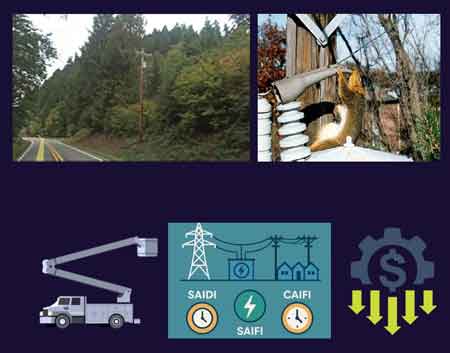
Lateral monitoring enables real-time fault detection, oscillography capture, load profiling, GPS event stamping, and remote switching visibility on distribution laterals, reducing outage duration, wildfire exposure, and coordination errors at the grid edge where most branch faults originate.
Lateral circuits represent the least instrumented portion of medium voltage distribution, yet field experience shows that the majority of temporary and permanent faults originate on these branch segments. In many systems, a single feeder may supply dozens of laterals. Across a service territory, lateral endpoints can outnumber feeder automation devices by a factor of ten or more.
When laterals operate as blind spots, operators are forced to infer fault location from upstream breaker and recloser behavior. Those devices were never designed to resolve branch-level events. The result is extended patrol time, broader isolation switching, and avoidable feeder lockouts.
The decision is not whether laterals matter. The decision is whether operating without branch intelligence is acceptable in a grid environment defined by DER penetration, wildfire exposure, and bidirectional power flow complexity.
Lateral monitoring represents an architectural shift in distribution automation. Traditional fuse-based protection offered no communication, no event record, and no control authority beyond interruption. Even standalone lateral reclosers historically required separate control cabinets and communications modules, increasing installation and maintenance burden.
Modern lateral monitoring integrates sensing, control, and communications within a single platform. Devices now capture oscillography, GPS-synchronized event sequences, programmable load-profiling intervals, and device health metrics, while supporting remote visibility and configuration.
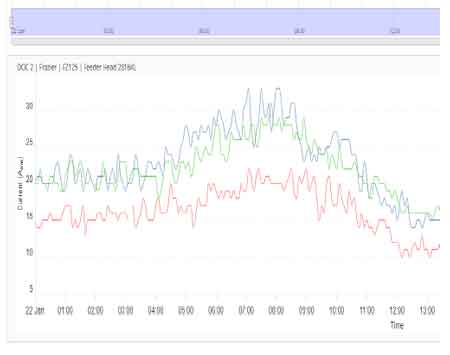
When coordinated with distribution line monitoring, operators can correlate feeder breaker signatures with branch-level current waveforms. Fault current that once appeared ambiguous upstream can be traced to a specific lateral segment with time-aligned evidence.
Download our FREE Electrical Training Catalog and explore a full range of expert-led electrical training courses.

This alters the restoration strategy. If a lateral shows a confirmed trip, rapid load collapse, and a downstream voltage absence, switching crews can surgically sectionalize rather than isolate entire feeder sections. Outage minutes compress because the fault boundary is known rather than assumed.
The cascading consequence of operating without this architecture is operational amplification. A restriking tree contact on a single lateral can propagate upstream through reclose sequences and force feeder lockout, converting a localized branch disturbance into a multi-thousand customer outage.
Fuse operation alone provides no discrimination between transient contact, sustained arcing, or downstream equipment failure. Lateral monitoring provides waveform and magnitude evidence that supports differentiation between temporary faults, high-impedance conditions, and load anomalies.
When paired with lateral fault detection, branch intelligence supports adaptive trip settings during wildfire red flag conditions. Sensitive thresholds can reduce ignition risk. However, overly aggressive sensitivity increases nuisance trips and dispatch volume.
This is a threshold discipline issue, not a configuration convenience. If DER backfeed energizes a branch assumed to be de-energized, fault magnitude and directionality may differ from historical expectations. In such edge cases, coordination with grid modeling is essential to prevent misinterpretation of switching.
Utilities must choose between branch intelligence at scale or prolonged feeder lockouts under growing DER complexity. There is no stable middle ground once bi-directional flow becomes a normal operating condition.
A single feeder may support 20 to 50 laterals. Across a mid-sized utility, this can translate to thousands of branch endpoints requiring visibility. Full SCADA class infrastructure at every location is economically unrealistic.
Modern lateral monitoring leverages cellular IoT, hybrid RF mesh with cellular backhaul, and private LTE strategies to reduce total cost per endpoint while maintaining remote visibility. When integrated with grid edge sensors, lateral data density increases without overwhelming control room workflows.
The constraint emerges in telemetry reliability. Cellular latency, packet loss, and coverage shadow zones introduce uncertainty into real-time decision loops. Silence cannot be interpreted as a normal state. Monitoring architecture must explicitly distinguish between device health loss and system normalcy.
If this logic is not embedded in operating procedures, operators risk making switching decisions based on assumed device states rather than verified telemetry.
Large-scale deployment transforms lateral devices into a distributed fleet requiring disciplined governance. Settings management, credential control, encrypted communications, firmware upgrades, and DNP3 gateway oversight are not optional features. They are prerequisites for scale.
When synchronized with ADMS, branch intelligence feeds switching models and restoration sequencing. However, model fidelity depends on the accuracy of the topology. If GIS mapping does not reflect field conditions, lateral monitoring data may be misinterpreted, leading to incorrect switching assumptions.
This is where integration with electrical fault detection analytics and broader power system reliability oversight becomes critical. Branch intelligence must be contextualized within system-wide operational logic rather than consumed as isolated event logs.
Lateral devices now incorporate a visible break indication, secure latching, hot-line trip capability, and a fast dead-state trip response. These features directly influence crew exposure and public safety.
A single incorrect assumption about lateral status can energize downstream work zones. Lateral monitoring increases switching confidence only if operators treat branch telemetry as authoritative evidence within defined communication health boundaries.
Once oscillography confirms repeated restrike and no corrective action is taken, accountability becomes documented. Branch visibility increases decision gravity. The presence of data removes plausible deniability.
Stay informed with our FREE Asset Intelligence & Predictive Maintenance Newsletter — get the latest news, breakthrough technologies, and expert insights, delivered straight to your inbox.
Under accelerating DER interconnection and wildfire sensitivity, lateral monitoring is no longer an incremental upgrade. It becomes a prerequisite infrastructure for defensible distribution operations.
The engineering decision is therefore binary. Either branch circuits remain blind extensions of feeder automation, or they become instrumented control points integrated into restoration, risk mitigation, and reliability governance strategy.
Explore 50+ live, expert-led electrical training courses –